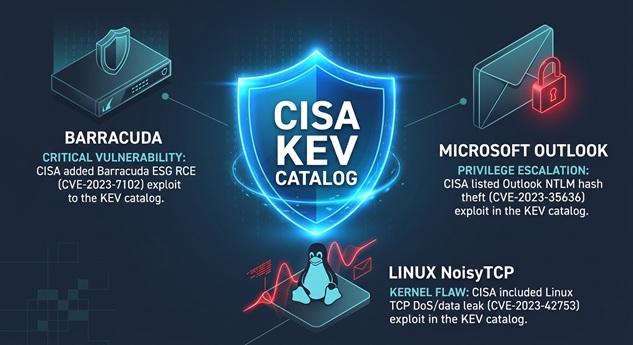
CISA Adds Barracuda, Outlook, and Linux NoisyTCP Flaws to KEV Catalog
An 11-year-old Linux kernel vulnerability, dubbed NoisyTCP, affects almost all Linux distributions and lets attackers crash systems running Nginx, Apache, and SSH servers with default configurations. Furthermore, the U.S. Cybersecurity and Infrastructure Security Agency (CISA) confirmed active exploitation of a Microsoft Outlook zero-day vulnerability, CVE-2026-124194, that can expose user authentication credentials with a single click.
What Happened: CISA Adds Barracuda, Outlook, and Linux Kernel Flaws to KEV Catalog
CISA added multiple high-severity vulnerabilities to its Known Exploited Vulnerabilities (KEV) catalog between November 10 and November 13, 2026. Consequently, federal agencies face strict patching deadlines under Binding Operational Directive (BOD) 26-04. Moreover, private organizations should treat these additions as urgent signals to prioritize remediation.
The most impactful additions include chained Barracuda Email Security Gateway flaws enabling root access, a Microsoft Outlook spoofing bug stealing NTLMv2 hashes, a Google Chrome use-after-free zero-day, and the NoisyTCP Linux kernel denial-of-service vulnerability. Therefore, defenders across enterprise, government, and cloud environments must act quickly.
Technical Details of the Barracuda Email Security Gateway Exploit Chain
Two vulnerabilities affecting Barracuda products can be chained to bypass authorization controls and obtain root access to the device. CVE-2026-116606 (CVSS 9.3) is an authentication bypass in the Barracuda Email Security Gateway (ESG). In addition, CVE-2026-111560 (CVSS 8.6) is a command injection weakness in the timezone configuration setting.
An attacker with network access to the administrative interface could trigger CVE-2026-116606 to restore a crafted backup archive and modify the appliance’s global configuration. Subsequently, the attacker could exploit CVE-2026-111560 to inject operating system commands executed with root privileges. Barracuda confirmed active exploitation affecting a small number of organizations.
- CVE-2026-116606: Authentication bypass in Barracuda ESG versions before 9.4.0.030
- CVE-2026-111560: Command injection affecting ESG, Load Balancer ADC, WAF, WSG, Message Archiver, and WAF Control Center
- Attack vector: Network access to administrative interface
- Impact: Root access, full mail inspection, redirection, or exfiltration
Technical Details of the Microsoft Outlook and Chrome Zero-Days
CVE-2026-124194 is a spoofing vulnerability in Microsoft Outlook with a CVSS score of 6.5. However, Microsoft confirmed it is being actively exploited in the wild. The flaw allows an attacker to steal the user’s NTLMv2 hash, which can then be used for pass-the-hash attacks or offline cracking.
Meanwhile, CVE-2026-125350 is a use-after-free vulnerability in Google Chromium. CISA added it to the KEV catalog on November 10, 2026, without public details on exploitation mechanics. Chrome users should update to the latest stable release immediately.
Technical Details of the NoisyTCP Linux Kernel Flaw
CVE-2026-99288 is a pre-authenticated remote NULL pointer dereference in the Linux kernel’s TCP networking subsystem. Discovered by security researcher Hyunwoo Kim, the 11-year-old flaw affects almost all Linux distributions running Nginx, Apache, or SSH servers with default configurations.
Unauthenticated attackers can trigger a kernel panic remotely via maliciously crafted TCP packets that exploit the timing between SYN cookie handling and socket hashing. Specifically, a race condition during lockless socket lookups allows recycled socket memory to be accessed before proper initialization, causing a NULL pointer dereference and Denial of Service (DoS).
Prerequisites for Successful Exploitation
- Linux system receiving TCP packets directly
- Running Nginx, Apache, or SSH server
- Two or more RX queues, or RPS distributing packets across multiple CPUs
Although the race window is narrow and the attack does not allow arbitrary code execution or data alteration, the resulting kernel panic takes down the host entirely. Thus, availability-critical systems face significant risk.
Business and Operational Impact
The confirmed exploitation of these vulnerabilities carries severe consequences for affected organizations. Email security gateways process all inbound mail, meaning root access allows attackers to inspect, copy, or redirect every message without leaving mailbox-level audit trails.
- Email compromise: Barracuda ESG root access enables silent mail interception and redirection
- Credential theft: Outlook NTLMv2 hash theft facilitates lateral movement and domain compromise
- Browser compromise: Chromium use-after-free could enable sandbox escape or remote code execution
- Service disruption: NoisyTCP kernel panics crash Linux servers running critical web and SSH infrastructure
- Compliance risk: Data exposure and service downtime may trigger breach notification obligations
Mitigation and Recommendations
Immediate Actions for Barracuda ESG Defenders
- Apply patch identifiers BNSF-40425 (ESG 9.4.017 and later) or BNSF-40430 (earlier versions) immediately
- Upgrade to ESG firmware version 9.4.0.030 or later
- Re-enable automatic patching if previously disabled
- Restrict administrative interface access to trusted internal networks only
- Review mail logs and appliance configurations for unauthorized changes
Immediate Actions for Microsoft Outlook Defenders
- Apply November 2026 Patch Tuesday updates for Microsoft Office and Outlook
- Monitor for suspicious NTLMv2 authentication attempts
- Enable SMB signing and consider disabling NTLM where feasible
- Deploy network segmentation to limit lateral movement from compromised credentials
Immediate Actions for Linux NoisyTCP Defenders
- Apply the latest Linux kernel patch (fix merged into mainline approximately two weeks ago)
- If patching is delayed, disable SYN cookies as a temporary measure
- Alternatively, serialize traffic to a single RX queue to block the race condition
- Monitor for unexpected kernel panics or service restarts
Immediate Actions for Chrome Users
- Update Google Chrome to the latest stable release
- Ensure automatic updates are enabled for all endpoints
Bottom line: CISA’s KEV additions are not suggestions—they are confirmed exploited vulnerabilities with federal patching mandates. Organizations running Barracuda ESG, Microsoft Outlook, Google Chrome, or Linux web servers must patch immediately, restrict administrative exposure, and monitor for indicators of compromise.
Incident Summary
| CVE IDs / Incidents: | CVE-2026-116606, CVE-2026-111560 (Barracuda); CVE-2026-124194 (Outlook); CVE-2026-125350 (Chrome); CVE-2026-99288 (Linux NoisyTCP) |
| Affected Systems: | Barracuda ESG / ADC / WAF / WSG / BMA / WCC; Microsoft Outlook; Google Chrome; Linux kernel (Nginx/Apache/SSH servers) |
| Disclosure Date: | November 10–13, 2026 (CISA KEV additions) |
| Patch Status: | Patches available for all; federal deadline November 13, 2026 (BOD 26-04) |
| Exploitation: | Active exploitation confirmed for Barracuda, Outlook, and NoisyTCP |
References
- CISA, “CISA Adds Six Known Exploited Vulnerabilities to Catalog,” November 10, 2026, https://www.cisa.gov/news-events/alerts/2026/11/10/cisa-adds-six-known-exploited-vulnerabilities-catalog
- CISA, “CISA Adds Two Known Exploited Vulnerabilities to Catalog,” November 13, 2026, https://www.cisa.gov/news-events/alerts/2026/11/13/cisa-adds-two-known-exploited-vulnerabilities-catalog
- The Hacker News, “Barracuda Flaws Could Be Chained to Bypass Authorization and Gain Root Access,” November 3, 2026, https://thehackernews.com/2026/11/barracuda-flaws-could-be-chained-to.html
- SecurityWeek, “Recently Patched Barracuda Vulnerabilities Exploited in Attacks,” November 11, 2026, https://www.securityweek.com/recently-patched-barracuda-vulnerabilities-exploited-in-attacks/
- BleepingComputer, “New NoisyTCP vulnerability lets attackers crash Linux servers,” November 16, 2026, https://www.bleepingcomputer.com/news/linux/new-noisytcp-linux-kernel-flaw-lets-attackers-crash-servers/
- Outpost24, “Microsoft Patch Tuesday – November 2026,” November 10, 2026, https://outpost24.com/blog/microsoft-patch-tuesday-november-2026/