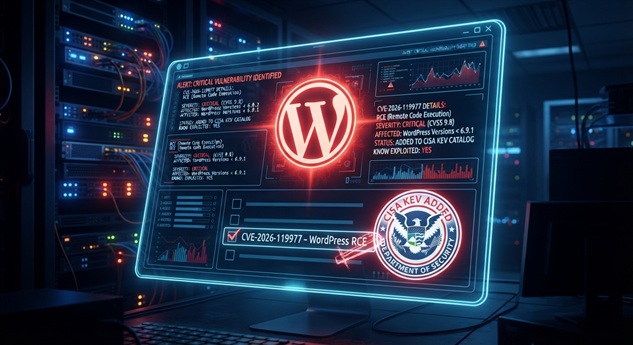
CISA Confirms Active Exploitation of WordPress Core RCE Flaw CVE-2026-119977
The U.S. Cybersecurity and Infrastructure Security Agency (CISA) has confirmed active exploitation of a high-severity remote code execution flaw in WordPress Core. CVE-2026-119977 stems from a Time-of-check Time-of-use (TOCTOU) race condition during the WordPress upgrade process. Attackers are already weaponizing it at scale.
What Happened: WordPress Core RCE Flaw CVE-2026-119977 Under Active Attack
On October 28, 2026, the WordPress security team released version 7.1.4 to address a critical weakness in the core upgrade process. Tracked as CVE-2026-119977, the flaw allows unauthenticated remote attackers to execute code on a target server during the upgrade window. The vulnerability was reported by Picus Security researcher Umut Bayram.
CISA confirmed active exploitation on November 3, 2026, and added CVE-2026-119977 to its Known Exploited Vulnerabilities (KEV) Catalog. Consequently, Federal Civilian Executive Branch (FCEB) agencies must patch by Friday under Binding Operational Directive (BOD) 26-04. CISA also urged all network defenders, including private sector organizations, to prioritize remediation.
WordPress security firm Wordfence reported blocking 13,095 attacks targeting this vulnerability in a single 24-hour period. The attack volume indicates rapid mass exploitation.
Technical Details of the CVE-2026-119977 Vulnerability
The root cause is a TOCTOU race condition in WordPress Core’s full-package upgrade routine. During a core upgrade, WordPress stages installation files in a predictable, web-accessible temporary path. An attacker who can race the upgrade process can swap the staged files for malicious ones. Because the upgrade process runs with elevated privileges, the attacker’s code executes as the web server user.
Key attack characteristics:
- Attack vector: Network — the flaw is exploitable remotely without authentication
- Attack complexity: High — exploitation requires winning a race condition
- Privileges required: None — unauthenticated attackers can trigger the flaw
- Scope: The vulnerable component is WordPress Core itself, not a plugin or theme
The vulnerability specifically affects sites running full-package core upgrades. Sites that update via background auto-updates with differential patches may have a different exposure profile.
Business and Operational Impact
WordPress powers more than 43 percent of all websites on the internet. A core RCE vulnerability therefore carries extraordinary blast radius. Successful exploitation can lead to:
- Complete server compromise: Attackers gain remote code execution with web server privileges
- Webshell deployment: Persistent backdoors for long-term access
- Data exfiltration: Theft of customer databases, user credentials, and payment information
- Malware distribution: Compromised sites serving drive-by downloads or phishing pages
- SEO poisoning: Injection of spam links and redirect chains
- Supply chain risk: Compromised WordPress sites can be used to distribute tainted plugins or themes
Furthermore, the vulnerability arrives on the heels of the wp2shell exploit chain disclosed in July 2026. That earlier chain — combining CVE-2026-63030 and CVE-2026-60137 — was weaponized by Chinese-speaking threat actors to breach more than 18,500 records from small businesses and government organizations. The recurrence of core RCE flaws within months signals elevated risk for the WordPress ecosystem.
Mitigation and Recommendations
Immediate Actions for Defenders
- Update WordPress Core immediately. Upgrade to WordPress 7.1.4 or later. This is the single most important step.
- Review server logs for suspicious requests. Look for requests targeting upgrade staging paths or unexpected file modifications during upgrade windows.
- Disable automatic core upgrades temporarily. If you cannot patch immediately, consider disabling automatic background updates until you can manually upgrade.
- Apply Web Application Firewall (WAF) rules. Wordfence and other WAF providers have released detection rules for this vulnerability.
- Audit file integrity. Compare current WordPress core files against known-good hashes to identify unauthorized modifications.
Additional Hardening Measures
Beyond patching, organizations should reduce their attack surface. Implement the following measures:
- Least privilege: Run the web server and PHP processes under restricted accounts
- Network segmentation: Isolate WordPress instances from sensitive internal networks
- File integrity monitoring: Deploy continuous monitoring to detect unauthorized file changes
- Backups: Maintain offline, tested backups that can be restored quickly if compromise occurs
- Security headers: Enforce Content Security Policy and other headers that limit exploitation avenues
Bottom line: CVE-2026-119977 is actively exploited at scale against WordPress Core. Every unpatched site is a target. Patch to 7.1.4 now, and assume attackers are already scanning your infrastructure.
Incident Summary
| CVE ID / Incident: | CVE-2026-119977 |
| Affected Systems: | WordPress Core versions prior to 7.1.4 |
| Severity: | High (CISA KEV confirmed) |
| Disclosure Date: | October 28, 2026 |
| CISA KEV Addition: | November 3, 2026 |
| Patch Status: | Fixed in WordPress 7.1.4 |
| Attack Volume: | 13,095+ blocked attacks in 24 hours (Wordfence) |
References
- Lawrence Abrams, “CISA flags WordPress RCE flaw as actively exploited in attacks,” BleepingComputer, November 4, 2026, https://www.bleepingcomputer.com/news/security/cisa-flags-wordpress-rce-flaw-as-actively-exploited-in-attacks/ (accessed November 4, 2026).
- U.S. Cybersecurity and Infrastructure Security Agency (CISA), “CISA Adds One Known Exploited Vulnerability to Catalog,” CISA Alert, November 3, 2026, https://www.cisa.gov/news-events/alerts/2026/11/03/cisa-adds-one-known-exploited-vulnerability-catalog (accessed November 4, 2026).
- Wordfence Threat Intelligence, “WordPress Core <= 7.1.3 — Unauthenticated Upgrade Window Staged Installer Remote Code Execution,” Wordfence Advisory, October 2026, https://www.wordfence.com/threat-intel/vulnerabilities/wordpress-core/wordpress-core-470-713-unauthenticated-upgrade-window-staged-installer-remote-code-execution (accessed November 4, 2026).
- WordPress Security Team, “WordPress 7.1.4 Security Release,” WordPress.org News, October 28, 2026, https://wordpress.org/news/2026/10/wordpress-7-1-4/ (accessed November 4, 2026).