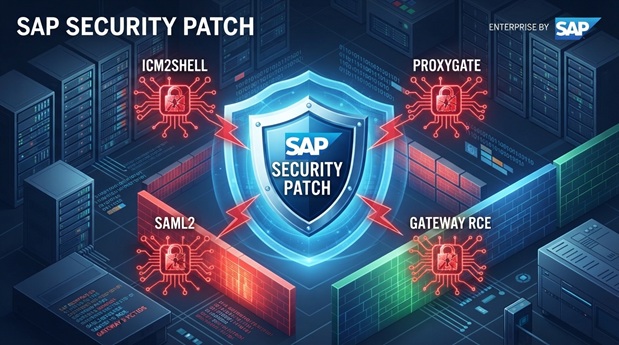
SAP Patches Four CVSS 10.0 Flaws
SAP released critical security updates on November 10, 2026, patching four maximum-severity vulnerabilities rated CVSS 10.0. These flaws affect SAP NetWeaver, SAP Web Dispatcher, SAP Gateway, and the SAML2 service provider. Attackers can exploit them without authentication to execute remote code, impersonate servers, or log in as any user.
What Happened: SAP Patches Four CVSS 10.0 Flaws on November Patch Day
On November 10, 2026, SAP published its monthly Security Patch Day bulletin. The update addressed 35 vulnerabilities across the SAP portfolio. However, four flaws stood out because SAP assigned them the highest possible CVSS score of 10.0.
Three of the four flaws reside in SAP NetWeaver components. The fourth affects the SAP Web Dispatcher. None require user interaction or valid credentials. An attacker with network reachability can exploit them directly. Consequently, security researchers and CISOs have flagged these patches as priority-one actions for any organization running affected SAP systems.
Technical Details of the SAP Vulnerabilities
The four vulnerabilities span authentication, memory corruption, and access control. Below is a breakdown of each flaw and its impact.
ICM2SHELL (CVE-2026-76964) — Internet Communication Manager RCE
CVE-2026-76964 affects the Internet Communication Manager (ICM) in SAP NetWeaver AS ABAP. The flaw exists in kernel code that reassembles split WebSocket messages. A crafted control frame with an invalid length field triggers a heap out-of-bounds write before any authentication occurs.
Onapsis, the SAP security firm that discovered the bug, provided SAP with a working exploit. The exploit runs operating system commands as <sid>adm, the account that owns the SAP installation. WebSocket support is enabled by default. Therefore, even systems that do not actively use WebSocket features are exposed.
Web Dispatcher RCE (CVE-2026-89126)
CVE-2026-89126 shares the same root cause as the ICM flaw because the Web Dispatcher and ICM share kernel code for WebSocket handling. The bug affects standalone and embedded Web Dispatchers, including those in SAP HANA XS Classic and XS Advanced.
A crashed Web Dispatcher cuts off every SAP system behind it while it restarts. Successful exploitation yields the same operating-system command execution privileges as the ICM flaw. Researchers have not observed this flaw exploited in the wild yet, but the exploit code exists and is circulating.
PROXYGATE (CVE-2026-89103) — SAP Gateway Server Impersonation
CVE-2026-89103 targets SAP Gateway, which connects SAP systems and programs using Remote Function Call (RFC) protocols. The gateway uses access control lists to decide which outside programs may connect. However, the default proxy list (prxyinfo) ships with permissive settings.
An attacker can send a crafted request that causes the gateway to treat the attacker as one of the system’s own application servers. This impersonation allows the attacker to run operating system commands as <sid>adm. The flaw affects AS Java, dual-stack, and standalone gateway installations.
Importantly, the secinfo and reginfo lists that most hardening guides cover do not mitigate this vulnerability. Exposure depends on the prxyinfo proxy list or the gw/acl_mode_proxy profile parameter.
SAML2 Authentication Bypass (CVE-2026-120017)
CVE-2026-120017 affects the SAML 2.0 service provider in SAP NetWeaver AS ABAP and ABAP Platform. Under certain configurations, the service provider fails to verify signatures on incoming SAML assertions. An attacker can forge an assertion and log in as any user, including privileged accounts.
A full compromise can follow, potentially reaching connected systems. The vulnerability affects any AS ABAP system that uses SAML2 for browser logon, such as Fiori Launchpad or Web GUI behind an identity provider.
Business and Operational Impact
SAP systems power critical operations for tens of thousands of enterprises worldwide. The impact of these four flaws is severe and multi-layered.
- Complete system takeover: Successful exploitation of the ICM, Web Dispatcher, or Gateway flaws grants root-level command execution on the underlying operating system.
- Data exfiltration: Attackers can access financial records, customer data, supply-chain information, and proprietary business processes.
- Supply-chain ripple effects: Many organizations integrate SAP with third-party logistics, billing, and HR platforms. Compromise can spread laterally through connected systems.
- Compliance violations: Unpatched CVSS 10.0 flaws can trigger audit failures under SOC 2, ISO 27001, and GDPR requirements.
- Business continuity risk: A crashed Web Dispatcher halts every SAP application behind it until the service restarts.
Moreover, out-of-maintenance kernels remain affected. Organizations running older releases may not receive patches and must upgrade to supported kernels before they can remediate.
Mitigation and Recommendations
SAP strongly recommends applying the November 2026 kernel and Web Dispatcher patches as a priority. RedRays, which analyzed the SAP for Me notes, advises updating the kernel and all Web Dispatchers in a single coordinated rollout.
Immediate Actions for Defenders
- Apply patches immediately. Install the corrected kernel versions and Web Dispatcher patches listed in SAP Notes 3778530, 3778556, 3798345, and 3849308.
- Inventory every Web Dispatcher. One missed instance leaves the entire environment exposed. Include standalone, embedded, HANA XS Classic, and XS Advanced instances.
- Restrict Gateway proxy lists. Review
prxyinfofiles. Restrict proxy connections to hosts that genuinely need RFC access. Setgw/acl_mode_proxy=1where supported. - Audit SAML2 configurations. Review trusted identity providers in transaction SAML2. Check audit logs for SAML logons by privileged users from unexpected sources.
- Shield the ICM. If users reach the ICM only through a Web Dispatcher, patch the Web Dispatcher first to shield the ICM temporarily. Ensure no direct ICM port access exists.
- Rotate credentials. After patching, rotate passwords and secrets used by the virtualization and SAP environments.
Temporary Workarounds
If patching is not immediately possible, consider these mitigations:
- Turn off WebSocket support on the ICM and Web Dispatcher. This breaks ABAP Push Channels and some Fiori features.
- Restrict Xen Orchestra access to dedicated management networks.
- Block known malicious IP addresses at the perimeter firewall.
Bottom line: These four SAP vulnerabilities are as severe as flaws get. Patch today, inventory every instance, and verify your gateway proxy lists before attackers do.
Incident Summary
| CVE IDs / Incidents: | CVE-2026-76964 (ICM2SHELL), CVE-2026-89126 (Web Dispatcher), CVE-2026-89103 (PROXYGATE), CVE-2026-120017 (SAML2) |
| Affected Systems: | SAP NetWeaver AS ABAP, SAP Web Dispatcher, SAP Gateway, SAP NetWeaver AS ABAP and ABAP Platform SAML2 service provider; HANA XS Classic and XS Advanced |
| Severity: | CVSS 10.0 (maximum) for all four |
| Disclosure Date: | November 10, 2026 |
| Patch Status: | Patches available via SAP for Me (Notes 3778530, 3778556, 3798345, 3849308) |
| Exploitation: | Proof of concept demonstrated by Onapsis; no confirmed in-the-wild exploitation reported yet |
References
- The Hacker News, “SAP Patches Four CVSS 10.0 Flaws, Including Two Enabling Remote Code Execution,” November 10, 2026, https://thehackernews.com/2026/11/sap-patches-four-cvss-100-flaws.html (accessed November 10, 2026).
- BleepingComputer, “SAP patches ICM2SHELL and PROXYGATE maximum severity flaws,” November 10, 2026, https://www.bleepingcomputer.com/news/security/sap-patches-icm2shell-and-proxygate-maximum-severity-flaws/ (accessed November 10, 2026).
- Onapsis, “ICM2SHELL Advisory,” November 2026, https://onapsis.com (accessed November 10, 2026).
- Onapsis, “PROXYGATE Advisory,” November 2026, https://onapsis.com (accessed November 10, 2026).
- SAP Security Patch Day, November 2026, https://support.sap.com/security (accessed November 10, 2026).