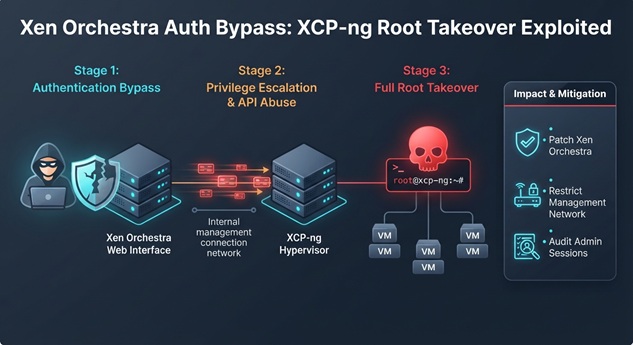
Critical Xen Orchestra Authentication Bypass Enables XCP-ng Root Takeover
Cybersecurity researchers disclosed a critical authentication bypass vulnerability in Xen Orchestra today. The flaw is being actively exploited in attacks that grant administrator privileges and allow full takeover of XCP-ng virtualization hosts. Xen Orchestra is a widely used web-based management platform for XCP-ng environments. The vulnerability does not yet have a CVE identifier but has been assigned VSA-2026-062 by vendor Vates.
What Happened: Xen Orchestra Auth Bypass Grants Admin Access to Virtualization Hosts
Vates, the French company behind Xen Orchestra and the XCP-ng open-source virtualization platform, published a security advisory on November 10, 2026. The advisory confirms that attackers are already exploiting the authentication bypass in the wild. The flaw affects both Xen Orchestra and the Xen Orchestra Appliance (XOA).
An attacker with network access to the Xen Orchestra management interface can bypass authentication by sending a specially crafted cookie. The platform then retrieves an existing authentication token and logs the attacker in as its owner. Consequently, the attacker gains admin-level privileges over the entire virtualization environment. Moreover, Vates warns that Xen Orchestra compromise can lead to arbitrary code execution on managed pools and full XCP-ng node takeover as root.
Technical Details of the Xen Orchestra Authentication Bypass
The vulnerability stems from how Xen Orchestra processes authentication cookies sent through REST API requests. By crafting a cookie containing an empty JSON object ({}), an attacker can trick the platform into retrieving an existing token.
Specifically, the attack works as follows:
- The attacker sends an authenticationToken cookie with the value j:%7B%7D (URL-encoded {})
- Xen Orchestra processes this as a valid token reference
- The platform retrieves an existing authentication token and authenticates the attacker as its owner
- The attacker then calls the /rest/v0/users/me/authentication_tokens endpoint to obtain reusable login token IDs
Security researchers Filip Magic and Christoffer Olsen of TDC NET Security discovered the vulnerability. Vates has released Xen Orchestra 6.9.1 (stable) and 6.10.0 (latest), which include patched xo-server packages 5.211.2 and 5.213.1.
Furthermore, Vates confirmed active exploitation and shared the following indicators of compromise:
- Attacker infrastructure: Connections to 91.211.251.112:8001 or ustar3rqxgnskzgnwkgpofgtvxevm6cx3lxdbwt4mndtveqyaohid.onion:3333
- Suspicious cookies: HTTP requests containing authenticationToken=j:%7B%7D or authenticationToken=j:{}
- Unexpected VMs: A virtual machine named pivot2
- Modified VM configs: VMs configured with hvm_serial: file parameter
- Unusual files: /etc/cron.d/zz-ustar, /etc/cron.d/zz-ustar2, /.ustar5, and /.ustar6
Detection Commands for XCP-ng Hosts
Administrators can run the following commands on XCP-ng hosts to check for signs of compromise:
- Check for VMs with file-based serial ports:
xe vm-list params=name-label,platform | grep -B1 'hvm_serial: file' - Search logs for serial file references:
zgrep -- '-serial file:' /var/log/xensource.log* - Look for malicious files:
ls -la /etc/ld.so.preload /.ustar* /etc/cron.d/zz-ustar*
However, Vates cautions that exploitation may not generate identifiers in standard logs. Therefore, organizations should monitor HTTP traffic for the suspicious cookies described above.
Business and Operational Impact
A successful attack on Xen Orchestra has severe consequences for any organization running virtualized infrastructure. The business impacts include:
- Complete infrastructure compromise: Admin access to Xen Orchestra equals control over all managed VMs, hosts, and pools
- Data exfiltration: Attackers can snapshot, clone, or export virtual machines containing sensitive data
- Service disruption: VMs can be shut down, deleted, or reconfigured to deny service
- Lateral movement: Compromised XCP-ng nodes become launchpads for attacks against internal networks
- Supply chain risk: MSPs and hosting providers using Xen Orchestra could expose multiple downstream customers
Xen Orchestra is used by enterprises, managed service providers, and cloud hosting providers worldwide. Consequently, a single compromised instance can cascade into a multi-tenant breach.
Mitigation and Recommendations
Organizations running Xen Orchestra should act immediately to reduce exposure and detect potential compromise.
Immediate Actions for Defenders
- Upgrade to Xen Orchestra 6.9.1 (stable) or 6.10.0 (latest) immediately
- If patching is not possible, restrict Xen Orchestra access to dedicated management networks
- Block known malicious IP addresses and Tor exit nodes
- Review HTTP logs for suspicious authenticationToken cookies
- Run the IOC detection commands on all XCP-ng hosts
- Rotate all passwords and secrets used by the virtualization environment
- Review recently created VMs, users, and authorized SSH keys
Network Segmentation
Also, limit Xen Orchestra management interfaces to internal networks or VPN-only access. Never expose the management console directly to the internet without additional controls.
Bottom line: Patch Xen Orchestra immediately, restrict network access, and hunt for the published IOCs. This is an actively exploited authentication bypass with a direct path to root-level control of your entire virtualization stack.
Incident Summary
| CVE ID / Incident: | VSA-2026-062 (CVE pending) |
| Affected Systems: | Xen Orchestra, Xen Orchestra Appliance (XOA), XCP-ng virtualization hosts |
| Disclosure Date: | November 10, 2026 |
| Patch Status: | Available — Xen Orchestra 6.9.1 and 6.10.0 |
| CVSS Score: | Not yet assigned |
| Exploitation: | Confirmed active exploitation in the wild |
| Fixed Versions: | xo-server 5.211.2 and 5.213.1 |
References
- Vates Security Advisory, “VSA-2026-062,” November 10, 2026, https://docs.vates.tech/security-advisories/advisories/2026/vates-sa-2026-062/, accessed November 10, 2026.
- BleepingComputer, “Critical Xen Orchestra auth bypass flaw exploited to hijack VM servers,” November 10, 2026, https://www.bleepingcomputer.com/news/security/critical-xen-orchestra-auth-bypass-flaw-exploited-to-hijack-vm-servers/, accessed November 10, 2026.
- TDC NET Security, Filip Magic and Christoffer Olsen, vulnerability discovery disclosure, November 2026.