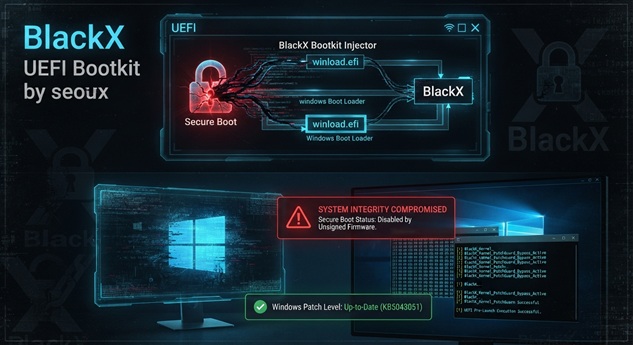
A new UEFI bootkit named BlackX is actively bypassing Secure Boot on fully patched Windows systems. Kaspersky researchers attribute the espionage campaign to APT41 and warn that the bootkit exploits a now-patched vulnerability that requires manual remediation steps most administrators have not taken.
What Happened: APT41 Deploys BlackX UEFI Bootkit Against Central Asian Diplomatic Targets
In early 2026, Kaspersky discovered a sophisticated cyber espionage campaign targeting diplomatic organizations in Tajikistan, Uzbekistan, and Turkmenistan. The attackers deployed a new UEFI bootkit called BlackX to maintain long-term, covert access to compromised systems.
BlackX exploits the Baton Drop vulnerability (CVE-2022-21894) to bypass Secure Boot protections. Consequently, the bootkit can load malicious drivers and interfere with security solutions even on systems that have received all standard Windows updates. Kaspersky attributes the operation to APT41 with medium confidence. APT41 is a Chinese state-sponsored threat group also known as Brass Typhoon, Wicked Panda, and Barium.
Technical Details of the BlackX UEFI Bootkit
BlackX shares remarkable similarities with BlackLotus, a notorious UEFI bootkit first observed in 2022. Both bootkits exploit the same Baton Drop flaw to enroll custom Machine Owner Keys (MOKs) and load arbitrary EFI files. However, BlackX deploys a different kernel driver and follow-on payloads than its predecessor.
The bootkit injects a malicious Windows kernel driver signed with a now-revoked certificate issued to Wenjiang District Mingyu Network Technology Service Studio. Furthermore, the driver performs several anti-security actions:
- Disables security-related processes and registry callbacks
- Tampers with Event Tracing for Windows (ETW) providers to obstruct monitoring
- Targets Kaspersky and Avast products specifically when detected on the host
- Protects bootkit files by intercepting user open requests and launching Calculator instead
In addition to the kernel driver, BlackX deploys two espionage payloads:
- Remote Access Trojan (RAT): Uses Google Drive, OneDrive, or Yandex.Disk for command-and-control. It executes .NET payloads and handles file uploads and downloads.
- OxiDLLRunner: An OLLVM-obfuscated DLL sideloaded by googleupdate.exe. It decrypts v8_context_snapshot.bin to launch shellcode and a Rust payload, then retrieves additional plugins from archivetj[.]com.
Business and Operational Impact
The BlackX campaign carries severe implications for government and enterprise defenders. Specifically, the bootkit undermines one of the most trusted hardware-rooted security controls: Secure Boot.
- Long-term persistence: UEFI-level compromise survives OS reinstallation and hard drive replacement.
- Security tool evasion: The bootkit actively disables endpoint protection and monitoring capabilities.
- Diplomatic targeting: Focus on Central Asian diplomatic agencies suggests intelligence collection motivation.
- State-sponsored attribution: APT41 involvement raises the risk of follow-on supply chain or infrastructure attacks.
Mitigation and Recommendations
The most critical finding from Kaspersky’s research is that all BlackX victims ran fully patched Windows releases. The patch for CVE-2022-21894 does not automatically revoke the vulnerable “Windows Production PCA 2011” certificate. Therefore, administrators must trigger the revocation manually.
Immediate Actions for Defenders
- Manually revoke vulnerable boot managers: Follow Microsoft’s instructions to add the certificate to the Secure Boot blocklist.
- Verify Secure Boot certificate revocations: Ensure the “Windows Production PCA 2011” certificate is properly blocked on all endpoints.
- Audit UEFI firmware settings: Confirm Secure Boot is enabled and that no unauthorized Machine Owner Keys (MOKs) are enrolled.
- Scan for BlackX indicators: Look for the malicious kernel driver certificate and suspicious googleupdate.exe activity.
- Monitor cloud storage C2 channels: Track unusual outbound connections to Google Drive, OneDrive, and Yandex.Disk from sensitive systems.
Long-Term Hardening Measures
Organizations should treat UEFI security as a core component of their endpoint protection strategy. Moreover, automated patch management alone is insufficient when critical mitigations require manual steps. Implement regular firmware integrity checks and restrict cloud storage access from high-security networks.
Bottom line: BlackX proves that even fully patched Windows systems remain vulnerable to UEFI bootkits when manual Secure Boot revocation steps are skipped. Administrators must complete the revocation process immediately to close this gap.
Incident Summary
| CVE ID / Incident: | CVE-2022-21894 (Baton Drop) exploited by BlackX UEFI Bootkit |
| Threat Actor: | APT41 (Brass Typhoon, Wicked Panda, Barium) |
| Affected Systems: | Windows systems with Secure Boot enabled but missing manual certificate revocation |
| Target Sector: | Diplomatic organizations in Central Asia |
| Disclosure Date: | October 24, 2026 |
| Patch Status: | Original CVE patched in 2022; manual revocation required for full protection |
References
- Kaspersky Securelist, “UEFI Bootkit BlackX,” October 24, 2026, https://securelist.com/uefi-bootkit-blackx/121539/, accessed October 24, 2026.
- BleepingComputer, “BlackX UEFI bootkit exploits Baton Drop flaw to bypass Secure Boot,” October 24, 2026, https://www.bleepingcomputer.com/news/security/blackx-uefi-bootkit-exploits-baton-drop-flaw-to-bypass-secure-boot/, accessed October 24, 2026.
- The Hacker News, “BlackX UEFI Bootkit Bypasses Secure Boot on Patched Windows Systems Missing Revocations,” October 23, 2026, https://thehackernews.com/2026/10/blackx-uefi-bootkit-bypasses-secure.html, accessed October 24, 2026.
- Microsoft Tech Community, “Revoking Vulnerable Windows Boot Managers,” https://techcommunity.microsoft.com/blog/windows-itpro-blog/revoking-vulnerable-windows-boot-managers/4121735, accessed October 24, 2026.