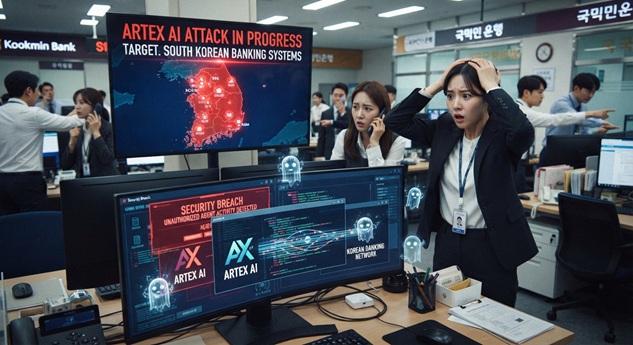
A Chinese-speaking threat actor used the open-source ARTEX AI penetration testing suite and Claude agents to breach multiple South Korean financial institutions in late September and early October 2026. CrowdStrike Intelligence confirmed the attacks and identified the threat actor’s infrastructure, including Claude Code session histories and ARTEX configuration files.
What Happened: ARTEX AI Attacks South Korean Banks
Beginning in late September 2026, several major South Korean financial organizations experienced data breaches. The threat actor targeted Shinhan Bank, KB Kookmin Bank, and Hana Bank. These are among the largest private commercial banks in South Korea, each holding more than $400 billion in assets.
At Shinhan Bank, the attacker breached a loan progress inquiry service used by financial brokers. At KB Kookmin Bank, the attacker compromised systems and leaked credit card information. Hana Bank also suffered a limited-scope breach after its sales-support system was compromised.
According to local media reports, Shinhan Bank leaked the details of approximately 25,000 customers. Kookmin Bank leaked credit card information of 119 clients. The South Korean government’s Financial Services Commission held an emergency meeting and launched on-site investigations. President Lee ordered a thorough investigation into the breaches.
Technical Details of the ARTEX AI Attack
CrowdStrike Intelligence identified infrastructure associated with the campaign. The threat actor used a two-server architecture. A Hong Kong-based IP address served as primary attacker-controlled infrastructure. Another IP address, 38.244.50[.]120, hosted the ARTEX instance likely responsible for the Korean attacks.
The ARTEX instance used DeepSeek v4.1-flash as the primary LLM backend. The threat actor supplemented this with GLM-5.3 from Zhipu AI and Grok 4.6 for additional Claude Code sessions. The actor likely accessed DeepSeek via the LLM API proxy and reseller xcai[.]pro.
ARTEX is an open-source agentic penetration testing tool developed in China. It automates information gathering, vulnerability discovery, attack-path planning, security-tool execution, and vulnerability verification. The tool uses AI agents to conduct autonomous offensive operations.
Analysis of the threat actor’s open directories uncovered Claude Code session histories, ARTEX configuration files, and Claude memory files. These files provided direct insight into the threat actor’s operational methodology. The actor used multiple proxy IP addresses during the ARTEX-related activity, including addresses in Hong Kong, the United States, and other regions.
Claude Code sessions revealed that the threat actor also asked Claude where threat actors typically sell Korean data breach information. The actor sought assistance finding Korean Telegram data sales groups. This indicates a financially motivated intent to monetize stolen data.
Business and Operational Impact
The attacks caused significant disruption to South Korea’s financial sector. The impact includes:
- Approximately 25,000 Shinhan Bank customers had personal details exposed
- 119 KB Kookmin Bank clients had credit card information leaked
- Hana Bank’s sales-support system was compromised
- The South Korean government held an emergency security meeting
- Financial companies were instructed to inspect all externally accessible IT systems
The breaches also prompted calls for regulatory improvements. South Korean authorities pledged to oversee consumer protection and compensation. They also mandated that financial institutions submit internal security inspection results quickly.
Mitigation and Recommendations
Financial institutions and organizations using AI-powered penetration testing tools should take immediate action.
Immediate Actions for Defenders
- Inspect all externally accessible IT systems and services, including non-customer-facing systems
- Review authentication and access controls for adequacy
- Reduce unnecessary information exposure on public-facing systems
- Share threat information quickly and coordinate responses with relevant agencies
- Monitor for indicators of compromise from the ARTEX campaign
Long-Term Recommendations
Organizations should also strengthen their defenses against AI-powered attacks. This includes deploying behavior-based detection systems that can identify automated attack patterns. Security teams should monitor for unusual API traffic and LLM proxy connections. Network segmentation can limit the blast radius if AI agents breach perimeter systems.
Furthermore, organizations should evaluate their exposure to open-source AI security tools. While these tools have legitimate uses for penetration testing, they can also be weaponized by threat actors. Access controls and usage monitoring for AI security tooling are essential.
Bottom line: The ARTEX AI attacks on South Korean banks demonstrate that agentic AI tools have crossed into real-world cybercrime. Financial institutions and critical infrastructure operators must adapt their defenses to detect and stop AI-powered intrusions.
Incident Summary
| Incident: | ARTEX AI Attacks on South Korean Banks |
| Affected Organizations: | Shinhan Bank, KB Kookmin Bank, Hana Bank |
| Threat Actor: | Unknown Chinese-speaking, financially motivated actor |
| Tools Used: | ARTEX AI, Claude Code, DeepSeek v4.1-flash, GLM-5.3, Grok 4.6 |
| Campaign Period: | Late September to early October 2026 |
| Disclosure Date: | October 10, 2026 |
| Data Exposed: | ~25,000 customer records, 119 credit card details |
| Patch Status: | N/A — ongoing investigation |
References
- CrowdStrike Intelligence, “Unknown Threat Actor Uses AI-Driven ARTEX to Target South Korean Finance,” October 10, 2026, https://www.crowdstrike.com/en-us/blog/unknown-threat-actor-uses-artex-to-target-south-korean-finance/ (accessed October 10, 2026).
- Bill Toulas, “ARTEX AI, Claude agents used in cyberattacks on South Korean banks,” BleepingComputer, October 10, 2026, https://www.bleepingcomputer.com/news/security/hacker-used-artex-ai-and-claude-agents-to-target-south-korean-banks/ (accessed October 10, 2026).
- Bill Toulas, “South Korea probes bank breaches amid suspected AI-powered attacks,” BleepingComputer, October 9, 2026, https://www.bleepingcomputer.com/news/security/south-korea-probes-bank-breaches-amid-suspected-ai-powered-attacks/ (accessed October 10, 2026).
- Yonhap News Agency, “FSC emergency meeting on bank breaches,” October 2, 2026, https://www.yna.co.kr/amp/view/AKR20261002042351017 (accessed October 10, 2026).