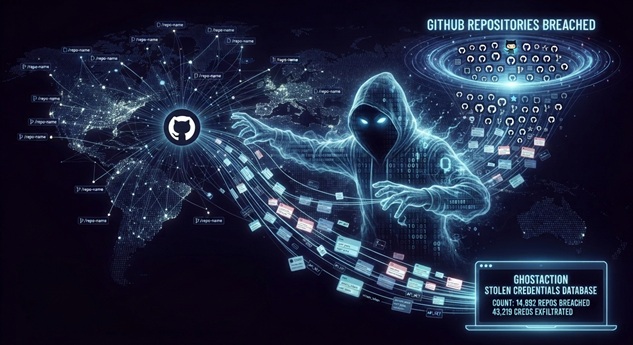
GhostAction Supply Chain Attack Steals Credentials from Tens of Thousands of GitHub Repositories
Cybersecurity researchers have disclosed an ongoing GhostAction supply chain attack that has compromised more than 500 GitHub accounts. The attackers have planted credential-stealing workflows in tens of thousands of open-source repositories since October 7, 2026. Consequently, developers must check their repositories immediately and rotate any exposed secrets.
What Happened: GhostAction Compromises 500+ GitHub Accounts to Steal Credentials
The GhostAction campaign first surfaced in September 2025. However, the latest wave is far larger than earlier activity. On October 9, 2026, StepSecurity and Socket reported that attackers had hijacked high-profile maintainer accounts to push malicious workflows.
The first known victim was Takashi Kitao. He is the author of pyxel, a popular game engine with 18,400 stars on GitHub. At 13:20 UTC on October 7, attackers used his account to push a malicious workflow to 27 repositories.
Eight hours later, the attackers struck again. They compromised the account of Henry Wu (henrywoo), the original author of Uber’s athenadriver. In just 16 minutes, the attackers pushed the same malicious workflow to 318 repositories.
Moreover, Socket reported that more than 500 GitHub accounts had committed the workflow since October 7. The total number of affected repositories has reached tens of thousands. Therefore, this represents one of the largest supply chain attacks on open-source infrastructure in recent years.
Technical Details of the GhostAction Supply Chain Attack
The GhostAction attack chain follows a consistent pattern. First, the attackers obtain a maintainer’s GitHub credentials. Most likely, they use leaked personal access tokens from infostealer logs or credential dumps.
Next, the attackers scan the repository’s workflow files for secrets. This reconnaissance step helps them identify which repositories hold valuable credentials.
Then, they inject a workflow that masquerades as a security audit. The workflow typically appears as security-audit.yml or github_actions_security.yml. It triggers on workflow_dispatch and any unfiltered push event.
The embedded payload performs four main actions. First, it appends named GitHub Actions secrets found during reconnaissance. Second, it scans the working tree for 13 credential patterns associated with AWS keys, AI services, source control, and SaaS APIs.
Third, it checks the entire git history for the same credential patterns. This step harvests secrets that developers committed and later deleted. Fourth, it pairs AWS access key IDs with their matching secret access keys.
Finally, the payload exfiltrates all captured data to a hard-coded IP address at 193.32.204[.]199 over plain HTTP. The stolen data includes CI/CD secrets, cloud credentials, AI API keys for Anthropic, OpenAI, and OpenRouter, and GitHub and GitLab tokens.
Business and Operational Impact
The GhostAction campaign poses severe risks to organizations that depend on open-source software. The impact extends far beyond the compromised repositories themselves.
- Credential exposure: Attackers have targeted 2,577 distinct secrets across affected repositories. These include SSH private keys, Azure credentials, DockerHub tokens, database passwords, and Cloudflare API keys.
- Downstream compromise: Private forks and downstream mirrors inherit the malicious workflow. Consequently, any organization that forked an affected repository may also leak credentials.
- Supply chain propagation: Compromised publishing credentials could lead to malicious package releases on npm, PyPI, and DockerHub. Although no such releases have been confirmed yet, the risk remains active.
- Repository mapping: Every workflow execution returns a repository identifier to the attacker. Therefore, the threat actors now hold a detailed map of reachable execution contexts.
In at least one case observed on August 30, 2026, the attackers altered the DevOpsGPT repository to embed an XMRig cryptocurrency miner in its Docker image. This demonstrates that the group is willing to pivot from credential theft to direct monetization.
Mitigation and Recommendations
Immediate Actions for Defenders
- Audit your repositories. Search for
security-audit.ymlorgithub_actions_security.ymlfiles pushed since August 31, 2026. Assume compromise if either file is present. - Revoke compromised credentials. Rotate all GitHub personal access tokens, SSH keys, and any secrets stored in repository settings.
- Delete malicious workflows. Remove the injected workflows from all branches, not just the default branch.
- Check forks and mirrors. Inspect downstream forks for inherited malicious workflows. Also review any private forks that may contain committed credentials.
- Scan git history for secrets. Use tools such as GitGuardian, TruffleHog, or GitHub secret scanning to identify credentials that may have been committed in the past.
Long-Term Supply Chain Security
Organizations should also adopt stronger controls to prevent similar attacks. First, enforce branch protection rules that require reviews for workflow changes. Second, use least-privilege access for GitHub tokens and rotate them regularly.
Furthermore, enable GitHub’s dependency review and secret scanning features. These tools can alert you to exposed credentials and suspicious activity early. Finally, monitor CI/CD logs for unexpected outbound connections, especially to unknown IP addresses over plain HTTP.
Bottom line: The GhostAction campaign is active and growing. Developers and organizations must audit their repositories, rotate exposed secrets, and harden their CI/CD pipelines immediately.
Incident Summary
| Campaign Name: | GhostAction |
| Disclosure Date: | October 9, 2026 |
| Attack Type: | Supply chain attack via compromised GitHub accounts |
| Affected Accounts: | 500+ GitHub accounts |
| Affected Repositories: | Tens of thousands since October 7, 2026 |
| Known Victims: | Takashi Kitao (pyxel), Henry Wu (henrywoo / athenadriver) |
| Malicious Workflows: | security-audit.yml, github_actions_security.yml |
| Exfiltration Target: | 193.32.204[.]199 (plain HTTP) |
| Data Stolen: | GitHub Actions secrets, AWS keys, AI API keys, cloud/SaaS credentials, git history secrets |
| Patch Status: | No software patch applicable; credential rotation and workflow removal required |
References
- StepSecurity, “GhostAction Returns: Malicious GitHub Actions Workflows Steal Cloud and AI Credentials,” October 9, 2026, https://www.stepsecurity.io/blog/ghostaction-returns.
- Socket, “GhostAction Cloud Credentials Theft: 500+ GitHub Accounts Compromised,” October 9, 2026, https://socket.dev/blog/ghostaction-cloud-credentials.
- GitGuardian, “GhostAction GitHub Actions Supply Chain Attack Returns,” October 2026, https://blog.gitguardian.com/ghostaction-github-actions-supply-chain-attack-returns/.
- The Hacker News, “Credential-Stealing GitHub Actions Workflows Planted in Tens of Thousands of Repositories,” October 9, 2026, https://thehackernews.com/2026/10/credential-stealing-github-actions.html.