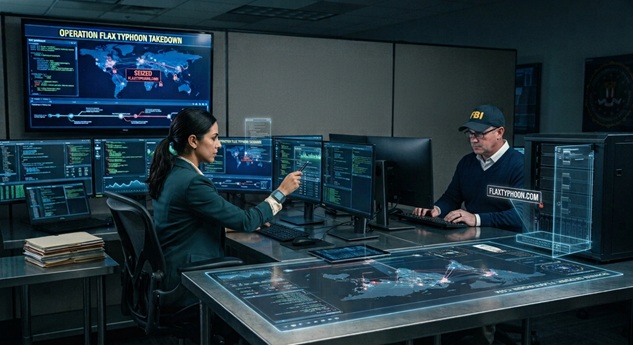
The FBI has seized seven domains used by Chinese state-sponsored hackers known as Flax Typhoon to operate two hacking platforms, MicroScan and FishHub. These tools were used in attacks that breached critical infrastructure and other organizations worldwide. The operation marks a significant disruption of a China-linked contractor that U.S. authorities say has contracts with the Chinese government.
What Happened: FBI Seizes Flax Typhoon Hacking Infrastructure in International Operation
On October 8, 2026, the U.S. Department of Justice announced that the FBI had seized seven domains supporting hacking tools operated by Integrity Technology Group, a China-based cybersecurity company. The seizures targeted infrastructure for MicroScan, a vulnerability-scanning platform, and FishHub, a spear-phishing and data-theft tool.
Furthermore, the FBI, CISA, NSA, and international partners issued a joint cybersecurity advisory explaining how Chinese government-linked hackers used Integrity Tech’s tools and infrastructure. The advisory says attackers targeted U.S. government agencies, critical manufacturing, healthcare, IT organizations, law enforcement, educational institutions, and religious groups. Organizations in Southeast Asia, Africa, and North America were also affected.
This is not the first disruption of Integrity Tech’s operations. In September 2024, the Justice Department dismantled an Integrity Tech-operated Mirai botnet of more than 200,000 compromised consumer devices worldwide. The UK government sanctioned Integrity Tech in 2025, and the European Union followed in 2026.
Technical Details of the Flax Typhoon Attack Platforms
MicroScan is a Python-based vulnerability scanner containing more than 1,300 penetration-testing scripts. It was used alongside a Mirai botnet to scan potential targets for security weaknesses. The platform targeted widely used software including Oracle WebLogic, Apache Struts, WordPress, Jenkins, and other applications.
Commonly Targeted Vulnerabilities
The joint advisory identified eight vulnerabilities that were frequently targeted by the hackers:
- CVE-2015-3306: ProFTPD unauthorized file read vulnerability
- CVE-2015-5477: ISC BIND denial-of-service vulnerability
- CVE-2016-3081: Apache Struts remote code execution vulnerability
- CVE-2019-11510: Pulse Secure VPN arbitrary file read vulnerability
- CVE-2021-22205: GitLab remote code execution vulnerability
- CVE-2021-3199: ONLYOFFICE DocumentServer unauthorized file write vulnerability
- CVE-2014-6278: GNU Bash (Shellshock) remote code execution vulnerability
- CVE-2023-22894: Strapi information disclosure vulnerability
Moreover, the attackers used the open-source EBurst tool to conduct password-spraying attacks against Microsoft Exchange servers. They also employed other tools to steal emails, collect Active Directory credentials, and exfiltrate data.
FishHub Spear-Phishing and Data Theft
The second platform, FishHub, was used to conduct spear-phishing attacks and deliver additional malware to already compromised networks. This malware gave attackers unauthorized remote access and allowed them to search for specific files and exfiltrate data to servers controlled by Integrity Tech.
Investigators found data belonging to more than 20 organizations on a server linked to FishHub, including six universities in Taiwan. The FBI also discovered a custom web application that let third parties browse stolen emails without needing direct access to compromised accounts.
To maintain persistence, the hackers installed SoftEther VPN software on compromised systems. They often renamed the installer to conhost.exe or dllhost.exe to appear as legitimate Windows files.
Business and Operational Impact
The Flax Typhoon operation had wide-reaching consequences for organizations across multiple sectors and continents. The impact includes:
- Government agencies: U.S. government services and Southeast Asian government organizations had email stolen
- Critical infrastructure: A South Carolina power company, airports in Japan and Poland, and Taiwanese natural gas and electricity companies were scanned
- Healthcare systems: Medical organizations in the U.S. and Southeast Asia were targeted
- Educational institutions: Universities in Taiwan and other regions were breached
- Religious organizations: Faith-based groups in multiple countries were affected
The attackers used a botnet of internet-connected devices infected with Mirai malware to scan potential targets. Targets included critical infrastructure networks in the United States and other countries. The FBI confirmed that scanning activity led to successful breaches at two Taiwanese universities.
Additionally, the hackers ran a web application providing third-party access to stolen email content. This raises concerns about whether stolen data was shared with or sold to other threat actors.
Mitigation and Recommendations
Immediate Actions for Defenders
- Turn off unused services and ports, including remote access and file sharing
- Sanitize user input in web applications to block cross-site scripting attacks
- Require multifactor authentication for webmail, VPNs, and critical system accounts
- Watch for unexpected Active Directory replication, which signals DCSync activity
- Check cloud accounts for connected applications that can read files and email
- Review web application logs for attack attempts
- Apply patches for the eight vulnerabilities listed in the advisory
- Replace products that no longer receive security updates
Threat Hunting Guidance
The joint advisory contains 39 pages of indicators of compromise. These include IP addresses, domains, malware hashes, and details of the attackers’ tools. Some indicators date back to 2016. Organizations should review these IOCs and hunt for signs of this activity in their own networks.
For suspected compromise, isolate affected hosts first. Then hunt to determine the scope of the breach. Collect enough hunting data before removing the attackers. Finally, harden the network to prevent re-entry.
Bottom line: The Flax Typhoon takedown shows how nation-state actors increasingly rely on contractors and commercial tools. Organizations must patch known vulnerabilities, enable multifactor authentication, and actively hunt for IOCs to defend against this persistent threat.
Incident Summary
| Incident: | FBI Seizes Flax Typhoon Hacking Infrastructure (MicroScan & FishHub) |
| Threat Actor: | Flax Typhoon / Integrity Technology Group (China-linked) |
| Affected Sectors: | Government, critical infrastructure, healthcare, education, religious organizations |
| Disclosure Date: | October 8, 2026 |
| Seized Domains: | c0cc.cc, 98aicai.com, 98aicode.com, outlook3650.com, youtubecard.com, linkedinns.net, 98aiblog.com |
| Patch Status: | Patches available for targeted CVEs; see CISA advisory for details |
References
- U.S. Department of Justice, “Justice Department and FBI Seize Vulnerability Scanning and Spear-Phishing Tools Operated by Chinese Government-Linked Contractor,” October 8, 2026, https://www.justice.gov/opa/pr/justice-department-and-fbi-seize-vulnerability-scanning-and-spear-phishing-tools-operated, accessed October 9, 2026.
- FBI, CISA, NSA, et al., “People’s Republic of China State-Sponsored Cyber Actor Compromises Networks and Steals Sensitive Data,” Joint Cybersecurity Advisory, October 8, 2026, https://www.ic3.gov/CSA/2026/261008.pdf, accessed October 9, 2026.
- BleepingComputer, “FBI disrupts Chinese hacking tools used to breach critical infrastructure,” October 8, 2026, https://www.bleepingcomputer.com/news/security/fbi-disrupts-chinese-hacking-tools-used-to-breach-critical-infrastructure/, accessed October 9, 2026.
- The Hacker News, “FBI Says China-Linked Hackers Ran Portal Giving Third Parties Access to Stolen Emails,” October 8, 2026, https://thehackernews.com/2026/10/fbi-says-china-linked-hackers-ran.html, accessed October 9, 2026.