CISA Adds Check Point CVE to KEV After TSGA Backdoor and ESXi Wiper Attacks
The U.S. Cybersecurity and Infrastructure Security Agency (CISA) added a critical missing-authorization flaw in Check Point Gaia OS to its Known Exploited Vulnerabilities (KEV) catalog on November 13, 2026. The vulnerability, tracked as CVE-2026-123039 (CVSS score: 7.8), has already been exploited in active attacks that deployed the TSGA backdoor and wiper malware against VMware ESXi hosts worldwide. Attackers chained this privilege escalation with earlier PHP2Shell flaws to gain root access and carry out destructive operations.
What Happened: Attackers Exploit Check Point CVE-2026-123039 to Deploy TSGA Backdoor and Wiper
Check Point disclosed on November 12, 2026, that an unknown threat actor has been actively targeting unpatched Check Point Security Gateways since October 30, 2026. The campaign began with Israeli organizations before expanding globally on November 2, 2026. Attackers leveraged the PHP2Shell vulnerabilities for initial access, then escalated privileges through the DynamicCLI interface, CVE-2026-123039, to gain root control on affected appliances.
Check Point observed active exploitation against “a couple of dozen customers” during the campaign. Furthermore, some victims were also subjected to destructive wiper malware deployment. Consequently, the incident demonstrates a clear shift from espionage to sabotage in some environments.
CISA responded rapidly by adding CVE-2026-123039 to its KEV catalog on November 13, 2026. Federal agencies must now apply the patch by November 16, 2026, under CISA’s binding operational directive. This short remediation window underscores the severity of the threat.
Technical Details of the CVE-2026-123039 Vulnerability
CVE-2026-123039 is a missing authorization flaw in the Gaia OS DynamicCLI daemon. The daemon runs as root and listens on a world-writable local socket without authenticating connecting processes. Therefore, any authenticated local user can send a command to the socket and have it executed with root privileges.
The vulnerability impacts the following Check Point products and versions:
- Check Point Force Firewalls
- Check Point Management and Log Servers
- Multi-Domain Security Management and Multi-Domain Log Server
- Maestro Orchestrator
Affected versions include R82.20, R82.10, R82, R81.20, R81.10, and R81.
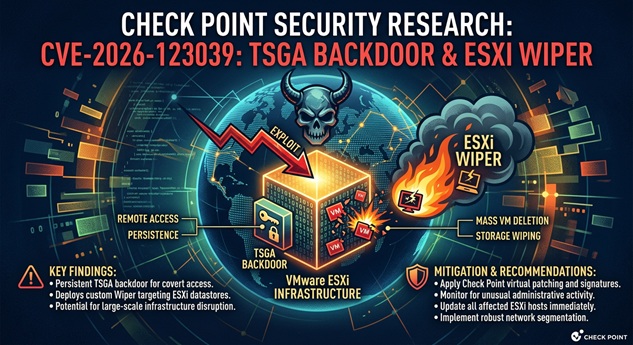
Attackers exploited this flaw in a multi-stage chain. First, they gained initial access via PHP2Shell (CVE-2026-109618 and CVE-2026-109619) through vulnerable Mobile Access portals. Next, they weaponized CVE-2026-123039 to escalate privileges from the portal service account to root. Then, they deployed PHP web shells to establish persistent remote access.
The access afforded by the web shell paved the way for TSGA, a standalone passive backdoor that also includes a second component called TSProxy. TSGA was deployed as slot_CPconfigdaemon and provides encrypted remote access, configuration theft, backup persistence, process injection, and binary firewall-log tampering. TSProxy injects code into selected appliance processes, intercepting networking functions to handle attacker connections while allowing ordinary traffic to continue.
Post-exploitation actions included deploying the gogo scanner for internal reconnaissance, lateral movement to VMware ESXi hosts over SSH using the vpxuser service account, and staging a Linux ELF wiper called destroy_v6. The wiper recursively deletes all files in the target directory and attempts to overwrite them with zeros before deletion. Attackers also dropped politically themed DREAM_ANNEXATION.txt notes in each processed directory.
Business and Operational Impact
The exploitation of CVE-2026-123039 carries serious consequences for organizations running affected Check Point appliances. The impact spans multiple domains:
- Gateway compromise: Attackers gain root access to security appliances, effectively neutralizing the perimeter defense layer.
- Network reconnaissance: Deployment of the gogo scanner enables discovery of internal assets and services, accelerating lateral movement.
- Virtual infrastructure destruction: Lateral movement to ESXi hosts and wiper deployment can destroy virtual machines and erase critical data.
- Configuration theft: TSGA backdoor extracts appliance configurations, potentially exposing VPN credentials, firewall rules, and network topology.
- Log tampering: Binary firewall-log tampering undermines incident response by obscuring attacker activity.
- Regulatory exposure: Failure to patch by CISA’s November 16 deadline exposes federal agencies to compliance violations under binding operational directives.
Moreover, the campaign targeted organizations across multiple sectors with no specific geographic or sector preference in later waves, indicating opportunistic exploitation. This broad targeting increases the probability of supply-chain and downstream impacts for organizations that rely on managed service providers or shared infrastructure.
Mitigation and Recommendations
Immediate Actions for Defenders
- Apply Check Point’s security fixes immediately for affected versions (R82.20, R82.10, R82, R81.20, R81.10, and R81). Patches were available approximately one week before exploitation began.
- Verify that Mobile Access portals are not exposed to untrusted networks unless strictly required, and restrict access by source IP where possible.
- Audit Check Point appliances for indicators of compromise, including the presence of slot_CPconfigdaemon, PHP web shells, and TSProxy components.
- Check ESXi hosts for signs of the destroy_v6 wiper and DREAM_ANNEXATION.txt notes.
- Reset credentials for the vpxuser service account on VMware ESXi hosts and enforce multi-factor authentication for SSH access.
Detection and Monitoring Guidance
Security teams should monitor for unusual SSH connections from Check Point gateways to internal ESXi hosts, unexpected file creation in CLFS log directories, and anomalous authentication attempts against Mobile Access portals. In addition, review logs for evidence of PHP2Shell exploitation patterns and scanning activity originating from LightNode VPS infrastructure.
Broader Risk Management
Organizations should assess their exposure to supply-chain and third-party risks. Also, evaluate whether managed service providers or shared infrastructure rely on vulnerable Check Point appliances. Finally, incorporate CISA KEV additions into patch-prioritization workflows to reduce the window between disclosure and exploitation.
Bottom line: CVE-2026-123039 is an actively exploited privilege escalation flaw that enables root access to Check Point security appliances. Organizations must patch immediately, audit for compromise, and monitor ESXi hosts for destructive follow-on activity.
Incident Summary
| CVE ID / Incident: | CVE-2026-123039 |
| Affected Systems: | Check Point Force Firewalls, Management/Log Servers, Multi-Domain Security Management/Log Server, Maestro Orchestrator (versions R82.20, R82.10, R82, R81.20, R81.10, R81) |
| Disclosure Date: | November 12, 2026 |
| Patch Status: | Security fixes available; CISA KEV patch deadline November 16, 2026 |
| Threat Actor: | Unknown; assessed as possible China-aligned actor (Armory Castle toolkit overlap) |
| Exploitation Timeline: | Initial wave October 30, 2026; global wave November 2, 2026; KEV addition November 13, 2026 |
References
- Check Point Research, “PHP2Shell Exploitation on Check Point Gateway,” November 12, 2026, https://research.checkpoint.com/2026/php2shell-exploitation-on-check-point-gateway/, accessed November 16, 2026.
- CISA, “CISA Adds Two Known Exploited Vulnerabilities to Catalog,” November 13, 2026, https://www.cisa.gov/news-events/alerts/2026/11/13/cisa-adds-two-known-exploited-vulnerabilities-catalog, accessed November 16, 2026.
- The Hacker News, “Hackers Exploit PHP2Shell Flaws in Check Point Gateways to Deploy TSGA Backdoor and Wipe ESXi Files,” November 13, 2026, https://thehackernews.com/2026/11/hackers-exploit-php2shell-flaws-in.html, accessed November 16, 2026.
- NIST NVD, “CVE-2026-123039,” https://nvd.nist.gov/vuln/detail/CVE-2026-123039, accessed November 16, 2026.
- Check Point Support, “CVE-2026-123039 – DynamicCLI Missing Authorization,” SK1000362, https://support.checkpoint.com/results/sk/sk1000362, accessed November 16, 2026.