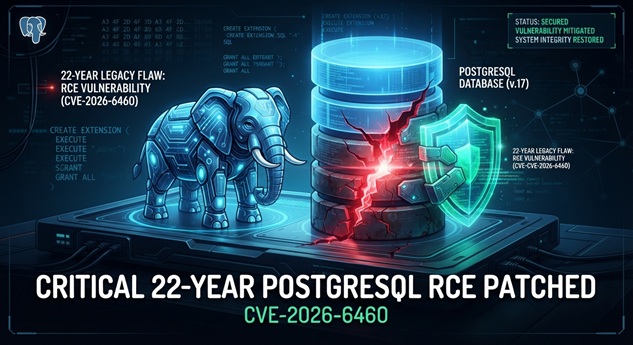
22-Year-Old PostgreSQL Bug Grants Authenticated RCE
Researchers have disclosed CVE-2026-6460, a 22-year-old type confusion flaw in PostgreSQL that can allow an authenticated database user to achieve remote code execution. The vulnerability was patched on November 9, 2026, alongside 51 other security flaws. It has not yet been reported as actively exploited in the wild, but its severity and age make it a critical finding for any organization running PostgreSQL.
What Happened: 22-Year-Old PostgreSQL Bug Enables Authenticated RCE
On November 9, 2026, the PostgreSQL Global Development Group released a set of security updates fixing 52 vulnerabilities. The headline flaw is CVE-2026-6460, a type confusion bug that lets a database user with object-creation privileges run code on the server. The flaw carries a CVSS score of 8.8 and was introduced more than two decades ago.
Security researcher Mehmet Ince discovered the bug and published a technical writeup demonstrating exploitation on PostgreSQL 18.6. He showed that the vulnerability could be triggered by a lowest-privileged login role. Furthermore, the researcher adapted the exploit for managed PostgreSQL services and privately disclosed proofs of concept to AWS, Azure, Google Cloud, Databricks, Supabase, and Ubicloud.
Technical Details of the CVE-2026-6460 Vulnerability
The flaw resides in PostgreSQL’s handling of composite types. Composite types are user-defined structures made from named fields, each with its own data type. The vulnerability works because PostgreSQL allows a field’s type to be changed via ALTER TYPE while older values of that type are still held elsewhere in the server. The server can then read an old value as if it had the new type, leading to type confusion.
The exploitation steps are as follows:
- Create a composite type with a
uuidattribute and prepare a statement that builds a value of that type. - Use
ALTER TYPEto change the attribute’s type to a different one, such asbytea. - The prepared statement keeps using the old bytes, but the server now interprets them with the new type.
When the new type is bytea, the function that converts it to text interprets those bytes as a pointer to an “expanded object” and calls its methods. With a null pointer, the process crashes. Using the same confusion applied to an array, an attacker can leak a memory address. Combined, these primitives allow redirecting execution to attacker-controlled code and ultimately running system commands.
The root cause dates to a commit on May 5, 2004, when PostgreSQL gained the ability to change a column’s type. The exploitability was enhanced by a later change on May 14, 2015, when expanded objects were introduced.
In addition to CVE-2026-6460, the November 2026 release also fixed 51 other flaws. Thirty-two of them received a CVSS score of 8.8. Other notable fixes include:
- A use-after-free in the
dblinkextension. - Another type confusion in PL/pgSQL.
- A logical replication flaw that could write to a subscriber’s catalog.
- CVE-2026-116322: An unauthenticated client can trigger a restart of PostgreSQL 18 servers.
Business and Operational Impact
The impact of CVE-2026-6460 extends far beyond self-managed PostgreSQL installations. It affects managed PostgreSQL services because a regular database user can bypass the provider’s isolation controls and execute code at the operating system level.
- Data breaches: Successful exploitation can expose sensitive data stored in the database or the underlying host.
- Multi-tenant risk: On shared managed services, one compromised database user could affect other tenants.
- Compliance violations: Unpatched databases running under PCI DSS, HIPAA, or GDPR may fall out of compliance.
- Service disruption: The initial exploit can crash the server, and follow-on commands can cause further instability.
Mitigation and Recommendations
Organizations running PostgreSQL should treat this patch with high urgency. The following steps are recommended:
- Upgrade immediately. Update the server to the fixed version matching your major release:
- PostgreSQL 18 → 18.7
- PostgreSQL 17 → 17.12
- PostgreSQL 16 → 16.16
- PostgreSQL 15 → 15.20
- PostgreSQL 14 → 14.25 (final release for EOL version 14)
- Rebuild C-language extensions. Extensions built against older releases may not be protected. Rebuild or update every C-language extension at the same time as the server update.
- Update client tools. Patch
pg_dump,pg_restore,reindexdb, andvacuumdbon every machine that runs them. - Restart services. If PostgreSQL runs outside its package’s service unit, such as under Patroni, restart it immediately after updating.
- Avoid the disable setting. Do not use the new
composite_type_mismatchsetting to turn off checks, as this carries security risks. - Managed service verification. If you use a managed provider, verify that the minor version has actually been upgraded rather than assuming.
Bottom line: A bug that has existed for 22 years in one of the world’s most trusted databases is now public and patchable. Every organization running PostgreSQL should upgrade now, rebuild extensions, and verify their managed providers have done the same.
Incident Summary
| CVE ID: | CVE-2026-6460 |
| Affected Systems: | PostgreSQL versions before 18.7, 17.12, 16.16, 15.20, and 14.25 |
| Disclosure Date: | November 9, 2026 |
| Patch Status: | Patches available; upgrade required |
| CVSS Score: | 8.8 |
| Exploitation: | No confirmed in-the-wild exploitation reported |
References
- The Hacker News, “PostgreSQL Patches 52 Flaws, Including 22-Year-Old Bug Enabling Authenticated RCE,” November 13, 2026, https://thehackernews.com/2026/11/postgresql-patches-52-flaws-including.html (accessed November 13, 2026).
- Antonio Cortes, “A 22-year-old PostgreSQL bug that ends up running code,” November 13, 2026, https://antoniocortes.com/en/postgres-type-confusion-rce/ (accessed November 13, 2026).
- Mehmet Ince, “How I Ended Up Turning a 22-Year-Old PostgreSQL Type Confusion Primitive Into RCE,” November 2026, https://mehmetince.net/part-3-6-how-i-ended-up-turning-a-22-year-old-postgresql-type-confusion-primitive-into-rce-cve-2026-6460/ (accessed November 13, 2026).
- PostgreSQL Security Advisory, “CVE-2026-6460,” November 9, 2026, https://www.postgresql.org/support/security/CVE-2026-6460/ (accessed November 13, 2026).
- PostgreSQL Release Notes, “Release 18.7,” November 9, 2026, https://www.postgresql.org/docs/18/release-18-7.html (accessed November 13, 2026).
- PostgreSQL Announcement, “PostgreSQL 18.7, 17.12, 16.16, 15.20, 14.25 and 19 RC 2 Released,” November 9, 2026, https://www.postgresql.org/about/news/postgresql-187-1712-1616-1520-1425-and-19-rc-2-released-3442/ (accessed November 13, 2026).