CryptoBilis Supply Chain Attack Steals Recovery Phrases via Cellular Networks
Cryptocurrency hardware wallet maker Trezor confirmed that malicious hardware implants in Safe 5 devices sold by Southeast Asian reseller CryptoBilis were designed to steal wallet recovery phrases and transmit them to attackers over cellular networks. Furthermore, Trezor released a firmware update that neutralizes the implants. This supply chain attack highlights the growing threat of physical hardware tampering in the cryptocurrency ecosystem.
What Happened: Trezor Safe 5 Hardware Implants Steal Recovery Phrases via Cellular Networks
German defense technology company Quantum Systems confirmed that it detected an incident in late October that was part of an active cyberattack by “hostile actors.” The company responded quickly, working with relevant authorities to resolve the issue swiftly and ensure its unmanned systems could safely resume operations.
However, this article focuses on a separate but related supply chain security incident. Trezor, a leading manufacturer of cryptocurrency hardware wallets, confirmed on November 13, 2026, that three Safe 5 devices sold by Southeast Asian reseller CryptoBilis contained malicious hardware implants. These implants were designed to steal wallet recovery phrases and send them to attackers over cellular networks.
All three compromised devices were purchased from CryptoBilis between August 20 and September 23, 2026. Trezor says 48 CryptoBilis customers have contacted the company following its October warning, with devices being examined in its laboratory or through photographs of their internal components. Moreover, the company has inspected devices from other resellers in the region and found no evidence of tampering.
Technical Details of the Trezor Safe 5 Hardware Implant Attack
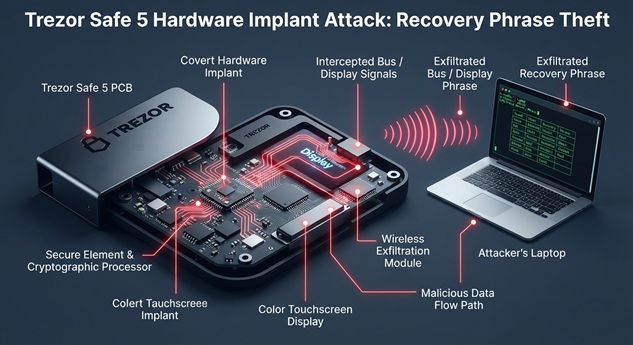
The implant consists of an additional circuit board installed between the Safe 5’s main board and display. This placement allows it to monitor screen activity without modifying the device’s legitimate firmware or Secure Element. Consequently, the attack bypasses the cryptographic protections that make hardware wallets secure.
When wallet recovery words appear on the screen, either during the creation of a new wallet backup or while restoring an existing wallet, the implant collects them. It can also capture passphrases displayed on the screen, encrypt the stolen information, and transmit it over a mobile network to an attacker-controlled server. If a connection is unavailable, the implant holds on to the captured data and repeatedly attempts to transmit it until successful.
Trezor says its engineers analyzed the implant’s firmware and confirmed that the malicious hardware can capture sensitive information displayed or entered on the wallet’s screen. The implant’s capabilities represent a sophisticated supply chain attack that targets the physical hardware layer rather than software vulnerabilities.
Business and Operational Impact
The Trezor hardware implant incident carries significant implications for the cryptocurrency industry and supply chain security. The key impacts include:
- Physical layer compromise: Unlike software attacks, hardware implants cannot be detected through traditional security measures such as antivirus software or network monitoring
- Recovery phrase exposure: The most sensitive data in cryptocurrency wallets — the seed phrase — is captured at the point of display, bypassing all encryption protections
- Cellular exfiltration: Data transmission over mobile networks means the attack works even on air-gapped systems that never connect to the internet
- Trust erosion in hardware wallets: As hardware wallets are marketed as the most secure way to store cryptocurrency, physical tampering undermines this core value proposition
- Reseller network disruption: Trezor has reduced its global reseller network by approximately 80% in response to this incident
So far, the confirmed implants have been limited to Safe 5 devices sold through CryptoBilis, and no affected customers have reported losing funds. However, the psychological impact on consumer confidence may be significant.
Mitigation and Recommendations
Trezor has taken several steps to address this supply chain attack. On November 11, 2026, the company released firmware version 2.13.1, which includes protections that prevent the implants from capturing information. Trezor stated that the update “stops the implants we’ve found from capturing anything on devices that run it, making the current batch of implants useless.”
Immediate Actions for Trezor Safe 5 Users
- Install firmware version 2.13.1 or later immediately to prevent future data capture
- If you purchased a Trezor device from CryptoBilis since March 2026, transfer your cryptocurrency to a newly created wallet using a new recovery phrase
- Request a replacement device from Trezor if you purchased from CryptoBilis
- Be aware that the firmware update cannot protect recovery phrases that may have already been captured before installation
General Hardware Wallet Security Best Practices
- Purchase hardware wallets directly from the manufacturer when possible
- Inspect devices for signs of tampering, including unusual components or loose connections
- Verify the authenticity of resellers before purchasing
- Consider purchasing from authorized retailers with strong supply chain controls
- Regularly check for firmware updates and apply them promptly
Bottom line: The Trezor hardware implant attack demonstrates that even the most secure cryptocurrency storage solutions can be compromised at the physical layer. Users should purchase directly from manufacturers, inspect devices for tampering, and apply firmware updates immediately to protect against known threats.
Incident Summary
| Incident: | Trezor Safe 5 Hardware Implant Supply Chain Attack |
| Affected Systems: | Trezor Safe 5 devices sold by CryptoBilis reseller (August–September 2026) |
| Disclosure Date: | November 13, 2026 |
| Attack Vector: | Hardware implant between main board and display; cellular exfiltration |
| Data at Risk: | Wallet recovery phrases (seed phrases) and passphrases |
| Patch Status: | Firmware 2.13.1 released November 11, 2026 — neutralizes implants |
| Confirmed Victims: | 3 confirmed compromised devices; 48 CryptoBilis customers contacted Trezor |
| Funds Stolen: | No reported thefts at time of publication |
References
- Lawrence Abrams, BleepingComputer, “Trezor confirms crypto-stealing implants in three wallets, releases fix,” November 13, 2026. https://www.bleepingcomputer.com/news/cryptocurrency/trezor-confirms-crypto-stealing-implants-in-three-wallets-releases-fix/
- Trezor Blog, “Our CryptoBilis Investigation: What We Found and What We’ve Changed,” November 2026. https://trezor.io/blog/news/our-cryptobilis-investigation-what-we-found-and-what-weve-changed
- Lawrence Abrams, BleepingComputer, “Ledger confirms hardware wallet spy implant behind crypto thefts,” October 2026. https://www.bleepingcomputer.com/news/security/ledger-confirms-hardware-wallet-spy-implant-behind-crypto-thefts/
- Quantum Systems, “Cyberattack Defeated,” November 2026. https://quantum-systems.com/news/cyberattack-defeated/