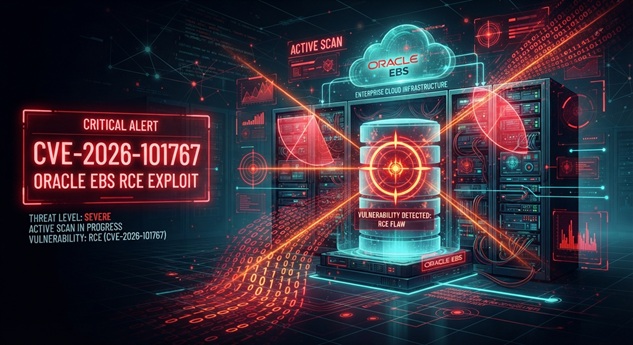
Hackers Scan for Critical Oracle EBS RCE Flaw Days After Patch
Threat actors have started scanning for a newly patched critical vulnerability in Oracle E-Business Suite (EBS) within days of its disclosure. Tracked as CVE-2026-101767, this unauthenticated SQL injection flaw carries a CVSS score of 9.8 and chains directly to remote code execution. It exposes financial, payroll, HR, and procurement records on affected systems.
What Happened: Hackers Probe Critical Oracle EBS Flaw Days After Patch
Oracle patched CVE-2026-101767 on October 20, 2026, as part of its Critical Patch Update. By October 27, 2026, threat intelligence firm Defused Cyber confirmed that its EBS decoys had already recorded exploitation attempts in the wild. The speed from patch to probing underscores a shrinking window for enterprise remediation.
The vulnerability was discovered by researchers at Horizon3.ai and reported to Oracle on July 24, 2026. Oracle rated the flaw as a case of improper authentication in the Application Object Library. However, Horizon3.ai clarified that the root cause is an unauthenticated SQL injection in EBS’s Thin Client Framework (TCF) servlet. Consequently, an attacker with network access can run SQL as the APPS database user. Furthermore, they can escalate to operating system commands with the privileges of the EBS application account.
Oracle EBS is a cornerstone enterprise resource planning (ERP) platform. It manages sensitive business functions across Fortune 100 corporations, government agencies, and healthcare networks. Moreover, Shadowserver currently tracks over 670 internet-exposed Oracle EBS instances, most of them in the United States. Therefore, the attack surface is substantial and the risk is acute.
Technical Details of the CVE-2026-101767 Exploit Chain
CVE-2026-101767 resides in the Thin Client Framework servlet at /OA_HTML/AppsTCFServer. This servlet is associated with oracle.apps.fnd.tcf.SocketServer. The flaw allows an attacker to send a crafted HTTP POST request that instantiates the Gantt data-server class. This triggers backend SQL execution under the APPS database user.
Because the APPS account has broad read and write access across EBS application schemas, the attacker can manipulate data and execute stored procedures. The chain culminates in OS-level command execution on the application host. No valid credentials are required.
The following prerequisites enable exploitation:
- Network reachability to the EBS web tier
- The
/OA_HTML/AppsTCFServerservlet is reachable and not blocked - The target system has not applied Oracle’s October 2026 Critical Patch Update
Internet-facing deployments present the highest risk. However, internal systems are also vulnerable if an attacker can pivot from a compromised endpoint or adjacent network segment.
Indicators of Compromise
Horizon3.ai published the following IOCs to help defenders detect exploitation:
- Unauthenticated POST requests to
/OA_HTML/AppsTCFServerthat instantiate the Gantt data-server class, followed by backend database activity. - SQL reconnaissance shortly after unauthenticated web requests, such as queries for database version, current user, and directory objects.
- Unexpected files appearing in
$APPLPTMP, and theoracleaccount spawning/bin/shvia the Concurrent Manager to run OS commands.
Business and Operational Impact
Successful exploitation of CVE-2026-101767 gives attackers broad access to business-critical data. Depending on the EBS deployment, exposed records may include:
- Financial ledgers and accounts payable
- Payroll and compensation data
- Human resources files
- Procurement and supply chain records
Operating system access under the EBS application account can also enable further lateral movement. Attackers may install persistent backdoors, exfiltrate data, or deploy ransomware. The Cl0p extortion gang exploited a prior Oracle EBS zero-day, CVE-2025-61882, to breach organizations including Logitech, the Washington Post, and Harvard University. Similarly, ShinyHunters leveraged CVE-2026-35273 in Oracle PeopleSoft to compromise Nissan, Nottingham University, and the NAIC.
Since November 2021, CISA has added 46 Oracle vulnerabilities to its Known Exploited Vulnerabilities catalog. Thirteen of those were also used in ransomware campaigns.
Mitigation and Recommendations
Organizations running Oracle EBS must treat this as a high-priority patching event. Oracle issued updates on October 20, 2026, and strongly recommends that customers apply them immediately.
Immediate Actions for Defenders
- Apply the October 2026 Critical Patch Update to all affected Oracle EBS instances.
- Remove
/OA_HTML/AppsTCFServerfrom the EBS URL firewall allowlist if it is not strictly required. - Restrict access to the EBS web tier to trusted networks and enforce VPN or zero-trust controls.
- Monitor for IOCs listed above, focusing on unauthenticated POSTs to
AppsTCFServerand anomalous database queries. - Audit
$APPLPTMPfor unexpected files and review Concurrent Manager logs for spawned shells.
Long-Term Hardening
Oracle EBS should not be directly exposed to the internet. Organizations that require remote access should place EBS behind a secure remote access gateway, web application firewall, or zero-trust architecture. Additionally, maintaining an actively supported EBS version ensures timely access to future security fixes.
Bottom line: CVE-2026-101767 is a near-perfect storm of high severity, low complexity, and rapid post-patch exploitation. Delayed patching on Oracle EBS has repeatedly led to mass breaches. If your organization runs EBS, patch now or restrict access immediately.
Incident Summary
| CVE ID / Incident: | CVE-2026-101767 — NVD Record |
| Affected Systems: | Oracle E-Business Suite (Application Object Library / Thin Client Framework servlet) |
| Disclosure Date: | October 20, 2026 (Oracle Critical Patch Update) |
| Patch Status: | Patched in Oracle October 2026 CPU; apply immediately |
| CVSS Score: | 9.8 (Critical) |
| Attack Vector: | Unauthenticated SQL injection chaining to remote code execution over HTTP |
| Exposed Instances: | 670+ internet-facing Oracle EBS instances tracked by Shadowserver |
| First Exploitation Observed: | October 27, 2026 (Defused Cyber honeypot telemetry) |
References
- Horizon3.ai, “CVE-2026-101767: Oracle EBS SQL Injection RCE,” October 20, 2026. https://horizon3.ai/attack-research/vulnerabilities/cve-2026-101767/
- The Hacker News, “Hackers Target Critical Oracle E-Business Suite RCE Flaw Days After Security Patch,” October 28, 2026. https://thehackernews.com/2026/10/hackers-target-critical-oracle-e.html
- BleepingComputer, “Hackers now scanning systems for recently-patched Oracle flaw,” October 28, 2026. https://www.bleepingcomputer.com/news/security/hackers-now-scanning-systems-for-recently-patched-oracle-flaw/
- Oracle, “Oracle Critical Patch Update Advisory — October 2026,” October 20, 2026. https://www.oracle.com/security-alerts/cpuoct2026.html
- Defused Cyber, X post on CVE-2026-101767 exploitation, October 27, 2026. https://x.com/DefusedCyber/status/2115099999973364147