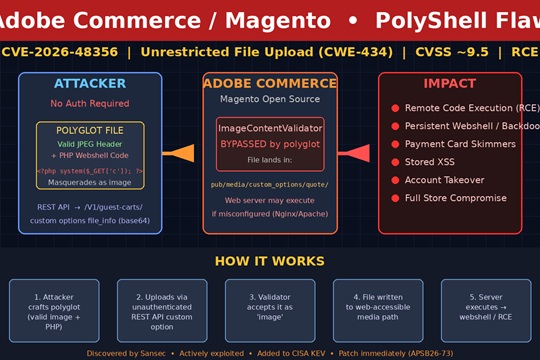
CISA Adds Adobe Commerce PolyShell Flaw to KEV
The U.S. Cybersecurity and Infrastructure Security Agency (CISA) added a critical Adobe Commerce and Magento vulnerability to its Known Exploited Vulnerabilities (KEV) catalog on October 27, 2026. Tracked as CVE-2026-48356 and dubbed PolyShell, this unrestricted file upload flaw carries a CVSS score of 9.3. Attackers are actively exploiting it to breach hundreds of online stores, inject malicious loaders, and potentially gain full control over affected systems.
What Happened: CISA Confirms Active Exploitation of Adobe Commerce PolyShell Flaw
CISA announced the KEV addition on Tuesday, citing confirmed evidence of in-the-wild attacks. Federal Civilian Executive Branch (FCEB) agencies must remediate the flaw by November 10, 2026, under Binding Operational Directive 26-04. However, CISA strongly urges all organizations—not just federal agencies—to prioritize patching.
Security firm Sansec reported that attackers have leveraged CVE-2026-48356 to infect at least 953 e-commerce stores. The campaign uses a Magento CMS block to insert a malicious loader. This loader then fetches and executes an attacker-controlled payload. Researchers have not yet recovered the final payload, but the activity has been ongoing since at least July 2025.
Technical Details of the PolyShell Vulnerability
CVE-2026-48356 is an unrestricted upload of a file with a dangerous type vulnerability. It exists in Adobe Commerce and Magento Open Source. The flaw allows an authenticated attacker with administrative privileges to upload malicious files—such as PHP web shells—through the Magento admin panel or CMS blocks.
The attack chain works as follows:
- The attacker authenticates to the Magento admin interface using stolen or brute-forced credentials.
- They navigate to the CMS block editor and upload a malicious file disguised as a legitimate image or template.
- The uploaded file bypasses insufficient extension and MIME-type validation checks.
- The server saves the file to a web-accessible directory, granting the attacker remote code execution.
- The attacker then uses the web shell to inject a loader that downloads additional payloads from a command-and-control server.
Adobe patched the vulnerability in July 2026 as part of APSB26-73. The fix strengthens file upload validation, restricts executable file types, and moves uploaded files outside the web root where possible. However, many store owners have not yet applied the update, leaving a large attack surface exposed.
Attack Infrastructure and Observed Activity
Sansec telemetry shows that the PolyShell campaign is highly automated. Attackers scan for unpatched Magento instances, exploit the upload flaw, and then plant a lightweight loader. The loader communicates with external infrastructure to retrieve next-stage malware. As of October 28, 2026, the final payload remains unidentified, suggesting the campaign may still be in an early access or reconnaissance phase.
Business and Operational Impact
The active exploitation of CVE-2026-48356 poses severe risks to e-commerce operations and customer trust. Key impacts include:
- Store takeover: Attackers can gain full administrative control of Magento backends, altering product listings, prices, and payment configurations.
- Customer data theft: Compromised stores expose customer names, addresses, payment card details, and order histories to theft and fraud.
- Payment fraud: Attackers can redirect checkout flows to fake payment gateways or steal card data in real time.
- Reputational damage: A breached store loses consumer confidence, leading to abandoned carts and revenue loss.
- Regulatory penalties: Under PCI-DSS and GDPR, merchants face fines if they fail to protect cardholder and personal data.
- SEO poisoning: Attackers inject spam links and malicious scripts that degrade search rankings and infect visitors.
With Magento powering roughly 250,000 active online stores worldwide, the potential blast radius is enormous. Small and mid-sized retailers without dedicated security teams are especially vulnerable.
Mitigation and Recommendations
Immediate Actions for Defenders
- Apply Adobe’s patch immediately — Upgrade to the fixed versions released in APSB26-73 (July 2026). If you missed the update, install it now.
- Audit file upload directories — Scan Magento directories for unexpected PHP files, web shells, or recently modified CMS blocks.
- Review admin access logs — Look for suspicious login attempts, unfamiliar IP addresses, or unexpected admin panel activity.
- Check CMS blocks and themes — Inspect all custom CMS blocks, widgets, and theme files for injected scripts or obfuscated code.
- Validate file upload configurations — Ensure uploaded files are stored outside the web root and that extension whitelists are enforced.
- Enable Web Application Firewall (WAF) rules — Use WAF policies that block known PolyShell exploitation patterns and restrict file uploads.
Long-Term Security Measures
Organizations should adopt a risk-based vulnerability management program aligned with CISA’s KEV catalog prioritization. Furthermore, implementing continuous monitoring for publicly exposed admin panels and enforcing multi-factor authentication (MFA) on all Magento accounts sharply reduces the likelihood of credential-based compromise. Regular penetration testing of e-commerce platforms also helps identify weak upload controls before attackers do.
Bottom line: CVE-2026-48356 is under active, mass exploitation. If you run Adobe Commerce or Magento and have not patched since July 2026, assume compromise until proven otherwise. Patch now, hunt for webshells, and harden your file upload controls.
Incident Summary
| CVE ID / Incident: | CVE-2026-48356 (PolyShell) |
| Affected Systems: | Adobe Commerce and Magento Open Source (unpatched versions prior to APSB26-73) |
| Disclosure Date: | July 2026 (patch); October 27, 2026 (CISA KEV addition) |
| Patch Status: | Fixed in APSB26-73; federal remediation deadline November 10, 2026 |
| Severity: | Critical (CVSS 9.3) |
| Observed Victims: | At least 953 online stores (per Sansec) |
References
- CISA, “CISA Adds Two Known Exploited Vulnerabilities to Catalog,” October 27, 2026, https://www.cisa.gov/news-events/alerts/2026/10/27/cisa-adds-two-known-exploited-vulnerabilities-catalog
- The Hacker News, “Adobe Commerce PolyShell Attacks Breach Hundreds of Stores as Brotli Exploit Traffic Emerges,” October 28, 2026, https://thehackernews.com/2026/10/adobe-commerce-polyshell-attacks-breach.html
- Security Affairs, “U.S. CISA adds Google Brotli and Adobe Commerce and Magento flaws to its Known Exploited Vulnerabilities catalog,” October 28, 2026, https://securityaffairs.com/201922/security/u-s-cisa-adds-google-brotli-and-adobe-commerce-and-magento-flaws-to-its-known-exploited-vulnerabilities-catalog.html
- Adobe Security Bulletin APSB26-73, July 2026, https://helpx.adobe.com/security/products/magento/apsb26-73.html
- Sansec, “Hackers infect 953 online stores with PolyShell” (via The Hacker News), October 2026, https://thehackernews.com/2026/10/hackers-infect-953-online-stores-with.html