CISA Confirms PHP2Shell RCE Exploitation Added to KEV Catalog
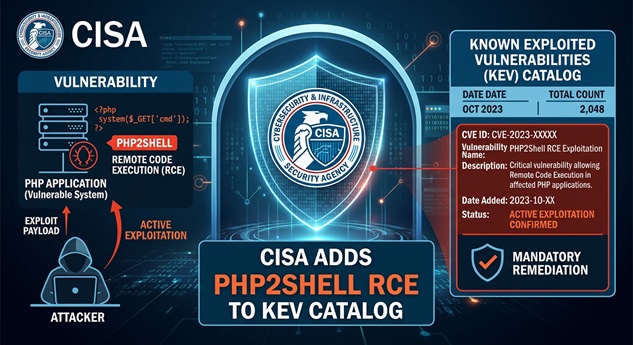
CISA confirmed active exploitation of two critical PHP vulnerabilities collectively tracked as PHP2Shell. Threat actors can exploit CVE-2026-109618 and CVE-2026-109619 to gain unauthenticated remote code execution on millions of unpatched systems worldwide.
What Happened: CISA Adds PHP2Shell to KEV Catalog
On October 26, 2026, the U.S. Cybersecurity and Infrastructure Security Agency added CVE-2026-109618 and CVE-2026-109619 to its Known Exploited Vulnerabilities catalog. Both flaws carry a CVSS score of 9.2 and enable unauthenticated remote code execution.
CVE-2026-109618 is an out-of-memory corruption vulnerability. CVE-2026-109619 is a stale internal request-state vulnerability. Threat actors without privileges can chain these issues to execute arbitrary code.
Federal Civilian Executive Branch agencies must patch by October 29, 2026, per Binding Operational Directive 26-04. CISA urges all organizations to prioritize remediation.
Technical Details of the PHP2Shell Vulnerabilities
The vulnerabilities reside in PHP’s request parsing and session handling. Attackers craft malicious HTTP requests to trigger memory corruption.
For CVE-2026-109618, the attacker sizes a request to fail memory allocation at the right moment. When PHP copies a form-field name into a hash table, the allocation failure corrupts heap memory. This opens the door to code execution.
For CVE-2026-109619, a stale internal request-state allows attackers to reuse or corrupt request metadata. Both flaws can be reached in default PHP configurations.
Successful exploitation requires:
- An exposed PHP service running an unpatched version
- Session upload progress enabled (default in many configurations)
- The ability to send crafted multipart HTTP requests
ReliaQuest reproduced CVE-2026-109618 in a lab and identified a specific artifact sequence. A POST request returns a 500 error. PHP reports memory exhaustion and heap corruption. The Apache worker handling the request crashes.
Business and Operational Impact
The impact is severe due to PHP’s massive footprint. PHP powers roughly 70% of all websites. Censys estimates over 32.5 million PHP services still run vulnerable versions.
Key impacts include:
- Complete server compromise on unpatched hosts
- Credential theft including password hashes and MFA secrets
- Active Directory attacks via NTLM relay tunnels
- Lateral movement from web servers to internal networks
- Supply chain risk from embedded PHP in third-party products
A European government entity was reportedly breached within two hours. Attackers accessed password hashes and MFA secrets. They also established an NTLM-relay tunnel and attempted Domain Admin privilege escalation.
Mitigation and Recommendations
Immediate Actions for Defenders
- Patch PHP immediately to versions 8.5.12, 8.4.27, 8.3.36, or 8.2.35
- Review web server logs for 500 errors followed by worker crashes
- Block known exploit IPs including 204.76.203.7 and 162.35.99.94
- Disable session upload progress if not required via session.upload_progress.enabled = Off
- Deploy web application firewall rules to filter malformed multipart requests
Detection Guidance
Monitor for these indicators:
- HTTP POST requests with PHP_SESSION_UPLOAD_PROGRESS markers
- Unexpected wget, curl, or php -r commands after web requests
- Apache workers crashing after 500 errors
- Outbound connections to 162.35.99.94 on ports 80 and 8080
Bottom line: PHP2Shell is one of the largest unauthenticated RCE exposures in recent memory. With millions of services still unpatched and federal agencies under a three-day mandate, every organization running PHP should treat this as a critical priority.
Incident Summary
| CVE ID / Incident: | CVE-2026-109618, CVE-2026-109619 (PHP2Shell) |
| Affected Systems: | PHP versions prior to 8.5.12, 8.4.27, 8.3.36, 8.2.35 |
| Severity: | CVSS 9.2 (Critical) |
| Disclosure Date: | October 21, 2026 |
| CISA KEV Addition: | October 26, 2026 |
| Patch Status: | Patches available; federal deadline October 29, 2026 |
| Exploitation Status: | Confirmed active exploitation in the wild |
| Known Threat Actors: | Suspected Lazarus Group (North Korea) activity observed |
References
- CISA, “CISA Adds Two Known Exploited Vulnerabilities to Catalog,” October 26, 2026, https://www.cisa.gov/news-events/alerts/2026/10/26/cisa-adds-two-known-exploited-vulnerabilities-catalog
- BleepingComputer, “CISA confirms PHP2Shell vulnerabilities now exploited in attacks,” October 27, 2026, https://www.bleepingcomputer.com/news/security/cisa-confirms-php2shell-vulnerabilities-now-exploited-in-attacks/
- The Hacker News, “CISA Confirms Active Exploitation of Two PHP2Shell Flaws,” October 27, 2026, https://thehackernews.com/2026/10/cisa-confirms-active-exploitation-of.html
- The Hacker News, “PHP2Shell Exploitation Attempts Continue Amid Suspected N. Korea Global Scanning Activity,” October 27, 2026, https://thehackernews.com/2026/10/php2shell-exploitation-hits-government.html
- ReliaQuest, “Threat Spotlight: PHP2Shell — Responding to Critical PHP Vulnerabilities,” October 22, 2026, https://reliaquest.com/blog/threat-spotlight-php2shell-responding-to-critical-php-vulnerabilities/
- CYFIRMA, “Suspected DPRK Campaign Staging PHP2Shell Targeting Against Global PHP Infrastructure,” October 2026, https://www.cyfirma.com/research/cyfirma-threat-advisory-suspected-dprk-campaign-staging-php2shell-targeting-against-global-php-infrastructure/