October 25, 2026
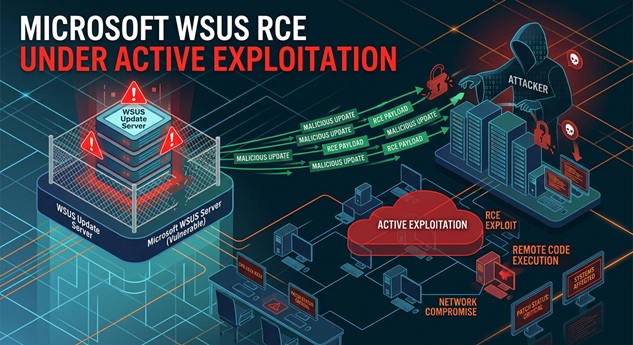
On October 14, 2025, Microsoft disclosed a critical remote code execution (RCE) vulnerability in the Windows Server Update Service (WSUS). Tracked as CVE-2025-59287, this flaw allows unauthenticated attackers to execute code with SYSTEM privileges over a network. Exploitation in the wild began within days of disclosure. Therefore, organizations must prioritize patching or mitigation immediately.
What Happened: Attackers Exploit Critical WSUS RCE in Active Campaigns
Microsoft initially disclosed CVE-2025-59287 during its October 2025 Patch Tuesday. However, the first security update did not fully mitigate the vulnerability. Consequently, Microsoft released an out-of-band emergency patch on October 23, 2025. Active exploitation was confirmed shortly after.
CISA added CVE-2025-59287 to its Known Exploited Vulnerabilities (KEV) catalog on October 24, 2025. The Dutch National Cyber Security Centre (NCSC-NL) confirmed exploitation by that same date. Furthermore, cybersecurity firms Huntress and Eye Security observed scanning and exploitation attempts starting October 23, with at least one confirmed compromise.
Proof-of-concept exploit code was released publicly by HawkTrace Security over the October 25 weekend. This development has significantly increased the risk of mass exploitation.
Technical Details of the WSUS Deserialization Vulnerability
CVE-2025-59287 is a deserialization of untrusted data vulnerability within Windows Server Update Services. It affects Windows Server versions 2012, 2012 R2, 2016, 2019, 2022, and 2025.
The attack works when a server has the WSUS Server Role enabled to act as an update source for downstream WSUS servers. Attackers exploit this without authentication, privileges, or user interaction. Successful exploitation grants remote code execution with SYSTEM privileges.
Attack Prerequisites
- Windows Server with WSUS Server Role enabled
- WSUS configured as an upstream update source for other WSUS servers
- Network access to TCP ports 8530 or 8531 (default WSUS listeners)
Exploitation Observed in the Wild
Post-exploitation behavior observed by Huntress and Darktrace includes:
- PowerShell execution with SYSTEM privileges spawned from wsusservice.exe and w3wp.exe
- Domain reconnaissance commands: whoami, net user /domain, ipconfig /all
- Exfiltration of enumerated data to webhook[.]site via PowerShell and cURL
- Use of Cloudflare Workers subdomains for command-and-control beaconing
- Deployment of the Skuld Stealer malware and Velociraptor for C2 tunneling
Additionally, the vulnerability could be potentially wormable between interconnected WSUS servers within an organization.
Business and Operational Impact
The exploitation of CVE-2025-59287 carries severe consequences for affected organizations:
- Full Domain Compromise: WSUS servers typically hold significant privileges, making them high-value targets for lateral movement
- Data Exfiltration: Attackers have used post-exploitation scripts to steal credentials, browser data, crypto wallets, and system information
- Service Disruption: Out-of-band patches require reboots, causing planned downtime during a critical patching cycle
- Compliance Risk: CISA KEV inclusion triggers mandatory patching deadlines for federal agencies under BOD 22-01
- Wormable Propagation: WSUS-to-WSUS trust relationships could enable rapid internal spread
Eye Security discovered approximately 2,500 publicly exposed WSUS instances worldwide, with 250 in Germany and 100 in the Netherlands. Huntress identified roughly 25 susceptible hosts within its partner base.
Mitigation and Recommendations
Organizations must act immediately to remediate or mitigate this vulnerability. The following steps are ordered by priority:
- Identify vulnerable systems: Run Get-WindowsFeature -Name UpdateServices in PowerShell or check Server Manager Dashboard for WSUS Server Role enablement
- Apply the out-of-band security update: Install the October 23, 2025 update for affected Windows Server versions and reboot immediately
- If patching is not immediately possible: Disable the WSUS Server Role and block inbound traffic to TCP ports 8530 and 8531 at the host firewall
- Do not revert workarounds: Keep mitigations in place until patches are fully installed and systems rebooted
- Monitor for compromise indicators: Watch for suspicious child processes from wsusservice.exe and w3wp.exe, and base64-encoded PowerShell commands
Immediate Actions for Defenders
- Audit all Windows Servers for WSUS role installation
- Scan for outbound connections to webhook[.]site and workers[.]dev subdomains
- Review logs for PowerShell executions spawning from WSUS processes
- Validate that WSUS listeners are not exposed to the internet unnecessarily
Patch Information
| Windows Server Version | KB Article |
| Windows Server 2025 | KB5070881 |
| Windows Server 2022, Version 23H2 | KB5070879 |
| Windows Server 2022 | KB5070884 |
| Windows Server 2019 | KB5070883 |
| Windows Server 2016 | KB5070882 |
| Windows Server 2012 R2 | KB5070886 |
| Windows Server 2012 | KB5070887 |
Bottom line: CVE-2025-59287 is an actively exploited critical RCE in Windows Server Update Services. Organizations must patch immediately, disable internet exposure of WSUS listeners, and monitor for signs of post-exploitation activity.
Incident Summary
| CVE ID / Incident: | CVE-2025-59287 — NVD Entry |
| Affected Systems: | Windows Server 2012, 2012 R2, 2016, 2019, 2022, 2025 with WSUS Server Role enabled |
| Severity: | Critical — CVSS 9.8 |
| Disclosure Date: | October 14, 2025 |
| Active Exploitation: | Confirmed — CISA KEV, October 24, 2025 |
| Patch Status: | Out-of-band patches available (KB5070879–KB5070887) |
| Attack Vector: | Network, no authentication required, low complexity |
| Impact: | Remote code execution with SYSTEM privileges |
References
- BleepingComputer, “Critical WSUS flaw in Windows Server now exploited in attacks,” October 24, 2025, https://www.bleepingcomputer.com/news/security/hackers-now-exploiting-critical-windows-server-wsus-flaw-in-attacks/.
- CISA, “Microsoft Releases Out-of-Band Security Update to Mitigate Windows Server Update Service Vulnerability, CVE-2025-59287,” October 24, 2025, https://www.cisa.gov/news-events/alerts/2025/10/24/microsoft-releases-out-band-security-update-mitigate-windows-server-update-service-vulnerability-cve.
- CISA, “CISA Adds Two Known Exploited Vulnerabilities to Catalog,” October 24, 2025, https://www.cisa.gov/news-events/alerts/2025/10/24/cisa-adds-two-known-exploited-vulnerabilities-catalog.
- Darktrace, “Darktrace’s Analysis of Post-Exploitation Activities on CVE-2025-59287,” October 29, 2025, https://www.darktrace.com/blog/wsus-exploited-darktraces-analysis-of-post-exploitation-activities-related-to-cve-2025-59287.
- Huntress, “Exploitation of Windows Server Update Services Remote Code Execution Vulnerability,” October 24, 2025, https://www.huntress.com/blog/exploitation-of-windows-server-update-services-remote-code-execution-vulnerability.
- Microsoft Security Response Center, “CVE-2025-59287 — Windows Server Update Service (WSUS) Remote Code Execution Vulnerability,” October 2025, https://msrc.microsoft.com/update-guide/vulnerability/CVE-2025-59287.
- National Vulnerability Database (NVD), “CVE-2025-59287 Detail,” accessed October 25, 2025, https://nvd.nist.gov/vuln/detail/CVE-2025-59287.
- The Hacker News, “Two New Windows Zero-Days Exploited in the Wild,” October 15, 2025, https://thehackernews.com/2025/10/two-new-windows-zero-days-exploited-in.html.