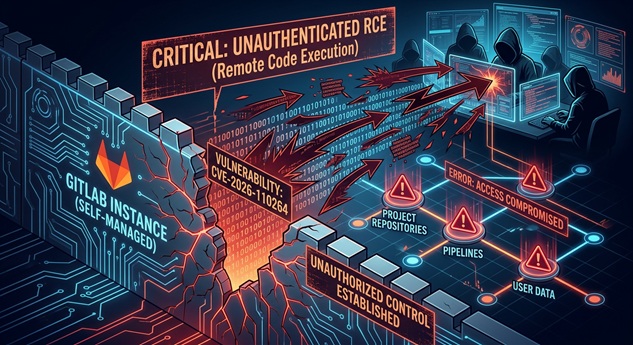
GitLab Critical RCE Allows Unauthenticated Code Execution Across 12 Years of Releases
GitLab has released emergency security updates for a critical unauthenticated remote code execution vulnerability that affects every self-managed version of the platform released since 2014. The flaw, tracked as CVE-2026-110264, carries a maximum CVSS score of 10.0 and lets an attacker run arbitrary code on a GitLab server without logging in.
What Happened: GitLab Patches 12-Year Unauthenticated RCE Vulnerability
On October 21, 2026, GitLab published fixes for CVE-2026-110264 across seven release branches. The vulnerability stems from an integer overflow in the Onigmo regular-expression compiler, which GitLab ships inside its own packages. Consequently, any self-managed instance running GitLab 7.0 or later is potentially exposed.
The disclosure is especially urgent for administrators who applied GitLab’s October 12 patch. That earlier update only covered versions 19.2 and later, leaving older installations unprotected. The October 21 release backports the fix to version 18.11.13 and beyond, extending coverage to releases GitLab normally does not patch. GitLab reserves such backports for severe issues.
GitLab.com and GitLab Dedicated tenants on internal releases 19.3.5-internal0 or later already run patched code. However, only self-managed administrators can upgrade on-premise instances. GitLab has reported no confirmed exploitation in the wild, and the flaw is not yet listed in the U.S. CISA catalog of known exploited vulnerabilities.
Technical Details of CVE-2026-110264
The root cause sits in GitLab’s use of the Onigmo regular-expression engine, a fork of Oniguruma that Ruby uses. GitLab patches and ships its own build of Onigmo inside every release package. Therefore, a weakness in that engine is present wherever GitLab has shipped it.
An attacker can trigger an integer overflow during the compilation of a specially crafted regular expression. Under certain conditions, GitLab says this overflow leads to unauthenticated arbitrary code execution on the server. The company has not publicly disclosed the exact preconditions an attacker needs to reach the compiler. As a result, administrators cannot rule themselves safe by configuration alone.
- Attack vector: Network — unauthenticated remote attacker
- Weakness: Integer overflow in regex compiler
- Impact: Arbitrary code execution with application privileges
- Authentication required: None
- Scope: Every self-managed GitLab release from 7.0 through 19.5.0
This is the fourth code-execution flaw in GitLab’s regular-expression engine reported by the same researcher, joaxcar, in one month. On October 12, GitLab fixed CVE-2026-97229, another unauthenticated CVSS 10.0 overflow in the same component, but that patch stopped at version 19.2. CVE-2026-110264 is the first to reach versions before 19.2.
Business and Operational Impact
Self-managed GitLab instances host source code, CI/CD pipelines, secrets, and issue trackers for organizations worldwide. A successful exploitation of CVE-2026-110264 could give an attacker full access to repositories, deployment credentials, and private issue data.
- Data exposure: Source code, secrets, and internal documentation at risk
- Supply chain compromise: Attackers could inject malicious code into CI/CD pipelines
- Operational downtime: Single-node upgrades require database changes that cause downtime
- Compliance implications: Unauthorized code execution may trigger breach notification obligations
Furthermore, the October 21 release fixes 11 security issues in total. Two additional high-severity flaws concern authentication: CVE-2026-15723 could let a logged-in user take over another account when SAML and LDAP auto-linking are both enabled, and CVE-2026-112212 is a cache-poisoning flaw in OAuth and OpenID Connect endpoints that could redirect sign-in flows to an attacker-controlled server.
Mitigation and Recommendations
Immediate Actions for Defenders
- Upgrade immediately. The only certain protection is patching. GitLab offers no interim workaround for CVE-2026-110264.
- Verify your version. Check the table below and upgrade to the fixed release for your branch.
- Plan for downtime on single-node instances. Versions 19.4.3 and 19.3.6 include database changes that run during upgrade. Multi-node setups can use GitLab’s zero-downtime procedure.
- Review logs for exploitation attempts. GitLab published two detection rules in its open-source TLDR framework: “Onigmo native worker crash” and “Org mode render error burst.”
- Audit CI/CD secrets. If you cannot patch immediately, rotate any credentials stored in GitLab CI/CD variables and review pipeline configurations for unauthorized changes.
Fixed Versions
| If you run | Upgrade to |
| 19.5 before 19.5.1 | 19.5.1 |
| 19.4 before 19.4.3 | 19.4.3 |
| 19.3 before 19.3.6 | 19.3.6 |
| 19.2 before 19.2.9 | 19.2.9 |
| 19.1 before 19.1.9 | 19.1.9 |
| 19.0 before 19.0.10 | 19.0.10 |
| 7.0 through 18.11, before 18.11.13 | 18.11.13 |
Bottom line: CVE-2026-110264 is a maximum-severity flaw with an exceptionally broad attack surface. Administrators should treat patching as an emergency and should not assume older versions are safe.
Incident Summary
| CVE ID / Incident: | CVE-2026-110264 |
| Affected Systems: | GitLab self-managed instances, versions 7.0 through 19.5.0 |
| Disclosure Date: | October 21, 2026 |
| Patch Status: | Available — seven fixed versions released |
| CVSS Score: | 10.0 (Critical) |
| CISA KEV: | Not listed as of October 22, 2026 |
| Exploitation in the wild: | None confirmed |
References
- The Hacker News, “Critical GitLab Flaw (CVSS 10.0) Could Allow Unauthenticated RCE Across 12 Years of Releases,” October 21, 2026, https://thehackernews.com/2026/10/critical-gitlab-flaw-cvss-100-could.html, accessed October 22, 2026.
- GitLab, “GitLab 19.5.1, 19.4.3, 19.3.6, 19.2.9, 19.1.9, 19.0.10, and 18.11.13 Released,” October 21, 2026, https://docs.gitlab.com/releases/patches/patch-release-gitlab-19-5-1-released/, accessed October 22, 2026.
- GitLab, “Detecting Security Incidents (TLDR Framework),” https://docs.gitlab.com/security/detecting_security_incidents/, accessed October 22, 2026.