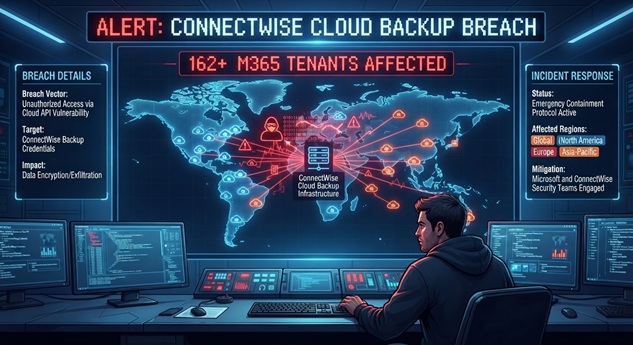
Hackers Breach 162+ Microsoft 365 Tenants via Compromised Vendor Credentials
ConnectWise has shut down customer access to its Cloud Backup service after hackers compromised vendor application credentials and used them to breach at least 162 Microsoft 365 tenants. The incident is an active supply-chain attack that bypasses multi-factor authentication and grants attackers broad access to emails, files, Teams chats, and directory data across affected organizations.
What Happened: ConnectWise Cloud Backup Supply-Chain Attack Hits MSPs and Clients
On October 15, 2026, administrators began reporting unauthorized access to Microsoft 365 tenants tied to ConnectWise Cloud Backup, formerly known as SkyKick Cloud Backup. Huntress, a managed threat detection platform, quickly confirmed the scale of the incident. The company identified at least 162 compromised tenants in its environment alone.
Microsoft also confirmed malicious activity involving the ConnectWise Cloud Backup service. The tech giant identified unauthorized authentication attempts originating from a single IP address, 144.172.64[.]128. In its assessment, Microsoft Threat Intelligence characterized the incident as an active supply-chain attack.
ConnectWise responded by shutting down application access for partners and clients. The company stated that it has no indicators suggesting stored backup data was compromised. However, the service interruption has left MSPs without cloud backup capabilities until further notice.
Technical Details of the ConnectWise Cloud Backup Attack
The attack exploits the very architecture that makes cloud backup possible. ConnectWise Cloud Backup operates through Microsoft Entra ID application identities called service principals. These identities hold permissions that allow the backup service to read and write mail, files, Teams messages, and directory data in customer tenants.
According to Todyl researchers, the attacker authenticated directly to Microsoft 365 as the backup application using its client secret. Because this is an app-only sign-in, it does not involve a user login. Consequently, multi-factor authentication provides no protection against this type of abuse.
The attacker used automated scripts with specific user agents to carry out the attacks:
- curl/7.88.1
- python-urllib/3.12
- python-requests/2.31
- python-requests/2.34.2
Sign-in attempts began on October 13 and 14, followed by broader exploitation on October 15 between 06:13 and 08:34 UTC. The attacker moved through tenants in sorted GUID order, a few seconds apart, suggesting a scripted operation working from a target list.
Reconnaissance and Persistence Behaviors
In some tenants, the attack went beyond simple access. Huntress observed that ConnectWise Cloud Management apps assigned themselves directory roles, mostly Exchange Administrator. In one tenant, the Cloud Management app for Microsoft Teams granted itself Global Administrator privileges. The attacker then added new client secrets to an MSP management tool and to Huntress’s own application, establishing persistence in approximately five minutes.
Microsoft also observed backdoor activity after successful service principal authentication. This was followed by Microsoft Graph API reconnaissance and attempts to add additional credentials.
Business and Operational Impact
The impact of this supply-chain attack extends across the entire MSP ecosystem. ConnectWise Cloud Backup serves managed service providers and IT teams that protect customer data in cloud environments. Consequently, a breach at the vendor level cascades down to every client tenant where the application is installed.
- Data Exposure: Attackers can read and write mail, OneDrive and SharePoint files, Teams chats, and directory data using the application’s existing permissions.
- Backup Service Disruption: ConnectWise shut down Cloud Backup access, leaving partners without backup capabilities until the incident is resolved.
- Persistence Risk: In affected tenants, attackers planted new credentials on other applications, extending access beyond the initial breach.
- MFA Bypass: The app-only nature of the attack means traditional identity protections like multi-factor authentication are ineffective.
Mitigation and Recommendations
Immediate Actions for Defenders
- Disable ConnectWise applications immediately. In the Microsoft Entra admin center, search for application ID 506e08f9-6e9a-4da4-942b-a099a03644ae. Set “Enabled for users to sign-in” to No. Do not delete the application, as this removes consent and complicates restoration.
- Review all ConnectWise and SkyKick applications. Search for “SkyKick” and “ConnectWise” in Enterprise applications. Disable any that cannot be verified as safe until ConnectWise confirms all credentials have been reset.
- Check service principal sign-in logs. In Entra, go to Monitoring > Sign-in logs, open the Service principal sign-ins tab, and filter by Application ID 506e08f9-6e9a-4da4-942b-a099a03644ae. Look for the IP address 144.172.64[.]128.
- Review application credentials. Examine client secrets and certificates on all Enterprise applications and App registrations for any additions since October 13 that were not created intentionally. Remove anything unexpected.
- Audit directory role assignments. If any ConnectWise or SkyKick application holds a directory role, especially Global Administrator, review it and remove unauthorized roles after disabling the app.
- Inspect Conditional Access policies. Check if any policy excludes ConnectWise applications from location-based blocks, as this could allow attacker infrastructure to bypass controls.
Long-Term Security Measures
Organizations should evaluate the principle of least privilege for third-party applications. Backup services require broad permissions, but defenders should regularly audit what applications hold and restrict access where possible. Furthermore, monitoring service principal sign-ins with anomaly detection can help catch similar app-only attacks before they escalate.
Bottom line: The ConnectWise Cloud Backup supply-chain attack demonstrates how trusted third-party applications can become silent weapons when their credentials fall into attacker hands. MSPs and their clients must disable affected applications, audit credentials, and monitor service principal sign-ins immediately. Do not wait for proof of data exfiltration before acting.
Incident Summary
| Incident: | ConnectWise Cloud Backup (SkyKick) Supply-Chain Attack |
| CVE ID: | N/A (credential compromise / supply-chain attack) |
| Affected Systems: | Microsoft 365 tenants with ConnectWise Cloud Backup (formerly SkyKick) installed |
| Disclosure Date: | October 15, 2026 (initial reports); October 17, 2026 (public confirmation) |
| Patch Status: | ConnectWise shut down service access; no timeline for restoration |
| Confirmed Compromised Tenants: | 162+ (Huntress telemetry as of October 16, 19:00 UTC) |
| Attacker IP: | 144.172.64[.]128 |
References
- Bill Toulas, “Hackers breach Microsoft 365 tenants via ConnectWise supply-chain attack,” BleepingComputer, October 17, 2026, https://www.bleepingcomputer.com/news/security/hackers-breach-microsoft-365-tenants-via-connectwise-supply-chain-attack/ (accessed October 17, 2026).
- Huntress, “ConnectWise (SkyKick) Vendor Credentials Abused in M365 Attacks,” Huntress Blog, October 16, 2026, https://www.huntress.com/blog/vendor-credential-enables-unauthorized-access (accessed October 17, 2026).
- Todyl, “Investigation: Unauthorized Access Through the ConnectWise Cloud Backup Microsoft 365 App,” Todyl Blog, October 16, 2026, https://www.todyl.com/blog/investigation-unauthorized-access-through-the-connectwise-cloud-backup-microsoft-365-app (accessed October 17, 2026).
- Microsoft Threat Intelligence, X (Twitter) Post, October 16, 2026, https://x.com/msftsecintel/status/2111358888125878426 (accessed October 17, 2026).
- ConnectWise Trust Center, “Security Advisory,” ConnectWise, October 17, 2026, https://www.connectwise.com/company/trust/advisories (accessed October 17, 2026).