Cisco Secure Email Gateway Zero-Day Grants Root via Malicious Attachments
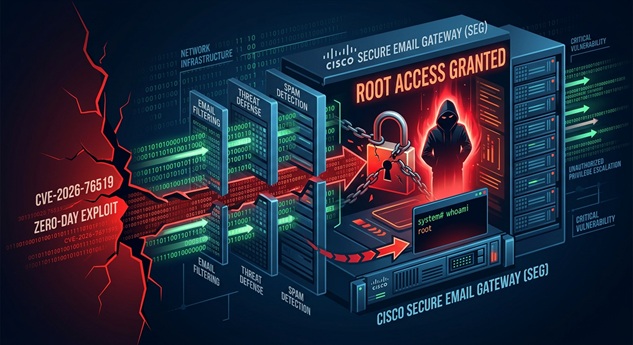
Cisco disclosed an actively exploited zero-day vulnerability in its Secure Email Gateway (SEG) on October 14, 2026. Tracked as CVE-2026-76519, this flaw lets remote unauthenticated attackers execute commands with root privileges by sending malicious email attachments. Consequently, organizations using vulnerable SEG appliances face immediate compromise risks.
What Happened: Cisco SEG Zero-Day Grants Root to Remote Attackers
Cisco’s Product Security Incident Response Team (PSIRT) confirmed active exploitation of CVE-2026-76519 in October 2026. Threat actors are leveraging a relative path traversal weakness in SEG’s Advanced Malware Protection (AMP) feature to write arbitrary files and execute commands with root privileges.
The vulnerability stems from improper handling of email attachments within the AMP subsystem. Furthermore, a successful exploit requires only a maliciously crafted attachment sent through an unpatched device. No user interaction is needed.
This disclosure follows a pattern of critical SEG vulnerabilities. In September 2026, Cisco patched CVE-2026-76461, another actively exploited zero-day in AsyncOS email parsing that also granted root command execution. Therefore, defenders running SEG appliances should treat this as part of an ongoing attack campaign targeting Cisco email security infrastructure.
Technical Details of the CVE-2026-76519 Vulnerability
CVE-2026-76519 is a relative path traversal flaw in the Advanced Malware Protection (AMP) feature of Cisco Secure Email Gateway. The vulnerability exists because SEG improperly handles email attachments when the File Reputation service is enabled.
Affected systems must meet the following conditions:
- File Reputation service is enabled and assigned to a mail policy
- Content Scanner Tools version is earlier than 25.3.0.5525
Admins can verify vulnerability status using the contentscannerstatus CLI command to check the Content Scanner Tools version. In addition, they should inspect the “Enable File Reputation” checkbox under Mail Policies in the web-based management interface.
Shadowserver tracks nearly 300 Cisco Secure Email Gateway instances exposed online. However, it is unclear how many remain unpatched or how many are honeypots.
Exploitation Method and Indicators of Compromise
Cisco shared specific indicators of compromise (IOCs) to help defenders detect exploitation:
- Suspected compromise indicator: Log message states “System Security: Suspected compromise indicator was found. Contact TAC for further recommendations.” This indicates compromise detected. Follow Cisco’s advisory recommendations.
- Incomplete security scan: Log message states “System Security: Security scan did not complete. Contact TAC for further recommendations.” Contact Cisco Technical Assistance Center for support.
- No compromise found: Log message states “System Security: No compromise indicator was found.” No compromise detected, but upgrade to a fixed release if applicable.
Moreover, Cisco warned that attackers may remove evidence of exploitation after gaining root-level command execution. Therefore, defenders should cross-check firewall and network logs for suspicious downloads and uploads to and from external or suspicious IP addresses.
Business and Operational Impact
CVE-2026-76519 poses severe risks to organizations relying on Cisco Secure Email Gateway for email security. The operational impacts include:
- Complete appliance compromise: Attackers gain root command execution on the underlying operating system
- Credential theft: Root access enables extraction of stored credentials, certificates, and API keys
- Lateral movement: Compromised SEG appliances can serve as launch points for attacks against internal networks
- Email infrastructure disruption: Attackers may permanently crash appliances or modify email flows
- Cloud instance exposure: Cisco confirmed potential compromises among cloud-hosted SEG deployments
Cisco has already deployed mitigations on cloud instances and contacted affected Cisco Secure Email Cloud device owners. Organizations contacted by Cisco should assume compromise and take immediate remediation steps.
Mitigation and Recommendations
Cisco released patches for CVE-2026-76519. All organizations running vulnerable SEG configurations should apply updates immediately.
Immediate Actions for Defenders
- Upgrade Content Scanner Tools to version 25.3.0.5525 or later
- Verify File Reputation settings and ensure the service is not assigned to vulnerable mail policies without patching
- Review SEG logs for the IOC messages listed above
- Audit firewall and network logs for suspicious uploads or downloads to external IPs
- Contact Cisco TAC if compromise indicators are detected
Post-Compromise Remediation
For organizations contacted by Cisco or that detect compromise:
- Restore the device to a secure configuration
- Renew all credentials and cryptographic materials installed on the appliance
- Restrict access to the appliance and implement robust access control mechanisms
- Rebuild cloud or virtual instances rather than simply patching in-place
Bottom line: CVE-2026-76519 is an actively exploited zero-day that grants root access to Cisco Secure Email Gateway appliances via malicious email attachments. Patch immediately, audit logs for IOCs, and assume compromise if contacted by Cisco.
Incident Summary
| CVE ID / Incident: | CVE-2026-76519 |
| Affected Systems: | Cisco Secure Email Gateway (SEG) with File Reputation enabled and Content Scanner Tools earlier than 25.3.0.5525 |
| Severity: | Critical — Unauthenticated remote root command execution |
| Disclosure Date: | October 14, 2026 |
| Exploitation Status: | Actively exploited in the wild (confirmed by Cisco PSIRT) |
| Patch Status: | Patches available — upgrade Content Scanner Tools to 25.3.0.5525+ |
References
- Cisco Security Advisory, “Cisco Secure Email Gateway Advanced Malware Protection Path Traversal Vulnerability,” October 14, 2026, https://sec.cloudapps.cisco.com/security/center/content/CiscoSecurityAdvisory/cisco-sa-esa-afw-zqYJkjxp
- BleepingComputer, “Cisco patches new Secure Email Gateway zero-day exploited in attacks,” October 14, 2026, https://www.bleepingcomputer.com/news/security/cisco-patches-actively-exploited-secure-email-gateway-zero-day/
- Shadowserver, “Cisco Secure Email Gateway Internet Exposure Statistics,” accessed October 14, 2026, https://dashboard.shadowserver.org/statistics/iot-devices/time-series/