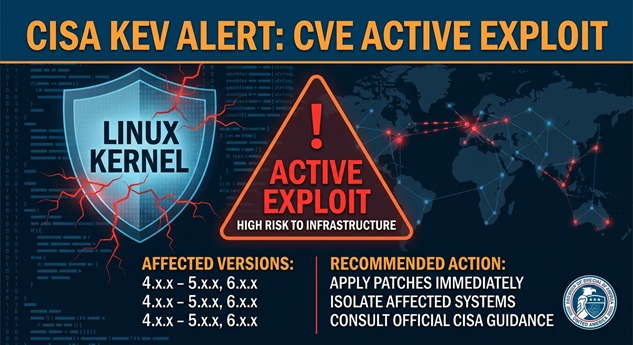
The U.S. Cybersecurity and Infrastructure Security Agency (CISA) has added three Linux kernel vulnerabilities to its Known Exploited Vulnerabilities (KEV) catalog after confirming active exploitation in the wild. Furthermore, one of the flaws carries a critical CVSS score of 9.8, and another has lurked in the kernel for 14 years. Organizations running Linux servers, cloud instances, and embedded devices should treat these vulnerabilities as a top patching priority.
What Happened: CISA Adds Three Linux Kernel Flaws to KEV Catalog
On September 18, 2026, CISA published two separate alerts confirming that hackers are actively exploiting three distinct Linux kernel flaws. Consequently, federal agencies must apply patches or mitigations by September 21, 2026. The vulnerabilities affect core kernel subsystems responsible for cryptographic operations, network packet filtering, and TLS record handling.
Red Hat has also updated its security advisories to acknowledge known exploits for all three flaws. In addition, STAR Labs researchers demonstrated CVE-2025-39964 by achieving privilege escalation and container escape in Google’s kernelCTF. Therefore, the threat is not theoretical — public proof-of-concept code and active attacks are already in motion.
Technical Details of the Linux Kernel Vulnerabilities
The three vulnerabilities target different areas of the kernel, but each enables a local attacker to escalate privileges, corrupt data, or crash systems. Moreover, at least two of the flaws have public exploit code available.
CVE-2025-39682: TLS Receive Path Memory Disclosure (CVSS 9.8)
This critical flaw sits in the kernel’s TLS receive-path logic. It mishandles zero-length records queued for later processing on the rx_list. As a result, different TLS record types can be processed together when kTLS is in use. An attacker with local access can trigger memory disclosure or denial-of-service conditions.
CVE-2026-53266: ebtables SNAT Out-of-Bounds Write (CVSS 8.8)
This vulnerability exists in the ebtables SNAT implementation for bridge packet filtering. When rewriting ARP addresses in nonlinear network fragments, the driver copies data into memory pages without confirming write access. Consequently, a local attacker can modify shared file-backed memory and potentially achieve privilege escalation.
CVE-2025-39964: AF_ALG Socket Race Condition (CVSS 7.8)
This 14-year-old race condition affects the AF_ALG cryptographic socket interface. Two concurrent writers on the same socket can interleave request payloads unpredictably. Therefore, attackers can corrupt cryptographic results or cause system crashes. STAR Labs demonstrated privilege escalation and container escape using this flaw.
Business and Operational Impact
Linux powers billions of cloud instances, enterprise servers, and connected devices worldwide. Because these flaws affect core kernel subsystems, the attack surface is enormous.
- Cloud Infrastructure: AWS, Azure, and GCP instances running unpatched kernels are at risk of local privilege escalation from compromised containers or low-privilege accounts.
- Enterprise Servers: Web servers, database hosts, and application servers running Linux distributions with vulnerable kernels face immediate danger from authenticated attackers.
- Embedded and IoT Devices: Routers, industrial controllers, and IoT gateways running Linux may not receive timely vendor updates, leaving them exposed indefinitely.
- Container Security: CVE-2025-39964 enables container escape, undermining isolation boundaries in Kubernetes and Docker environments.
Mitigation and Recommendations
CISA has marked all three flaws as requiring forensic triage. Therefore, federal agencies must examine every affected asset for signs of prior exploitation before patching. Organizations should follow these steps immediately.
Immediate Actions for Defenders
- Update Linux kernels to the latest patched versions provided by your distribution vendor.
- Prioritize internet-facing and multi-tenant systems where local user accounts are most likely.
- Review authentication logs and audit trails for suspicious local account activity.
- Scan container environments for signs of escape or unauthorized privilege escalation.
- Restrict local shell access to only users who absolutely require it.
Temporary Mitigations
If patching is not immediately possible, apply these temporary controls:
- Blacklist the
af_algkernel module to mitigate CVE-2025-39964. - Disable ARP hardware address rewriting in ebtables rules to mitigate CVE-2026-53266.
- Disable kTLS if not required, reducing exposure to CVE-2025-39682.
Bottom line: Patching is the only reliable fix. Therefore, apply vendor kernel updates immediately, audit systems for signs of prior exploitation, and restrict local access until all endpoints are hardened.
Incident Summary
| CVE IDs: | CVE-2025-39682, CVE-2026-53266, CVE-2025-39964 |
| Affected Systems: | Linux kernels with AF_ALG sockets, ebtables SNAT, and kTLS receive path |
| Disclosure Date: | September 18, 2026 (CISA KEV catalog additions) |
| Patch Status: | Patches available from major distributions |
| Severity Range: | CVSS 7.8 – 9.8 (High to Critical) |
| Exploitation Status: | Confirmed active exploitation in the wild |
References
- CISA, “CISA Adds Two Known Exploited Vulnerabilities to Catalog,” September 18, 2026, https://www.cisa.gov/news-events/alerts/2026/09/18/cisa-adds-two-known-exploited-vulnerabilities-catalog, accessed September 21, 2026.
- CISA, “CISA Adds One Known Exploited Vulnerability to Catalog,” September 18, 2026, https://www.cisa.gov/news-events/alerts/2026/09/18/cisa-adds-one-known-exploited-vulnerability-catalog, accessed September 21, 2026.
- BleepingComputer, “CISA alerts of active exploitation of three Linux kernel flaws,” September 21, 2026, https://www.bleepingcomputer.com/news/security/cisa-alerts-of-active-exploitation-of-three-linux-kernel-flaws/, accessed September 21, 2026.
- The Hacker News, “CISA Flags Three Linux Kernel Vulnerabilities Exploited in the Wild,” September 21, 2026, https://thehackernews.com/2026/09/cisa-flags-three-linux-kernel.html, accessed September 21, 2026.
- Red Hat, “CVE-2025-39682,” accessed September 19, 2026, https://access.redhat.com/security/cve/cve-2025-39682, accessed September 21, 2026.
- Red Hat, “CVE-2026-53266,” accessed September 19, 2026, https://access.redhat.com/security/cve/cve-2026-53266, accessed September 21, 2026.
- Red Hat, “CVE-2025-39964,” accessed September 19, 2026, https://access.redhat.com/security/cve/cve-2025-39964, accessed September 21, 2026.