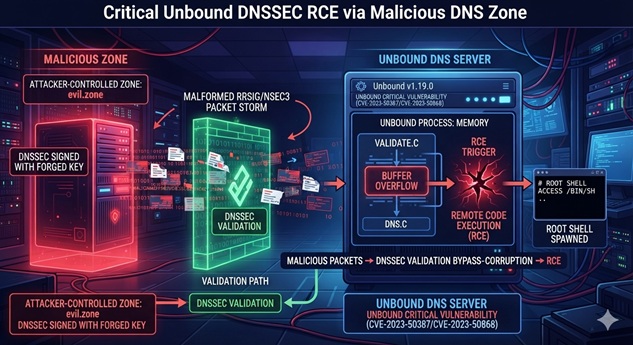
Critical Unbound DNSSEC Validator RCE via Malicious DNS Zone
A critical heap overflow vulnerability in the Unbound DNS resolver enables remote code execution through malicious DNS zones. The flaw, tracked as CVE-2026-81642, affects every Unbound release before version 1.26.1 and carries a CVSS score of 9.1. Security teams should prioritize patching this vulnerability immediately to protect their DNS infrastructure.
What Happened: Critical DNSSEC Validator Flaw in Unbound Resolver
NLnet Labs, the maintainer of the widely used Unbound DNS resolver, disclosed a critical heap overflow vulnerability on September 16, 2026. The flaw exists in the DNSSEC validator component of Unbound and allows an attacker who controls a malicious DNS zone to trigger remote code execution on vulnerable resolvers.
Furthermore, NLnet Labs released Unbound version 1.26.1 on the same day to address this vulnerability along with eight other security flaws. One additional critical issue, CVE-2026-82717, involves heap corruption in CNAME synthesis reported by Ben Morris of Anthropic. This second flaw could also lead to remote code execution under certain systems and compilation options.
However, NLnet Labs has not reported active exploitation of either bug at the time of disclosure. Consequently, CISA’s entry for CVE-2026-81642 marked exploitation status as “none” on Wednesday. Organizations should still treat this as a high-priority patching opportunity given the severity and ease of exploitation.
Technical Details of the Unbound DNSSEC Vulnerability
The overflow occurs while the validator digests a DNSKEY record whose owner name is a compression pointer into the record’s own data. This creates a heap overflow condition that can be exploited by an attacker controlling a malicious DNS zone.
The attack vector is particularly dangerous because:
- It requires no privileges on the target system
- It requires no user interaction
- It can be triggered over the network
- Every version up to and including 1.26.0 is affected
Moreover, the impact NLnet Labs lists includes denial of service, with remote code execution possible through attacker-controlled data. The CVSS score of 9.1 reflects the critical nature of this vulnerability with its network attack vector and lack of required privileges or user interaction.
It is important to note that the May 2026 critical validator bug CVE-2026-33278 is a different flaw. The 1.25.1 update that fixed CVE-2026-33278 does not address CVE-2026-81642.
Business and Operational Impact
The Unbound DNS resolver is deployed extensively across enterprise networks, ISPs, and cloud infrastructure. Therefore, this vulnerability poses significant risk to organizations relying on DNSSEC validation for security.
The key impacts include:
- DNS infrastructure compromise: Attackers could gain remote code execution on DNS resolvers, giving them control over domain resolution
- Network traffic redirection: Compromised resolvers could redirect users to malicious sites
- Cascading failures: DNS is critical infrastructure; resolver compromise can disrupt entire networks
- Compliance implications: Organizations in regulated industries may face audit findings for unpatched critical vulnerabilities
- Service availability: The vulnerability also enables denial of service attacks
Mitigation and Recommendations
Organizations should take immediate action to address this critical vulnerability.
Immediate Actions for Defenders
- Upgrade to Unbound 1.26.1 immediately. The update is available as source code with checksums and PGP signatures, as well as Windows installers and binaries.
- If immediate upgrading is not possible, apply the minimal patch or complete patch for CVE-2026-81642 using patch -p1, then run make install.
- Alternatively, apply the combined patch for all nine fixes released in version 1.26.1.
- Review DNS resolver configurations and identify all Unbound instances in your environment.
- Monitor DNS traffic for anomalous queries that could indicate exploitation attempts.
Patching Guidance
NLnet Labs has confirmed that the standalone patches for CVE-2026-81642 and CVE-2026-82717 have been tested and work on version 1.26.0. The organization’s security policy is to patch the latest released version.
Debian’s security tracker listed unbound 1.26.1-1 as fixed in unstable on Thursday, with the bookworm, trixie, and forky branches still listed as vulnerable. System administrators running Debian-based distributions should monitor their security updates closely.
Bottom line: CVE-2026-81642 is a critical vulnerability in one of the most widely deployed DNS resolvers. Organizations should patch to Unbound 1.26.1 or apply the available patches immediately to prevent potential remote code execution on their DNS infrastructure.
Incident Summary
| CVE ID / Incident: | CVE-2026-81642 |
| Affected Systems: | Unbound DNS resolver versions up to and including 1.26.0 |
| Disclosure Date: | September 16, 2026 |
| Patch Status: | Fixed in Unbound 1.26.1 |
| CVSS Score: | 9.1 (Critical) |
| Attack Vector: | Network, no privileges required, no user interaction |
References
- NLnet Labs Security Advisory, “Unbound DNSSEC Validator Heap Overflow,” September 16, 2026, https://nlnetlabs.nl/projects/unbound/security-advisories/.
- NLnet Labs, CVE-2026-81642 Details, https://nlnetlabs.nl/downloads/unbound/CVE-2026-81642.txt.
- NLnet Labs, CVE-2026-82717 Details, https://nlnetlabs.nl/downloads/unbound/CVE-2026-82717.txt.
- NLnet Labs, Unbound Release 1.26.1 Notes, https://github.com/NLnetLabs/unbound/releases/tag/release-1.26.1.
- The Hacker News, “Critical Unbound DNSSEC Validator Flaw Could Allow RCE via a Malicious DNS Zone,” September 17, 2026, https://thehackernews.com/2026/09/critical-unbound-dnssec-validator-flaw.html.