Critical Ghostscript PDF RCE Flaw Lets Attackers Hijack Servers via Malicious PDF Uploads
A critical heap buffer overflow vulnerability tracked as CVE-2026-39919 has been disclosed in the Ghostscript interpreter and rendering engine. Also known as the Ghostscript PDF RCE flaw, this vulnerability lets attackers execute remote code on targeted systems by uploading a malicious PDF file. The flaw was discovered on August 23, 2026, by researchers at Defiant’s Wordfence platform using their Argus AI-powered system, and it affects a broad range of Linux distributions and web applications.
What Happened: Ghostscript PDF RCE Flaw Grants Unauthenticated Remote Code Execution
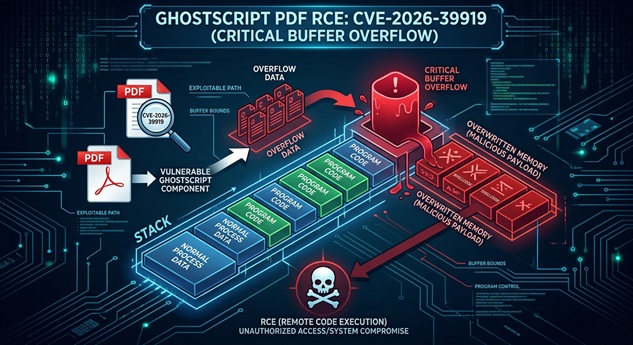
On August 23, 2026, Wordfence researchers using the Argus AI system identified a critical heap buffer overflow in Ghostscript. The flaw exists in the JPEG 2000 image decoder and stems from incorrect handling of low-bit-depth samples together with mismatched component resolutions.
Attackers can craft a malicious PDF file that triggers the overflow. Consequently, Ghostscript writes 1,024 bytes into a 256-byte buffer, corrupting nearby memory. This corruption leads directly to unauthenticated remote code execution on the affected system.
The researchers developed two proof-of-concept exploits. Their tests covered ten Linux environments, including Debian, Ubuntu, Fedora, Alpine, and AlmaLinux. Furthermore, they tested an official WordPress Docker image snapshot. Every tested environment contained the vulnerable code.
Technical Details of the Ghostscript PDF Vulnerability
Ghostscript is a PostScript and PDF interpreter widely used to render PDFs as images, generate thumbnails, and optimize PDF files. When a web application processes a PDF to create a preview or thumbnail, it typically uses the PHP Imagick extension to call ImageMagick, which in turn launches Ghostscript.
The vulnerability arises during JPEG 2000 decoding inside a specially crafted PDF. Incorrect handling of low-bit-depth samples and mismatched component resolutions causes the heap buffer overflow. The researchers demonstrated that modifying the PDF’s fonts, language settings, font configuration, and one core system library could enable successful exploitation.
For WordPress environments specifically, successful exploitation requires four conditions:
- An attacker can upload a PDF, either anonymously or through a low-privileged account.
- The site processes that PDF to generate a preview or thumbnail.
- The processing chain reaches Ghostscript, with the necessary software and policy settings permitting PDF rendering.
- Ghostscript contains the unpatched vulnerable decoding code.
Wordfence emphasized that stock WordPress does not allow anonymous Media Library uploads. However, custom plugins or themes that accept PDF uploads may expose the flaw.
Business and Operational Impact
The Ghostscript PDF RCE flaw carries serious consequences for web hosting providers, content management platforms, and any organization that processes untrusted PDF files.
- Remote code execution: Attackers can run arbitrary commands on the server, leading to full system compromise.
- Data breach risk: Compromised servers can leak customer data, credentials, and proprietary information.
- Service disruption: Exploitation can lead to defacement, cryptomining, or ransomware deployment.
- Supply chain exposure: Docker images and shared hosting environments may propagate the vulnerability to downstream users.
The vulnerability affects Ghostscript versions 9.21 through 10.07.1. Because Ghostscript is embedded in numerous applications and Linux distributions, the attack surface is extensive.
Mitigation and Recommendations
Immediate Actions for Defenders
- Upgrade Ghostscript to version 10.08.0 or later. Artifex released the fix on September 8, 2026, and also backported patches to older versions.
- If you use Docker, rebuild and redeploy containers with an updated, patched base image.
- Contact your hosting provider to confirm that Ghostscript has been upgraded if you do not manage the server directly.
- If upgrading is not immediately possible, block PDF uploads to the server or disable PDF rendering in ImageMagick.
- Audit WordPress plugins and themes that accept PDF uploads. Restrict upload capabilities to authenticated administrators only.
Long-Term Hardening
Organizations should implement defense-in-depth measures to reduce the impact of similar vulnerabilities in the future. Also consider the following steps:
- Run PDF processing in isolated sandboxed environments, not on production web servers.
- Use Web Application Firewalls to block suspicious PDF uploads.
- Monitor logs for unusual PDF processing activity and unexpected Ghostscript executions.
- Keep ImageMagick and Ghostscript policies restrictive, disabling unnecessary formats.
Bottom line: CVE-2026-39919 is a critical, widely exploitable vulnerability in one of the most common PDF rendering engines on the internet. Patch Ghostscript to 10.08.0 immediately. If you cannot patch, disable PDF rendering or block uploads until you can.
Incident Summary
| CVE ID / Incident: | CVE-2026-39919 |
| Affected Systems: | Ghostscript 9.21 through 10.07.1 on Debian, Ubuntu, Fedora, Alpine, AlmaLinux, WordPress Docker images, and any application rendering PDFs via Ghostscript |
| Disclosure Date: | August 23, 2026 (publicly reported October 13, 2026) |
| Patch Status: | Fixed in Ghostscript 10.08.0 (released September 8, 2026); backports available |
| Severity: | Critical (heap buffer overflow leading to unauthenticated RCE) |
| In-the-Wild Exploitation: | No confirmed in-the-wild exploitation as of October 13, 2026 |
References
- Bleeping Computer, “Ghostscript flaw lets hackers hijack servers via PDF uploads,” October 13, 2026, https://www.bleepingcomputer.com/news/security/ghostscript-flaw-lets-hackers-hijack-servers-via-pdf-uploads/, accessed October 14, 2026.
- Wordfence/Defiant, “CVE-2026-39919: Critical Ghostscript Heap Buffer Overflow in JPEG 2000 Decoder,” October 13, 2026, https://www.wordfence.com/blog/, accessed October 14, 2026.
- Artifex Software, Ghostscript Security Advisories, https://ghostscript.com/security-advisories.html, accessed October 14, 2026.