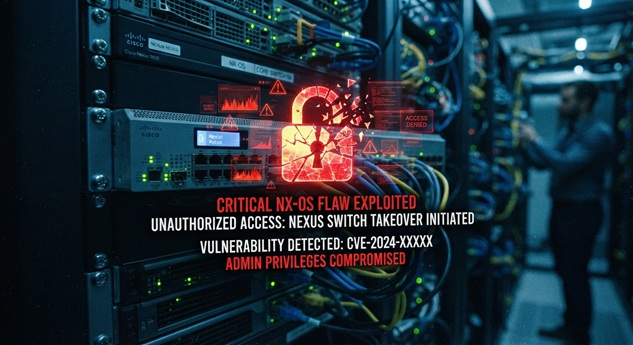
Cisco Critical NX-OS Flaws Enable Nexus Switch Takeover
Cisco disclosed five critical vulnerabilities in its NX-OS data center network operating system on October 7, 2026. These flaws affect Nexus 3000 and Nexus 9000 Series switches and could allow remote attackers to execute arbitrary code with root privileges or trigger denial-of-service conditions. Organizations running affected hardware should assess their exposure and apply patches immediately.
What Happened: Cisco Warns of Critical NX-OS Flaws Enabling Nexus Switch Takeover
On October 7, 2026, Cisco released security advisories for five critical vulnerabilities in NX-OS. The flaws reside in the NX-API, Next Generation OAM (NGOAM), and MPLS OAM features. Each vulnerability stems from insufficient input validation and could lead to remote code execution (RCE) with root privileges.
If an attacker cannot achieve full RCE, they may still crash processes and force the device to reload. This results in a denial-of-service condition that can disrupt data center traffic. All five flaws were discovered during internal security testing. Cisco stated it was not aware of public announcements or malicious exploitation at the time of disclosure.
However, the presence of multiple critical RCE paths in widely deployed data center switches makes this a high-priority patching event. The affected platforms, Nexus 3000 and 9000 Series, are common in enterprise and cloud environments.
Technical Details of the Cisco NX-OS Vulnerabilities
The five vulnerabilities all share a root cause: improper validation of input. However, each requires different features to be active for exploitation. The following table summarizes the key details:
| CVE ID | Attack Vector | Required Feature | Affected Platforms |
| CVE-2026-76471 | Crafted HTTP request to NX-API | NX-API (disabled by default) | Nexus 3000, Nexus 9000 |
| CVE-2026-76485 | Crafted IP packet to interface | NGOAM enabled | Nexus 3000, Nexus 9000 |
| CVE-2026-76486 | Crafted IP packet to interface | NGOAM + SRv6 or NV Overlay | Nexus 9000 (SRv6 subset) |
| CVE-2026-76501 | Crafted IP packet to interface | NGOAM + SRv6 enabled | Nexus 9000 (SRv6 models) |
| CVE-2026-76465 | Crafted MPLS echo-request | MPLS OAM (disabled by default) | Nexus 3000, Nexus 9000 |
Exploitation complexity varies. CVE-2026-76471 targets NX-API, which is disabled by default. CVE-2026-76465 targets MPLS OAM, also disabled by default. The NGOAM trio (CVE-2026-76485, CVE-2026-76486, CVE-2026-76501) is more concerning because NGOAM is more likely to be enabled in production environments for monitoring and diagnostics.
CVE-2026-76486 adds a further requirement: either Segment Routing over IPv6 (SRv6) or Network Virtualization (NV) Overlay must be enabled. NV Overlay requires a VXLAN EVPN VNI mapped to an NVE interface with at least one learned peer VTEP. CVE-2026-76501 is exploitable only when SRv6 is active, and only a subset of Nexus 9000 models support SRv6.
Cisco confirmed that Nexus 7000 Series switches and Nexus 9000 Series Fabric Switches running in ACI mode are not affected.
How to Check Exposure
Administrators can verify feature status using the following NX-OS CLI commands:
show feature | include ngoam— checks if NGOAM is enabledshow feature | include nve— checks if NV Overlay is enabledshow feature | include srv6— checks if SRv6 is enabledshow running-config | begin "interface nve"— verifies NVE configurationshow nve vniandshow nve peers— confirms VXLAN EVPN peer state
Business and Operational Impact
The impact of these flaws extends beyond a single compromised switch. In a data center environment, a root-level takeover of a core switch can open the door to lateral movement, traffic interception, and downstream system compromise.
- Service disruption: A denial-of-service attack against a critical Nexus switch can halt east-west and north-south traffic, affecting applications and users.
- Lateral movement: Root access on a network device provides attackers with visibility into traffic flows, VLANs, and routing tables.
- Supply chain and tenant exposure: In multi-tenant or cloud environments, a compromised switch can expose customer data or disrupt hosted services.
- Compliance risk: Unpatched critical vulnerabilities in network infrastructure can trigger audit findings under frameworks such as PCI-DSS, SOC 2, and NIST CSF.
Organizations with strict change windows may face a difficult choice: patch immediately and risk a brief maintenance window, or delay and accept elevated risk. Cisco’s temporary Live Protect shields offer a middle ground for switches that cannot be rebooted immediately.
Mitigation and Recommendations
Immediate Actions for Defenders
- Inventory affected devices. Identify all Nexus 3000 and 9000 Series switches running standalone NX-OS and check which features are active.
- Apply patched NX-OS releases. Cisco has released fixed software versions. Use the Cisco Software Checker tool to identify the correct upgrade path.
- Disable unneeded features. If NX-API, NGOAM, or MPLS OAM are not required, disable them to eliminate the attack surface.
- Enable Live Protect shields. For switches that cannot be upgraded and rebooted immediately, deploy Cisco’s temporary Live Protect shields as a stopgap.
- Monitor for suspicious activity. Watch for unexpected process crashes, device reloads, or crafted packets targeting NGOAM and MPLS OAM interfaces.
Network Architecture Hardening
Beyond immediate patching, organizations should review their network architecture. Reducing the attack surface of data center switches is an ongoing effort. Consider segmenting management traffic, restricting access to NX-API endpoints, and enforcing least-privilege access for network administrators.
Furthermore, maintain an accurate inventory of enabled features across the fleet. Features enabled for a temporary project and left active become silent attack vectors over time.
Bottom line: These five critical Cisco NX-OS vulnerabilities give attackers a clear path to root-level control of data center switches. Patch now, disable features you do not need, and use Live Protect shields if rebooting is not yet feasible.
Incident Summary
| CVE IDs / Incident: | CVE-2026-76471, CVE-2026-76485, CVE-2026-76486, CVE-2026-76501, CVE-2026-76465 |
| Affected Systems: | Cisco Nexus 3000 Series and Nexus 9000 Series Switches in standalone NX-OS mode with NX-API, NGOAM, or MPLS OAM enabled |
| Disclosure Date: | October 7, 2026 |
| Patch Status: | Fixed NX-OS releases available; Cisco Software Checker tool recommended for version identification |
| Exploitation Status: | No confirmed malicious exploitation at time of disclosure |
References
- Bill Toulas, “Cisco warns of critical flaws allowing Nexus switch takeover,” BleepingComputer, October 8, 2026, https://www.bleepingcomputer.com/news/security/cisco-warns-of-critical-flaws-allowing-nexus-switch-takeover/, accessed October 8, 2026.
- Cisco, “Cisco NX-OS Software Next Generation OAM Remote Code Execution Vulnerabilities,” Cisco Security Advisory, October 7, 2026, https://sec.cloudapps.cisco.com/security/center/content/CiscoSecurityAdvisory/cisco-sa-ngoam-rce-LWKQ4BU, accessed October 8, 2026.
- Cisco, “Cisco NX-OS Software MPLS OAM Remote Code Execution Vulnerability,” Cisco Security Advisory, October 7, 2026, https://sec.cloudapps.cisco.com/security/center/content/CiscoSecurityAdvisory/cisco-sa-moam-rce-uBTzYV7, accessed October 8, 2026.
- Cisco, “Cisco NX-OS Software NX-API Remote Code Execution Vulnerability,” Cisco Security Advisory, October 7, 2026, https://sec.cloudapps.cisco.com/security/center/content/CiscoSecurityAdvisory/cisco-sa-napi-rce-r2shwu2j, accessed October 8, 2026.