Google Domain Certificates Hijacked via ccTLD Registry Breach
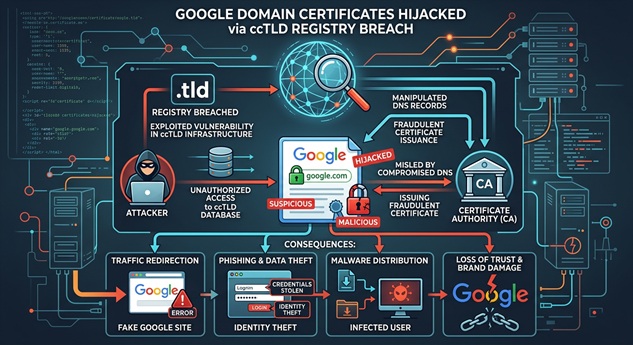
Attackers compromised the country-code top-level domain (ccTLD) registries for Ghana, Sierra Leone, and American Samoa. They used this access to change authoritative DNS records and obtain unauthorized HTTPS certificates for Google and other global brands. The incident did not breach Google’s systems. However, it put any domain under the affected ccTLDs at risk of impersonation and data interception.
What Happened: ccTLD Registry Hijack Targets Google and Global Brands
On October 6, 2026, Google disclosed a series of domain hijacks in the .gh, .sl, and .as ccTLDs. Attackers compromised third-party operators of these registries and modified authoritative DNS records. This allowed them to request and receive valid HTTPS certificates for domains they did not own.
Google confirmed that its own systems were not breached. Certificate Transparency logs revealed at least 12 unauthorized certificates issued between September 22 and September 27, 2026. The certificates covered Google and YouTube domains, including google.com.gh, google.sl, google.as, and matching YouTube names. Let’s Encrypt issued 11 certificates and ZeroSSL issued one.
Google also stated that CT log data pointed to additional impacted organizations. These include several leading global brands and widely used online services. The company did not name them but proactively blocked related certificates in Chrome and notified affected organizations where possible.
Technical Details of the ccTLD Hijack and Certificate Abuse
The attack exploited control of ccTLD registry infrastructure to alter DNS records for targeted domains. By changing authoritative DNS, the attacker could satisfy domain control validation checks used by Certificate Authorities. This allowed issuance of trusted TLS certificates for domains under the hijacked ccTLDs.
Key technical points include:
- Attackers modified DNS records at the registry level, not within victim organizations.
- The certificates were domain-validated, meaning CAs followed standard issuance procedures.
- Google found no evidence that issuing CAs acted improperly.
- The certificates have since been revoked, with revocation dates between September 26 and October 1, 2026.
- Chrome blocked the certificates via CRLSets, an emergency mechanism that quickly distrusts selected certificates.
Furthermore, Google warned that due to the complexity of DNS hijacks, it cannot guarantee that every affected domain was identified. Chrome’s blocks also do not protect users of other browsers or applications.
Business and Operational Impact
The incident poses risks for any organization operating domains under the affected ccTLDs. Attackers with valid TLS certificates can impersonate legitimate sites and intercept encrypted traffic. Potential impacts include:
- Credential theft and session hijacking for users visiting spoofed domains.
- Reputational damage to brands whose domains were impersonated.
- Regulatory scrutiny for organizations failing to monitor certificate issuance.
- Operational burden to audit domain portfolios and deploy protective DNS records.
Moreover, the incident highlights systemic risk in the trust model that ties certificate issuance to DNS control. When registry-level infrastructure is compromised, the standard chain of trust breaks down.
Mitigation and Recommendations
Google urges domain owners to take immediate steps to protect their namespaces. These actions reduce the risk of similar hijacks and limit the window for abuse if DNS control is lost.
Immediate Actions for Defenders
- Monitor Certificate Transparency logs for all domains, including parked and regional ccTLD properties.
- Publish restrictive Certification Authority Authorization records tied to authorized accounts and validation methods.
- Review recent CT log entries for unexpected certificate issuance under .gh, .sl, and .as domains.
- Report unauthorized certificates to the issuing CA through their Certificate Problem Report process.
Long-Term Protective Measures
Organizations should treat CT monitoring as a core security control. In addition, strict CAA records provide a safeguard after DNS control is restored. They prevent attackers from reusing cached domain validation to issue additional certificates. Google also supports industry efforts to reduce certificate validity periods and domain control validation reuse timelines.
Bottom line: Monitor your certificate footprint continuously. A hijacked registry can bypass your perimeter entirely, and browser blocks alone are not enough to protect every user.
Incident Summary
| Incident: | ccTLD Registry Hijack and Unauthorized Certificate Issuance |
| Affected ccTLDs: | .gh (Ghana), .sl (Sierra Leone), .as (American Samoa) |
| Known Targets: | Google, YouTube, and additional undisclosed global brands |
| Unauthorized Certificates: | At least 12 (11 Let’s Encrypt, 1 ZeroSSL) |
| Certificate Dates: | September 22–27, 2026 |
| Disclosure Date: | October 6, 2026 |
| Patch Status: | Certificates revoked; Chrome CRLSets deployed |
| Attribution: | Unknown |
References
- Google Security Blog, “Chrome’s Response to Recent ccTLD Registry Hijacks,” October 6, 2026, https://blog.google/security/chromes-response-to-recent-cctld-registry-hijacks/, accessed October 7, 2026.
- The Hacker News, “Attackers Hijack .gh, .sl, and .as Registries to Obtain Certificates for Google Domains,” October 7, 2026, https://thehackernews.com/2026/10/attackers-hijack-gh-sl-and-as.html, accessed October 7, 2026.
- BleepingComputer, “Hackers hijack Google domains after breaching ccTLD registries,” October 7, 2026, https://www.bleepingcomputer.com/news/security/hackers-hijack-google-domains-after-breaching-cctld-registries/, accessed October 7, 2026.
- Let’s Encrypt Community Forum, “Chrome’s Response to Recent ccTLD Registry Hijacks,” Matthew McPherrin, October 7, 2026, https://community.letsencrypt.org/t/chromes-response-to-recent-cctld-registry-hijacks/251941/2, accessed October 7, 2026.