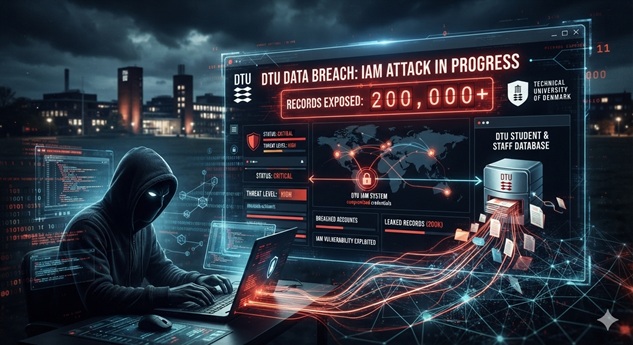
The Technical University of Denmark (DTU) has disclosed a serious cyberattack that may have exposed personal data of up to 200,000 current and former users. Attackers compromised the university’s identity and access management system, DTUBasen, and downloaded a large volume of records dating back more than two decades. Furthermore, the breach includes sensitive Danish civil registration numbers (CPR), home addresses, and next-of-kin details.
What Happened: Cyberattack on DTU Exposes 200,000 User Records
On Friday, October 2, 2026, DTU announced that unauthorized persons had gained access to its DTUBasen identity and access management system. The attackers used compromised credentials to log into the system. Consequently, they were able to download a large amount of personal data spanning more than 20 years.
DTU has approximately 40,000 active users and around 160,000 former users in the system. The potentially exposed population includes current and former employees, students, guests, and external partners. However, the university has stated that it cannot determine precisely what information was downloaded or exactly how many individuals have been affected.
The incident has been reported to the Danish Data Protection Agency (Datatilsynet) and referred to relevant authorities for further investigation. In parallel, DTU is working with external specialists to investigate the full course of events.
Technical Details of the DTU Data Breach
The attack followed a straightforward but effective path. Threat actors compromised multiple DTU user profiles. They then used these stolen credentials to access DTUBasen, the university’s central identity and access management platform.
Once inside, the attackers had broad access to personal records accumulated since 2003. The system contained information on nearly 200,000 individuals. For active users, the exposed data included:
- Danish civil registration number (CPR number)
- Full name and home address
- Profile picture
- Work email address and job title
- Office location and other work-related information
- Name, relationship, and telephone number of next of kin (if registered)
For former users, home addresses, profile pictures, and next-of-kin information are automatically deleted after six months. However, CPR numbers and full names remain in the system. Therefore, even inactive accounts carry exposure risk.
The university has not yet identified who may be responsible for the attack. Moreover, the exact scope of downloaded data remains unknown.
Business and Operational Impact
The DTU breach carries significant consequences for both individuals and the institution itself. The exposed data creates a fertile environment for follow-on attacks and identity fraud.
- Identity fraud risk: CPR numbers are Denmark’s primary personal identifier. They are used for banking, healthcare, and government services. Exposure of CPR numbers alongside names and addresses enables sophisticated identity theft.
- Enhanced phishing credibility: Attackers can use leaked personal details to craft highly convincing phishing emails, text messages, and phone calls.
- Reputational damage: As a leading technical university, DTU’s credibility in research and technology education may suffer.
- Regulatory scrutiny: The breach has been reported to Danish data protection authorities. Potential fines and compliance obligations under GDPR are likely.
- Notification costs: DTU must notify up to 200,000 individuals through Denmark’s official e-Boks digital mail system.
Mitigation and Recommendations
Immediate Actions for Affected Individuals
- Be alert for suspicious emails, text messages, and phone calls. Do not disclose passwords or sensitive information in replies to unexpected communications.
- Change passwords for any other services that use the same credentials as the DTU account.
- Place a credit alert on the affected CPR number through Danish financial institutions.
- Treat sudden authentication requests or login prompts as suspicious.
- Monitor bank accounts and credit reports for unusual activity.
Actions for Organizations Managing Identity Systems
- Implement multi-factor authentication (MFA) on all identity and access management platforms.
- Enforce regular password rotation and prohibit credential reuse across systems.
- Apply the principle of least privilege to limit the blast radius of compromised accounts.
- Conduct regular audits of IAM systems for anomalous access patterns.
- Establish data retention policies that minimize the storage of historical sensitive data.
- Segment IAM systems from general network access where possible.
Bottom line: The DTU breach is a sobering reminder that even technical institutions can fall victim to credential-based attacks. Every organization storing decades of identity data must treat IAM compromise as a top-tier threat and build defenses accordingly.
Incident Summary
| Incident: | Cyberattack on Technical University of Denmark (DTU) |
| Affected Systems: | DTUBasen identity and access management system |
| Disclosure Date: | October 2, 2026 |
| Potentially Affected Users: | Up to 200,000 (40,000 active + 160,000 former) |
| Data Exposed: | CPR numbers, names, addresses, contact details, next-of-kin info, work data |
| Attack Vector: | Compromised credentials used to access IAM system |
| Data Span: | Records dating back to 2003 |
| Patch Status: | Containment complete; investigation ongoing |
References
- BleepingComputer, “Danish university DTU breach exposes data of up to 200,000 people,” October 3, 2026, https://www.bleepingcomputer.com/news/security/danish-university-dtu-breach-exposes-data-of-up-to-200-000-people/, accessed October 3, 2026.
- Technical University of Denmark (DTU), “Cyberattack on DTU: Notification of a personal data breach,” October 2, 2026, https://www.dtu.dk/english/newsarchive/2026/10/cyberattack-on-dtu_notification-of-a-personal-data-breach, accessed October 3, 2026.
- The Copenhagen Post, “DTU data breach may affect personal information of 200,000 current and former users,” October 2, 2026, https://cphpost.dk/2026-10-02/life-in-denmark/dtu-data-breach-may-affect-personal-information-of-200000-current-and-former-users/, accessed October 3, 2026.