September 1, 2026
JFrog has released an emergency patch for a critical authentication bypass vulnerability in Artifactory, tracked as CVE-2026-82329 (CVSS 9.8), that allows unauthenticated remote attackers to obtain full administrative access. Security researchers at watchTowr have already confirmed active exploitation in the wild, with attackers observed minting themselves admin tokens days after the flaw was publicly disclosed on August 28, 2026. Organizations running JFrog Artifactory self-hosted deployments should treat this as a critical priority — compromise of a DevOps artifact repository can poison software supply chains at scale. Patch to version 7.161.20 or later immediately.
What Happened: Critical JFrog Artifactory Authentication Bypass Under Active Attack
JFrog released a critical security patch on August 28, 2026, addressing CVE-2026-82329, a severe authentication bypass in its Artifactory binary repository platform. The flaw carries a CVSS score of 9.8 out of 10, placing it at the top of the critical severity range. Within days of disclosure, threat intelligence firm watchTowr reported that attackers were actively exploiting the vulnerability in real-world attacks, minting themselves administrative tokens on compromised instances. The speed of exploitation after public disclosure underscores how attractive Artifactory targets are to adversaries — a compromised repository can serve as a single point of failure across an entire organization’s software delivery pipeline.
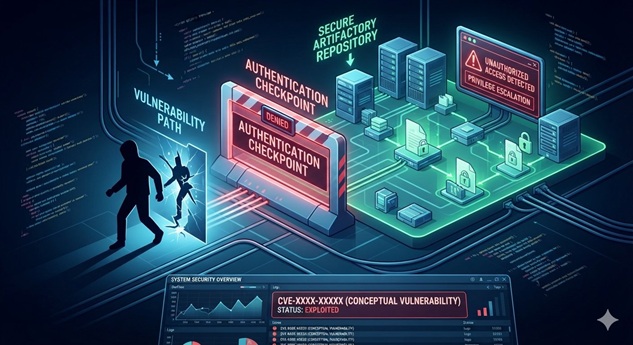
The vulnerability resides in JFrog Access, the internal component responsible for issuing and validating credentials across Artifactory deployments. Under default configurations, instances that do not have an additional join key explicitly set receive what researchers describe as a “phantom” join key. Attackers can abuse this phantom key to forge access tokens and escalate privileges to administrator level without any valid credentials. The attack requires only network access to the Artifactory instance — no authentication, user interaction, or special privileges are needed. Vercel CEO Guillermo Rauch called it “an RCE bomb” on LinkedIn, noting that since Artifactory hosts binary artifacts, compromise allows adversaries to poison everything downstream while admin-level access compounds the damage far beyond the initial foothold.
Technical Details of the CVE-2026-82329 Vulnerability
The root cause of CVE-2026-82329 is an authentication weakness in JFrog Access that affects Artifactory’s default configuration. When an Artifactory deployment is initially provisioned without an explicit additional join key, the system generates and assigns a phantom join key that is derivable or guessable under certain conditions. This phantom key allows an unauthenticated remote attacker to submit forged credential requests to the JFrog Access token issuance endpoint. The system accepts these requests and returns signed, administrator-level access tokens that grant full control over the Artifactory instance.
The vulnerability affects the following self-hosted Artifactory versions:
- 7.161.0 through 7.161.19 (patched in 7.161.20)
- 7.146.0 through 7.146.36 (patched in later 7.146.x release)
- 7.133.0 through 7.133.28 (patched in later 7.133.x release)
- 7.125.0 through 7.125.19 (patched in later 7.125.x release)
- 7.117.0 through 7.117.27 (patched in later 7.117.x release)
- 7.111.4 through 7.111.21 (patched in later 7.111.x release)
JFrog released version 7.161.20 on August 28, 2026, which patches the flaw for the 7.161.x line. Patches for older version branches are included in subsequent minor releases within each branch. Organizations should consult the official JFrog security advisories page for the exact patched version corresponding to their deployment branch. No workarounds are available that do not involve upgrading or explicitly configuring an additional join key — and even with a join key present, upgrading is the recommended path given the severity.
Business and Operational Impact
The impact of a successful CVE-2026-82329 exploit extends far beyond initial server compromise. Artifactory serves as the central artifact repository for DevOps teams, storing binary artifacts, Docker images, npm packages, Maven libraries, Helm charts, and other software components that flow directly into production builds and deployments. An attacker with administrative access to Artifactory can:
- Supply chain poisoning: Replace legitimate binary artifacts with malicious versions, distributing malware to every system that pulls those artifacts — including production environments.
- Build pipeline compromise: Modify build configurations, access credentials stored within Artifactory, and inject payloads into CI/CD workflows that trust artifacts from the repository.
- Credential and secret theft: Access stored credentials, API keys, and secrets used for artifact publishing and deployment, enabling lateral movement into CI/CD infrastructure and cloud environments.
- Data exfiltration: Download proprietary source code, intellectual property, and sensitive artifacts stored in private repositories.
Given the speed with which watchTowr confirmed exploitation, organizations should assume that any unpatched, internet-exposed Artifactory instance may already be compromised and conduct forensic analysis accordingly. The CISA KEV catalog has not yet listed CVE-2026-82329 at time of publication, but the active exploitation status makes it a likely candidate for future addition under BOD 22-01 requirements.
Mitigation and Recommendations
Immediate Actions for Defenders
- Patch immediately: Upgrade JFrog Artifactory to version 7.161.20 or later for the 7.161.x line. For older branches, apply the latest patched version in your respective branch as listed in the JFrog security advisories.
- Audit internet-exposed instances: Check firewall rules and cloud security groups to confirm Artifactory admin interfaces are not directly accessible from the internet. Restrict access to known IP ranges via VPN, jump host, or zero-trust network access.
- Review admin accounts and access tokens: Audit the Artifactory user management panel for any unexpected administrative accounts, newly created tokens, or sessions from unfamiliar IP addresses. Revoke any suspicious tokens immediately.
- Enable and verify join key configuration: Ensure an additional join key is properly configured per JFrog’s hardening documentation. While patching is the primary fix, proper join key hygiene adds defense in depth.
- Rotate credentials: After patching, rotate all Artifactory credentials, deploy tokens, and API keys used for artifact publishing and consumption to limit the impact of any credentials that may have been exfiltrated pre-patch.
Monitoring and Detection
Security teams should review Artifactory logs for anomalous token issuance events, particularly from IPs outside expected ranges. Watch for unexpected administrator role assignments, unusual artifact overwrite operations, and outbound connections from Artifactory servers to unknown external IPs. Consider deploying a custom watchTowr or community-authored YARA rule if your SIEM supports artifact scanning. Organizations with watchTowr’s platform can request a dedicated exposure assessment to determine whether their Artifactory instances were accessed prior to patching.
Bottom line: CVE-2026-82329 is a critical, actively exploited flaw that demands immediate patching. Treat any unpatched Artifactory instance as potentially compromised. The attack surface is broad because Artifactory sits at the heart of software delivery — a successful exploit gives attackers a foothold not just on the repository, but potentially across every system that consumes artifacts from it. Patch now, audit access logs, and rotate credentials as a precautionary measure.
Incident Summary
| CVE ID / Incident: | CVE-2026-82329 — JFrog Artifactory Authentication Bypass |
| Affected Systems: | JFrog Artifactory self-hosted: 7.161.0–7.161.19, 7.146.0–7.146.36, 7.133.0–7.133.28, 7.125.0–7.125.19, 7.117.0–7.117.27, 7.111.4–7.111.21 |
| Disclosure Date: | August 28, 2026 (patch release); active exploitation confirmed September 1, 2026 |
| Patch Status: | Version 7.161.20 patched for 7.161.x line; patches for older branches in subsequent minor releases |
References
- The Hacker News, “Attackers Exploit Critical JFrog Artifactory Flaw to Mint Admin Tokens Days After Disclosure,” September 1, 2026, https://thehackernews.com/2026/09/attackers-exploit-critical-jfrog.html, accessed September 1, 2026.
- CVE.org, “CVE-2026-82329 — Potential Authentication Bypass Leading to Administrative Access in Artifactory,” https://www.cve.org/CVERecord?id=CVE-2026-82329, accessed September 1, 2026.
- JFrog Security Advisories, “JFrog Security Advisories and CVE Information,” updated August 28, 2026, https://docs.jfrog.com/releases/docs/jfrog-security-advisories, accessed September 1, 2026.
- watchTowr (@watchtowrcyber), X (Twitter) post, September 1, 2026, https://x.com/watchtowrcyber/status/2094639075726668267, accessed September 1, 2026.
- Guillermo Rauch (@rauchg), LinkedIn post, August 2026, LinkedIn post, accessed September 1, 2026.