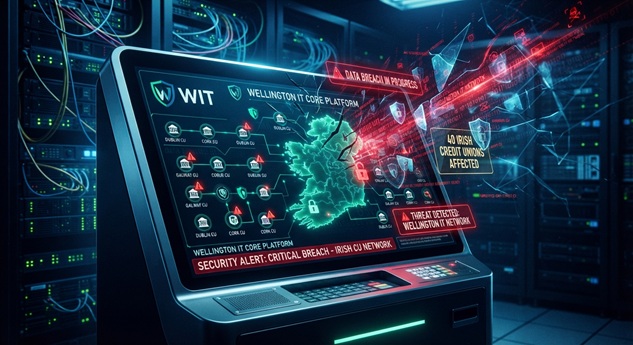
A cyberattack on Belfast-based IT provider Wellington IT has exposed sensitive payee records belonging to members of approximately 40 Irish credit unions. The breach, which occurred between October 2 and 4, 2026, exploited an authorization flaw through five million automated requests. Irish officials have called the delay in notifying affected organizations unacceptable.
What Happened: Wellington IT Breach Hits 40 Irish Credit Unions
Wellington IT supplies online banking and IT services to about 50 credit unions, including 43 in Ireland. Between October 2 and 4, 2026, an attacker used an automated script to exploit an authorization weakness in Wellington IT’s infrastructure. The script made roughly five million requests and ultimately allowed the attacker to access private payee records using valid credentials.
The company reportedly notified affected credit unions of a data breach that created risks of financial fraud, impersonation, and targeted phishing. However, Minister of State Robert Troy told RTÉ that the notification delay was not acceptable
. At least six credit unions have since published independent disclosures, including Capital Credit Union, Phoenix Credit Union, St. Canice’s Credit Union, First South Credit Union, Malahide Credit Union, and Limerick & District Credit Union.
On November 19, 2026, Wellington IT CEO Colin Mitchell issued a public statement confirming the incident and noting that the firm engaged external cybersecurity experts and is cooperating with the Data Protection Commissioner, Ireland’s National Cyber Security Centre, and the Garda National Cyber Crime Bureau.
Technical Details of the Wellington IT Attack
The breach targeted Wellington IT’s CU Online platform, which credit union members use to manage payees and initiate transfers. According to notices seen by the Irish Examiner, the attacker used an automated script to bombard the platform with approximately five million requests aimed at exploiting an authorization flaw.
The attacker accessed records using valid credentials. Consequently, Wellington IT has stated it cannot pinpoint exactly which member data was compromised because it lacks granular activity logs. This gap in logging creates uncertainty for every affected credit union and its members.
The following types of payee information were potentially exposed:
- Payee name or the name associated with the payee’s bank account
- Nickname the member assigned to the payee
- International Bank Account Number (IBAN)
- Bank Identifier Code (BIC)
- Bank account number
- Bank sort code
- Payee address information
- Payment reference information entered for the saved payee
Furthermore, the exposed records could reveal which specific credit union member saved a given payee. This linkage enables more precise social engineering and targeted phishing.
Account passwords, PINs, payment card details, and online banking credentials were reportedly not affected. Nevertheless, the exposed payee data is sufficient to craft convincing fraud and phishing campaigns.
Business and Operational Impact
The compromise of a third-party financial services provider carries consequences far beyond the single vendor. Credit unions rely on trust, and a breach at their IT provider undermines that relationship.
- Financial fraud risk: Exposed IBANs, account numbers, and sort codes can be used in authorized push payment fraud and other schemes
- Targeted phishing: Attackers now know which payees members use, enabling hyper-personalized phishing lures
- Impersonation attacks: Detailed payee data allows attackers to pose as legitimate recipients in social engineering calls
- Regulatory scrutiny: Irish regulators and law enforcement are now involved, increasing compliance pressure
- Reputational damage: Individual credit unions must reassure members while managing limited information from Wellington IT
- Notification costs: Multiple credit unions must independently notify members and provide support, multiplying response costs
The total number of impacted individuals remains unknown. Moreover, because Wellington IT cannot verify exactly whose data was accessed, every member of the affected credit unions should assume their payee records are at risk.
Mitigation and Recommendations
While the attack itself is in the past, the window for downstream fraud is still open. Attackers often sit on stolen data before using it. Consequently, immediate action is essential for both credit unions and their members.
Immediate Actions for Credit Unions
- Review all payee records for anomalies or unauthorized changes since early October
- Enhance transaction monitoring for unusual patterns involving previously saved payees
- Issue clear, direct member communications about the breach and phishing risks
- Verify that Wellington IT has implemented stronger authorization controls and logging
- Engage with regulators and law enforcement to demonstrate proactive response
Immediate Actions for Members
- Review saved payees in online banking and verify every entry
- Be suspicious of any unsolicited communication referencing known payees
- Do not click links in unexpected emails or texts about credit union services
- Report any suspected fraud to the credit union immediately
- Consider enabling additional account alerts for transfers and payee changes
Third-Party Risk Management
This incident is a textbook example of third-party risk in financial services. Organizations should audit their critical vendors’ logging practices, authorization controls, and incident notification timelines. Furthermore, contractual language should require rapid breach disclosure and clear liability frameworks.
Bottom line: The Wellington IT breach shows how a single IT provider’s weak authorization and logging gap can cascade into a multi-institution data exposure. Every member of the affected credit unions should treat their payee data as compromised and stay alert for targeted fraud attempts.
Incident Summary
| Incident: | Wellington IT data breach affecting Irish credit unions |
| Affected Organizations: | Approximately 40 Irish credit unions (43 served by Wellington IT total) |
| Attack Window: | October 2–4, 2026 |
| Disclosure Date: | November 18, 2026 (public confirmation) |
| Attack Vector: | Automated script exploiting an authorization flaw via ~5 million requests |
| Exposed Data: | Payee names, IBANs, BICs, account numbers, sort codes, addresses, payment references |
| Not Affected: | Account passwords, PINs, payment card details, online banking credentials |
| Regulators Involved: | Data Protection Commissioner (DPC), NCSC, GNCCB |
References
- Bill Toulas, “Data breach impacts 40 Irish credit unions in reported IT provider hack,” BleepingComputer, November 18, 2026. https://www.bleepingcomputer.com/news/security/data-breach-impacts-40-irish-credit-unions-in-reported-it-provider-hack/ (accessed November 19, 2026).
- RTÉ News, “Credit union data breach being assessed, says Minister Troy,” November 18, 2026. https://www.rte.ie/news/2026/1118/1599645-credit-union-data-breach-assessed/ (accessed November 19, 2026).
- Irish Government, Department of Finance, “Tánaiste and Minister Troy comment on suspected cybersecurity incident involving credit unions,” November 2026. http://www.gov.ie/en/department-of-finance/press-releases/tánaiste-and-minister-troy-comment-on-suspected-cybersecurity-incident-involving-credit-unions/ (accessed November 19, 2026).
- Irish Examiner, “Wellington IT credit union data breach,” November 2026. https://www.irishexaminer.com/news/arid-41938989.html (accessed November 19, 2026).
- Capital Credit Union, “Important information for members: cybersecurity incident,” November 2026. https://capitalcu.ie/important-information-for-members-cybersecurity-incident/ (accessed November 19, 2026).