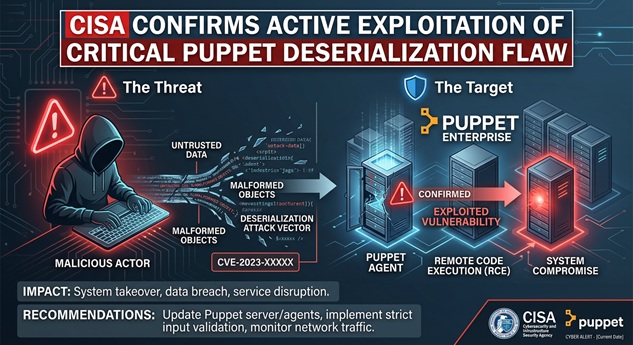
CISA Confirms Active Exploitation of Critical Puppet Deserialization Flaw
CISA added CVE-2026-115731 to its Known Exploited Vulnerabilities catalog on November 17, 2026, confirming active exploitation of a critical deserialization flaw in Perforce Puppet Enterprise. The vulnerability carries a CVSS 4.0 score of 9.4 and lets an attacker with a Puppet CA-signed certificate run arbitrary code on the Puppet Server. Federal agencies must patch by December 1, 2026.
What Happened: Puppet Enterprise Deserialization Flaw Hits CISA KEV
Perforce disclosed CVE-2026-115731 on November 3, 2026. The flaw sits in Puppet Server’s report-processing code. A client with any certificate signed by the Puppet Certificate Authority can submit a crafted report via an HTTP PUT request. The server deserializes the report without proper validation. This triggers remote code execution with the privileges of the Puppet service account.
The impact is severe because Puppet is a central infrastructure-as-code platform. It manages software and settings across entire server fleets. An attacker who compromises the Puppet Server can push changes to every managed system during the next Puppet run. Furthermore, an attacker with remote code execution can extract the Puppet CA signing keys. These keys then let the attacker impersonate other hosts on the network.
Technical Details of the CVE-2026-115731 Vulnerability
The root cause is unsafe deserialization of untrusted data. When Puppet Server receives an agent report, it rebuilds structured data from the report payload. The code does not safely check what the payload contains before executing it. This lets a malicious client embed executable code inside a crafted rich-data type.
The attack requires a valid Puppet CA-signed agent certificate. However, the certificate requirement offers less protection when the CA automatically signs requests without strong verification. In that configuration, an unauthenticated attacker with network access can obtain a trusted certificate and then exploit the vulnerability.
Neodyme AG security researcher Alain Rödel discovered and reported CVE-2026-115731 with artificial intelligence assistance. Neodyme published its findings in November 2026. The researcher also disclosed CVE-2026-115732, a related certificate-name authorization bypass with a CVSS score of 9.0.
Perforce stated it is not aware of specific attacks exploiting the flaw. However, a Reddit user reported tracing an intrusion involving CVE-2026-115731 on November 4, 2026, shortly after public disclosure. CISA’s addition of the flaw to the KEV catalog confirms evidence of active exploitation exists.
Affected Versions
- Puppet Enterprise 2026.0.0 before 2026.0.1
- Puppet Enterprise 2025.0.0 before 2025.12.1
- Puppet Enterprise 2023.8.0 before 2023.8.13
- Puppet Core 9.0.0 before 9.1.3
- Puppet Core 8.x before 8.22.2
The flaw also affects OpenVox, the open-source implementation of Puppet. OpenVox patched the issue in Agent 9.3.0 and 8.32.0, and Server 9.2.0 and 8.18.0.
Business and Operational Impact
The vulnerability poses risks to organizations that rely on Puppet for infrastructure management. A successful exploit can have cascading consequences across the entire managed environment.
- Central control compromise: Puppet Server is a sensitive point in the network. Changes made there reach every managed system automatically.
- Lateral movement: Attackers can use the compromised server to pivot to other parts of the network.
- Ransomware deployment: A threat actor with Puppet Server access can push malicious configurations to the entire fleet simultaneously.
- Data exfiltration: Mass extraction of sensitive data from managed systems becomes possible.
- Certificate authority theft: Stolen CA signing keys enable persistent impersonation of legitimate hosts.
Federal Civilian Executive Branch agencies face a December 1, 2026 deadline under Binding Operational Directive 26-04. Private organizations should treat this with similar urgency because the confirmed exploitation raises the threat level beyond a theoretical patch.
Mitigation and Recommendations
Organizations running affected Puppet versions should act immediately. Perforce released patches on November 3, 2026.
Immediate Actions for Defenders
- Upgrade Puppet: Install Puppet Enterprise 2026.0.1, 2025.12.1, or 2023.8.13. For Puppet Core, upgrade to 9.1.3 or 8.22.2.
- Disable automatic certificate signing: Do not allow the CA to auto-sign requests without strong verification.
- Restrict network access: Limit access to Puppet’s report service to trusted networks only.
- Review certificate records: Check for unexpected enrollments or unauthorized certificates in the Puppet CA.
- Monitor host logs: Look for unusual processes started by the Puppet Server service account.
Investigation Guidance
If the Puppet Server shows signs of compromise, investigate whether the signing key was accessed. Also check whether managed configurations were changed. Installing the patch closes the vulnerability. However, it does not undo changes an attacker may already have made. Therefore, a full compromise assessment is advisable for high-risk environments.
Bottom line: CVE-2026-115731 is a critical deserialization flaw in Puppet Enterprise that CISA has confirmed is under active exploitation. Organizations should patch immediately, disable automatic certificate signing, and audit their Puppet infrastructure for signs of unauthorized access.
Incident Summary
| CVE ID / Incident: | CVE-2026-115731 — Perforce Puppet Enterprise Deserialization of Untrusted Data |
| Affected Systems: | Puppet Enterprise 2023.8.x, 2025.x, 2026.0.0; Puppet Core 8.x, 9.0.0; OpenVox |
| Severity: | Critical — CVSS 4.0 score 9.4 |
| Disclosure Date: | November 3, 2026 |
| CISA KEV Addition: | November 17, 2026 |
| Federal Patch Deadline: | December 1, 2026 |
| Patch Status: | Available — Puppet Enterprise 2026.0.1, 2025.12.1, 2023.8.13; Puppet Core 9.1.3, 8.22.2 |
References
- CISA, “CISA Adds One Known Exploited Vulnerability to Catalog,” November 17, 2026, https://www.cisa.gov/news-events/alerts/2026/11/17/cisa-adds-one-known-exploited-vulnerability-catalog, accessed November 19, 2026.
- The Hacker News, “Hackers Exploiting Critical Puppet RCE Flaw Affecting Enterprise Management Servers,” November 2026, https://thehackernews.com/2026/11/hackers-exploiting-critical-puppet-rce.html, accessed November 19, 2026.
- Security Affairs, “U.S. CISA adds Perforce Puppet Enterprise flaw to its Known Exploited Vulnerabilities catalog,” November 18, 2026, https://securityaffairs.com/203377/hacking/u-s-cisa-adds-perforce-puppet-enterprise-flaw-to-its-known-exploited-vulnerabilities-catalog.html, accessed November 19, 2026.
- Cyber Security News, “CISA Warns of Puppet Enterprise Vulnerability Actively Exploited in Attacks,” November 2026, https://cybersecuritynews.com/puppet-enterprise-flaw-actively-exploited/, accessed November 19, 2026.
- Neodyme AG, “Puppet RCE — CVE-2026-115731,” November 2026, https://neodyme.io/en/blog/puppet_rce/, accessed November 19, 2026.