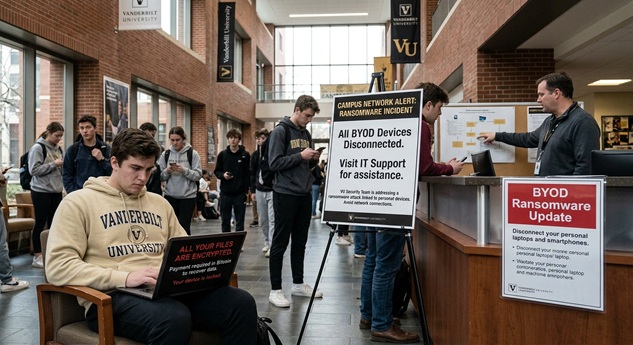
BYOD Ransomware Gang Encrypts Vanderbilt University
Vanderbilt University confirmed an active cybersecurity incident on Monday after the BYOD ransomware gang claimed responsibility for encrypting databases and stealing sensitive student, employee, and research data. The attackers allege they obtained more than one million Social Security numbers along with full names, email addresses, phone numbers, and work addresses.
What Happened: BYOD Ransomware Gang Hits Vanderbilt University
On November 9, 2026, Vanderbilt University issued a public statement warning that university devices, systems, and cloud-based services may be affected by an active cybersecurity incident. The university’s IT team immediately began investigating and working to contain the threat.
Shortly after the university’s announcement, the BYOD ransomware group claimed responsibility on its data leak site. The gang alleges it encrypted Vanderbilt’s databases and exfiltrated sensitive information belonging to students and employees. Furthermore, the attackers claim they achieved full takeover of the university’s data center.
The BYOD ransomware gang is a relatively new threat actor that emerged in 2026. Consequently, this attack represents one of its highest-profile targets to date. Last month, the same group claimed responsibility for an attack on the University of New Mexico Health Sciences Center that disrupted patient care and academic activities.
Technical Details of the BYOD Ransomware Attack
According to the attackers’ claims and evidence reviewed by BleepingComputer, the incident involved both data encryption and data exfiltration. The gang published a ransom note named “README_BYOD_31.txt” that was photographed on an affected Vanderbilt system.
The ransom note includes a link to the BYOD data leak site and contact information for the SESSION encrypted messaging platform. In addition, the note threatens to release stolen data and cause further disruption if the university does not negotiate.
Moreover, a video shared with BleepingComputer shows infected devices playing audio warnings that the network has been compromised by “BYOD.” The attackers claim they archived every Social Security number, full name, email address, phone number, work address, role, and birthday on the network.
Indicators of Compromise
- Ransom note filename:
README_BYOD_31.txt - Reference to “BYOD” branding in audio warnings and ransom notes
- Use of SESSION encrypted messaging platform for negotiations
- BYOD data leak site claims responsibility for the attack
Attack Vector (Unconfirmed)
Vanderbilt has not publicly disclosed the initial access vector. However, the BYOD gang’s previous attacks and typical ransomware tactics suggest possible entry points may include:
- Phishing emails targeting university staff or students
- Exploitation of unpatched vulnerabilities in public-facing services
- Compromised credentials through brute force or credential stuffing
- Supply chain compromise through third-party vendors
Business and Operational Impact
The Vanderbilt ransomware attack carries significant consequences for the university community and broader higher education sector:
- Student and employee data exposure: Over one million Social Security numbers, along with full names, email addresses, phone numbers, work addresses, roles, and birthdays allegedly stolen.
- Research data compromise: The attackers claim possession of Vanderbilt’s research data, which could include unpublished findings, intellectual property, and sensitive grant information.
- Data center takeover: BYOD claims full takeover of Vanderbilt’s data center, suggesting deep network penetration and potential for further damage.
- Operational disruption: University devices, systems, and cloud-based services may remain affected while IT teams investigate and remediate.
- Reputational damage: Higher education institutions face long-term reputational harm following high-profile ransomware incidents.
- Regulatory and compliance risk: Exposure of personally identifiable information may trigger breach notification requirements under state and federal laws.
Mitigation and Recommendations
Immediate Actions for Defenders
- Isolate affected systems: Shut down compromised devices and disconnect from networks to prevent further spread.
- Engage incident response: Contact law enforcement and engage external incident response specialists with ransomware expertise.
- Preserve evidence: Capture logs, ransom notes, and forensic images before remediation to support investigation.
- Notify affected individuals: Prepare breach notifications for students, employees, and any third parties whose data was exposed.
- Do not pay ransom: Paying ransomware demands does not guarantee data recovery and may violate sanctions regulations.
Long-Term Hardening for Higher Education
Universities remain prime targets for ransomware groups due to their large attack surfaces and valuable research data. Therefore, institutions should strengthen defenses through network segmentation, multi-factor authentication on all administrative systems, regular offline backups, and continuous vulnerability management.
Bottom line: The BYOD ransomware attack on Vanderbilt University demonstrates that higher education remains a top target for cybercriminals. Organizations should prioritize network segmentation, offline backups, and incident response readiness.
Incident Summary
| Incident: | Vanderbilt University BYOD Ransomware Attack |
| Threat Actor: | BYOD Ransomware Gang |
| Date Disclosed: | November 9, 2026 |
| Affected Systems: | Vanderbilt University databases, data center, cloud-based services, student and employee records |
| Data Allegedly Stolen: | Over 1 million SSNs, full names, email addresses, phone numbers, work addresses, roles, birthdays, research data |
| Attack Type: | Ransomware (encryption + data exfiltration) |
| Patch Status: | N/A (post-breach response in progress) |
| Ransom Note: | README_BYOD_31.txt |
References
- BleepingComputer, “Vanderbilt University hit in BYOD ransomware attack, data theft claimed,” November 9, 2026, https://www.bleepingcomputer.com/news/security/vanderbilt-university-hit-in-byod-ransomware-attack-data-theft-claimed/, accessed November 10, 2026.
- Vanderbilt University, Statement on X, November 9, 2026, https://x.com/VanderbiltU/status/2119839382869864769, accessed November 10, 2026.
- BleepingComputer, “UNM Health ransomware attack disrupts patient care, surgeries,” October 2026, https://www.bleepingcomputer.com/news/security/unm-health-ransomware-attack-disrupts-patient-care-surgeries/, accessed November 10, 2026.