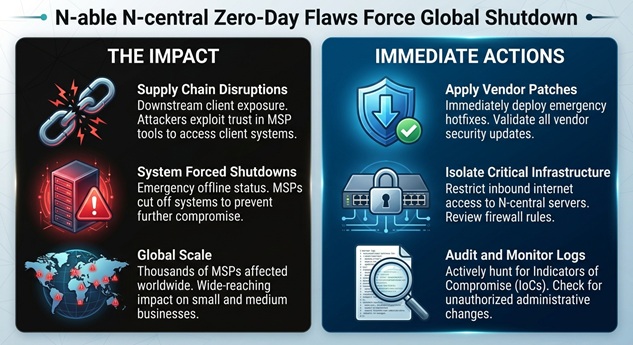
N-able has taken its hosted N-central environments offline worldwide after a security researcher disclosed more than 30 alleged zero-day vulnerabilities in the remote monitoring and management platform. Furthermore, the most severe exploit chain allows unauthenticated attackers to gain administrator access and execute remote commands on affected servers.
What Happened: Researcher Discloses 30+ N-able N-central Zero-Day Vulnerabilities
Security researcher Sean Bales disclosed the vulnerabilities late Sunday, November 8, 2026. Consequently, he published a GitHub repository called Able2Shell containing proof-of-concept exploits for the flaws.
N-central is a remote monitoring and management platform used by managed service providers and IT teams to monitor, manage, and secure customer devices and networks remotely. Therefore, any compromise of this platform could cascade to thousands of downstream endpoints.
In response, N-able announced a critical security incident and took its hosted N-central environments offline across the Americas, Europe, and Asia-Pacific regions on November 9. Moreover, the company urged on-premises customers to shut down their servers until a hotfix is available.
Technical Details of the N-central Zero-Day Flaws
The disclosed vulnerabilities were tested against N-central Appliance 2026.4.0.31. However, Bales believes most, if not all, flaws also affect earlier versions.
The vulnerabilities include:
- Authentication bypasses
- Credential disclosure
- Arbitrary file writes
- Directory traversal
- Cross-site scripting
- XML external entity injection
- Remote code execution
Most Critical Exploit Chain: XXE to Administrator Account Creation
The most severe exploit chain abuses an unauthenticated XXE vulnerability in N-central’s service-import functionality. For example, the attacker can steal a trusted local session, reset an account password, and execute commands on the server as the nable user.
Moreover, the same exploit can create an enabled Default Administrator account with attacker-controlled credentials. Consequently, this provides rogue administrative access to the N-central management interface.
Additional High-Severity Exploits
Other disclosed exploits include a stored XSS that can execute commands as root when an administrator views malicious patch metadata. In addition, a privilege-escalation flaw allows code running under the nable account to execute commands as root.
Bales confirmed to BleepingComputer that the unauthenticated XXE-to-RCE exploit was the most critical of the disclosed vulnerabilities.
Business and Operational Impact
The disclosure has caused widespread disruption across the managed services ecosystem. N-able’s hosted N-central environments are offline globally, and on-premises customers have been advised to shut down their servers.
- Global service outage: Hosted N-central environments across all regions are unavailable
- Managed service provider disruption: MSPs relying on N-central cannot monitor or manage customer endpoints
- On-premises customer downtime: Customers running on-premises instances must keep servers offline pending a hotfix
- Cascading supply chain risk: Compromised RMM platforms can be used to deploy malware to all managed endpoints
- Reputational damage: N-able’s incident response and disclosure handling are under scrutiny
Mitigation and Recommendations
N-able is actively developing and validating a hotfix. However, until a patch is available, administrators should take immediate action.
Immediate Actions for Defenders
- Take on-premises N-central servers offline until N-able releases an official hotfix
- Monitor N-able’s status page at uptime.n-able.com for updates every four hours
- Review managed endpoints for signs of unauthorized access or configuration changes
- Rotate credentials for any services accessible from N-central management networks
- Enable enhanced logging on all downstream endpoints managed through N-central
Post-Recovery Actions
Once N-central services are restored, organizations should conduct a thorough security review. Moreover, they should verify that no unauthorized administrator accounts were created during the exposure window.
Bottom line: The N-able N-central zero-day disclosure represents a severe supply chain risk for the managed services industry. Organizations using N-central should take their instances offline immediately, monitor for updates, and prepare for a comprehensive post-incident review once a hotfix is released.
Incident Summary
| CVE ID / Incident: | N-able N-central 30+ zero-day vulnerabilities (Able2Shell disclosure) |
| Affected Systems: | N-central RMM platform (hosted and on-premises) |
| Disclosure Date: | November 8, 2026 |
| Patch Status: | Hotfix under development; no ETA available |
| Exploitation Status: | No active exploitation observed as of November 9, 2026 |
References
- Bill Toulas, BleepingComputer, “N-able takes cloud platform offline after 30+ zero-days published,” November 9, 2026, https://www.bleepingcomputer.com/news/security/n-able-takes-cloud-platform-offline-after-30-plus-zero-days-published/.
- Sean Bales, GitHub, “Able2Shell — N-able N-central 0-Day Exploits,” November 8, 2026, https://github.com/Oracle-Security/CVEs/tree/main/0-Days/N-Central%20N-Able.
- N-able, “N-able Critical Security Incident Status Page,” accessed November 9, 2026, https://uptime.n-able.com/.