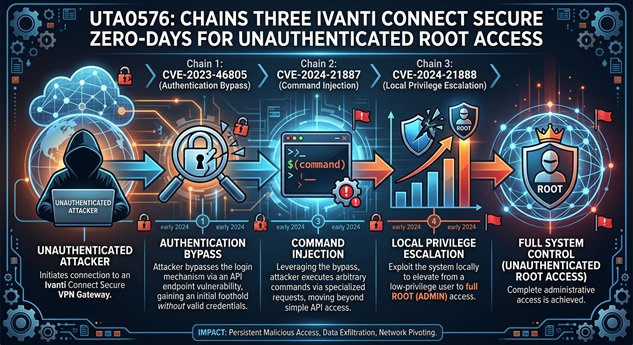
CISA has added two actively exploited Ivanti Connect Secure flaws to its Known Exploited Vulnerabilities catalog, intensifying pressure on federal agencies to patch before November 2. Threat actor UTA0576 chained three zero-day vulnerabilities to gain unauthenticated root access, steal Active Directory credentials, and erase forensic traces from fully patched VPN appliances.
What Happened: UTA0576 Chains Three Ivanti Connect Secure Zero-Days for Root Access
In early October 2026, Volexity discovered an unknown threat actor, tracked as UTA0576, exploiting a chain of zero-day vulnerabilities against fully patched Ivanti Connect Secure VPN appliances. The attack did not rely on malware or backdoors. Instead, UTA0576 abused authentication bypass, remote code execution, and privilege escalation flaws to execute commands as root and return results through HTTPS requests.
On October 30, 2026, CISA added CVE-2026-111357 and CVE-2026-118527 to its KEV catalog. Consequently, federal agencies must remediate CVE-2026-111357 by November 2, 2026, and CVE-2026-118527 by November 13, 2026. Moreover, CISA urges all organizations to adopt risk-based patching for these vulnerabilities.
Technical Details of the Ivanti Connect Secure Exploit Chain
The attack chain combined three distinct vulnerabilities to achieve unauthenticated root-level code execution:
- CVE-2026-104935 (CVSS 8.6) — An authentication bypass and remote code execution vulnerability. UTA0576 sent requests to
/dana-na/auth/url_default/welcome.cgiwith a craftedX-DSCGI-PATHheader pointing towu.cgi. This routed unauthenticated requests to an internal CGI handler. The attacker uploaded a Perl script disguised as a ZIP file, which the handler wrote to disk before validation. Furthermore, parallel execution requests exploited a race condition to run the script before deletion. - CVE-2026-111357 (CVSS 8.8) — A missing authentication for critical function vulnerability. After gaining code execution as the
cgi-serveruser, UTA0576 abused thedsinvokedservice to escalate privileges. The service normally runs maintenance tasks as root using commands stored in DSCache. UTA0576 patched the in-memory librarylibdsplibs.soto modify DSCache and redirect a maintenance task to the Perl interpreter, achieving root execution. - CVE-2026-118527 (CVSS 4.3) — A generation of predictable numbers or identifiers vulnerability. This allowed a remote authenticated attacker to upload files with attacker-controlled content to known disk locations.
Volexity did not observe first-stage malware or web shells on compromised devices. For each command, UTA0576 re-exploited the full chain and returned output via the HTTP response.
Business and Operational Impact
The Ivanti Connect Secure exploit chain poses severe risks to enterprise networks. The following impacts are most critical:
- Credential Theft: UTA0576 extracted domain credentials, LAPS passwords, and BitLocker recovery keys from Active Directory.
- Data Exfiltration: The threat actor dumped limited Active Directory metadata and exfiltrated results via compressed, encoded JSON files.
- Network Reconnaissance: Attackers conducted host reconnaissance, captured LDAP traffic, and performed password-spraying campaigns.
- Anti-Forensics: UTA0576 deleted entries from Ivanti debug logs and Linux audit logs, and restored in-memory patches to evade detection.
- VPN Gateway Compromise: Because the VPN appliance sits at the network edge, attackers can move laterally into internal infrastructure.
In addition, Ivanti’s Integrity Checker Tool cannot detect these attacks because modifications occur only in memory and are restored afterward. Therefore, forensic investigation is required to confirm compromise.
Mitigation and Recommendations
Organizations must act quickly to reduce exposure. The following steps are recommended:
Immediate Actions for Defenders
- Upgrade Ivanti Connect Secure immediately:
- Version 25.1.1.2 and earlier → upgrade to 25.1.1.3
- Version 22.8R2.5 and earlier → upgrade to 22.8R2.6
- Inventory all Ivanti Connect Secure appliances, including cloud deployments.
- Review authentication logs and LDAP query activity for anomalies.
- Inspect
/tmp/and/data/.icscap/directories for suspicious files. - Check for lateral movement originating from ICS VPN devices.
Detection Guidance
Volexity recommends memory analysis to identify exploitation artifacts. Key indicators include:
- Unexpected processes named
dsstatmondrunning packet captures - Python scripts in
/tmp/with names likeml.py,rq5.py,mk.py, orrr.py - Gaps in
/home/runtime/dlogs/debuglogor/var/log/audit/audit.log - Kerberoasting or password-spraying activity from the VPN appliance
Long-Term Hardening
- Segment VPN appliances from internal networks where possible.
- Enable multi-factor authentication for all VPN access.
- Restrict Active Directory service account permissions on VPN appliances.
- Monitor for unusual LDAP queries and packet capture activity.
Bottom line: UTA0576 demonstrated that even fully patched VPN appliances can fall to chained zero-days. Patching is critical, but organizations must also hunt for signs of compromise because this threat actor deliberately erased forensic evidence.
Incident Summary
| CVE IDs / Incident: | CVE-2026-104935, CVE-2026-111357, CVE-2026-118527 |
| Affected Systems: | Ivanti Connect Secure VPN appliances (versions 25.1.1.2 and earlier, 22.8R2.5 and earlier) |
| Disclosure Date: | October 13, 2026 (CVE-2026-104935); October 30, 2026 (CVE-2026-111357, CVE-2026-118527) |
| Patch Status: | Patches available in versions 25.1.1.3 and 22.8R2.6 |
| Threat Actor: | UTA0576 |
| CISA KEV Due Dates: | November 2, 2026 (CVE-2026-111357); November 13, 2026 (CVE-2026-118527) |
References
- Volexity, “A Series of Unauthenticated Events: Chained Exploitation of Ivanti Connect Secure Zero-Days,” October 13, 2026, https://www.volexity.com/blog/2026/10/13/a-series-of-unauthenticated-events-chained-exploitation-of-ivanti-connect-secure-zero-days/ (accessed November 1, 2026).
- CISA, “CISA Adds Two Known Exploited Vulnerabilities to Catalog,” October 30, 2026, https://www.cisa.gov/news-events/alerts/2026/10/30/cisa-adds-two-known-exploited-vulnerabilities-catalog (accessed November 1, 2026).
- The Hacker News, “Attackers Chain Three Ivanti Connect Secure Flaws to Gain Unauthenticated Root Access,” October 30, 2026, https://thehackernews.com/2026/10/attackers-chain-three-ivanti-connect.html (accessed November 1, 2026).
- Security Affairs, “U.S. CISA adds Ivanti Connect Secure flaws to its Known Exploited Vulnerabilities catalog,” October 30, 2026, https://securityaffairs.com/202175/security/u-s-cisa-adds-ivanti-connect-secure-flaws-to-its-known-exploited-vulnerabilities-catalog.html (accessed November 1, 2026).
- Ivanti, “Security Advisory — Ivanti Connect Secure CVE-2026-104935,” October 2026, https://hub.ivanti.com/s/article/Security-Advisory-Ivanti-Connect-Secure-CVE-2026-104935 (accessed November 1, 2026).