Northflank Breach Exposes AI API Keys in Black October Campaign
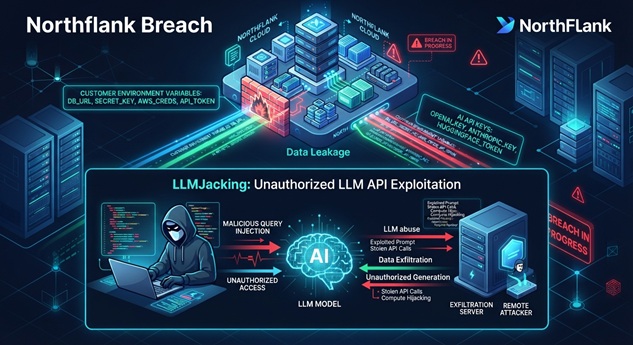
On October 30, 2026, cloud application hosting platform Northflank disclosed a security breach that exposed decrypted customer environment variables. Attackers abused stolen AI API keys across multiple accounts in what security researchers are calling part of a broader “Black October” campaign targeting AI developer platforms. This incident highlights a fast-growing threat: LLMJacking, where stolen credentials are used to hijack access to expensive AI services.
What Happened: Northflank Breach Exposes Customer AI API Keys
Northflank, a cloud platform used by developers to deploy applications, containers, databases, and AI workloads, received a threat alert from cloud security firm Wiz on October 30 at 11:43 UTC. Engineers confirmed the alert within a minute and began rolling out network policy patches. However, the company soon told all customers to assume their environment variables had been decrypted and the secrets stored within them stolen.
Multiple customers later reported unauthorized use of AI API keys supplied to the Northflank platform. The breach appears to be part of a wider pattern. In a report titled “Black October for AI Developer Platforms,” Wiz identified at least nine security incidents during the month affecting platforms including Northflank, Railway, OpenCode, Warp, and Lightning AI. Attackers specifically targeted environment variables containing AI service credentials.
Technical Details of the Northflank Breach and LLMJacking
The Northflank incident follows a well-defined attack chain that has become increasingly common against cloud-native development platforms.
Environment variables are widely used to store sensitive configuration data, including database passwords, cloud credentials, authentication tokens, and API keys. When these values are decrypted and stolen, attackers gain immediate access to the services they protect. In this case, the stolen credentials were AI API keys, which unlock access to large language model APIs from providers such as OpenAI, Anthropic, and Amazon Bedrock.
LLMJacking is the practice of using stolen credentials to access AI models via another organization’s API keys. The goal is typically one of two things:
- Resale: Attackers sell hijacked API access to buyers who want cheap or anonymous AI model usage.
- Direct abuse: Stolen keys are used to make massive numbers of API calls, generating large usage bills for the victim while the attacker gets free compute.
Wiz reported that in two investigated cases, compromised enterprise credentials were used to make approximately 2.5 million Amazon Bedrock API calls, generating roughly $100,000 in AI usage charges. The researchers also discovered infrastructure linked to services reselling access to AI models.
Business and Operational Impact
The Northflank breach and the broader Black October campaign carry serious consequences for affected organizations:
- Financial exposure: Unauthorized API usage can generate tens or hundreds of thousands of dollars in charges before detection.
- Credential chaining: Stolen environment variables often contain keys to other services, enabling lateral movement and secondary breaches.
- Platform trust: Developers rely on platforms to protect secrets. Repeated breaches erode confidence in cloud-native tooling.
- Incident response burden: Customers must rotate all secrets, review audit logs, and verify no downstream services were compromised.
Northflank has not disclosed how attackers gained initial access, how many customers were affected, or whether non-AI credentials were also stolen. BleepingComputer reached out for comment but had not received a response at the time of writing.
Mitigation and Recommendations
Organizations using cloud development platforms should take immediate steps to reduce exposure to this threat.
Immediate Actions for Defenders
- Rotate all secrets: If you use Northflank or any platform in the Black October list, assume exposure and rotate every API key, database password, and authentication token stored in environment variables.
- Review AI provider billing: Check usage dashboards and billing logs for unexpected spikes or unfamiliar request patterns.
- Enable audit logging: Ensure that all platform and cloud provider audit logs are active and feeding into a SIEM or log analysis pipeline.
- Disable public access: Where possible, turn off public network access to databases, caches, and add-ons.
Long-Term Defensive Measures
- Use secrets managers: Replace environment-variable secrets with dedicated secrets managers such as AWS Secrets Manager, Azure Key Vault, or HashiCorp Vault.
- Implement least privilege: Scope API keys to the minimum required permissions and restrict them to specific IP ranges or VPC endpoints.
- Monitor for anomalous API usage: Set billing alerts and usage thresholds to catch abuse early.
- Vet platform security posture: Before storing production secrets on any platform, review its security architecture, audit history, and incident response capabilities.
Bottom line: The Northflank breach is not an isolated incident. It is part of a coordinated push by attackers to monetize stolen AI API keys. Any organization storing AI service credentials in cloud development platforms should treat this as an active threat and rotate secrets immediately.
Incident Summary
| Incident: | Northflank Security Breach and AI API Key Abuse |
| Disclosure Date: | October 30, 2026 |
| Affected Platform: | Northflank cloud application hosting |
| Stolen Data: | Decrypted environment variables, AI API keys |
| Attack Vector: | Platform breach enabling secret decryption |
| Related Campaign: | Black October for AI Developer Platforms (Wiz) |
| Impact: | Unauthorized AI API usage, potential credential chaining, financial losses |
| Response: | Credential rotation enabled, audit logs opened to all customers, network patches applied |
References
- Lawrence Abrams, “Northflank security breach leads to abuse of customers’ AI API keys,” BleepingComputer, October 31, 2026. https://www.bleepingcomputer.com/news/security/northflank-security-breach-leads-to-abuse-of-customers-ai-api-keys/
- Wiz, “Black October for AI Developer Platforms,” Wiz Blog, October 2026. http://www.wiz.io/blog/black-october-for-ai-developer-platforms
- Northflank Status Page, “Security Incident Disclosure,” October 30, 2026. https://status.northflank.com/
- Lawrence Abrams, “Railway warns devs to rotate secrets after potential breach,” BleepingComputer, October 2026. https://www.bleepingcomputer.com/news/security/railway-warns-devs-to-rotate-secrets-after-potential-breach/
- Ax Sharma, “OpenCode hack exposes API keys amid AI distillation attacks,” BleepingComputer, October 2026. https://www.bleepingcomputer.com/news/security/opencode-hack-exposes-api-keys-amid-ai-distillation-attacks/
- Lawrence Abrams, “Hackers hijack exposed LLM endpoints in bizarre bazaar operation,” BleepingComputer, October 2026. https://www.bleepingcomputer.com/news/security/hackers-hijack-exposed-llm-endpoints-in-bizarre-bazaar-operation/