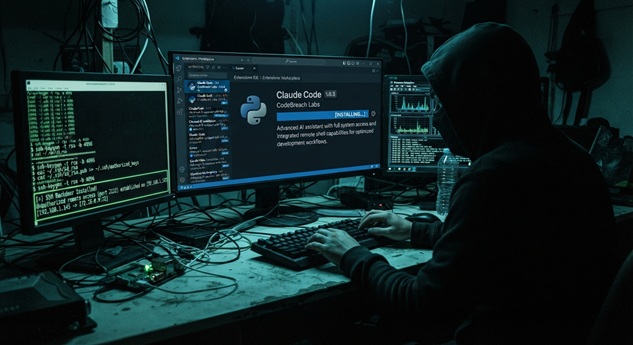
Claude Code Extension Plants SSH Backdoors
A trojanized version of Anthropic’s official Claude Code VS Code extension was distributed through Cursor’s extension marketplace for approximately 11 hours on October 29, 2026. Furthermore, the malicious update exposed up to 5,000 developers to malware designed to install persistent SSH backdoors and exfiltrate host reconnaissance data. Consequently, this incident highlights the growing risk of supply chain attacks against developer tooling and AI-assisted coding platforms.
What Happened: Attackers Trojanize Claude Code Extension on Cursor Marketplace
On October 29, 2026, a malicious version of the Claude Code extension appeared in Cursor’s VS Code extension marketplace. Moreover, the attackers distributed it under Anthropic’s legitimate publisher identity and extension ID (anthropic.claude-code) as version 2.1.313. Therefore, users who had auto-update enabled received the trojanized package without any additional warning.
The exposure window lasted from approximately 2:27 a.m. to 1:35 p.m. Pacific Time. During that window, Cursor estimates that at most 5,000 users installed the compromised extension. In addition, Cursor temporarily shut down its entire marketplace to audit other extensions and rotate access keys before restoring service.
Technical Details of the Claude Code Extension Supply Chain Attack
Researchers at OpenSourceMalware and Phorion analyzed the trojanized extension and found that attackers inserted a malicious 66-line JavaScript loader at the beginning of the extension.js file. However, the legitimate extension code remained otherwise unchanged, which made detection more difficult.
The malicious code activates after VS Code startup and when the extension’s webview opens. Furthermore, it performs the following actions on compromised systems:
- Collects system and user information, including Git email and public IP address
- Adds an attacker-controlled SSH key labeled “svc-telemetry” to ~/.ssh/authorized_keys
- Attempts to enable SSH access and establish a reverse tunnel to 134.209.82.225
- Installs persistence through a macOS LaunchAgent, Windows scheduled task, or Startup script
- Sends host details and backdoor status to the attacker’s server over unencrypted HTTP
The collected data includes the public IP address from api.ipify.org, hostname, local username, operating system, CPU architecture, home directory, current working directory, global Git email, and names of up to 40 environment variables containing KEY, TOKEN, SECRET, PASS, AWS, or GCP. In addition, the malware retries the tunnel roughly every minute to maintain connectivity.
However, coding errors in the malware’s SSH setup routines likely prevented remote access on many systems. For example, on macOS the malware checks Remote Login status without elevated privileges, causing it to skip SSH activation. On Windows, it attempts to install OpenSSH through PowerShell but incorrectly uses /bin/sh, a Unix shell unavailable on standard Windows installations. Therefore, the reverse tunnel could not provide access on machines where SSH was not already running.
Business and Operational Impact
This supply chain attack carries significant consequences for development teams, DevOps pipelines, and enterprise security programs.
- Credential Exposure: Environment variable names reveal which cloud providers, CI systems, and credential types are configured on developer machines
- Lateral Movement Risk: Successful SSH access would allow attackers to pivot through development networks and source code repositories
- Source Code Compromise: Developers often have access to proprietary code, API keys, and production deployment credentials
- Pipeline Poisoning: Compromised development environments can inject malicious code into build and release processes
- Trust Erosion: Incidents against trusted extension marketplaces undermine confidence in AI-assisted coding tools
Even when the SSH backdoor failed, the malware still installed persistence mechanisms and transmitted reconnaissance data. Consequently, attackers gained valuable intelligence about target environments that could support future campaigns.
Mitigation and Recommendations
Cursor has removed the malicious extension and worked with the hosting provider to take the attacker’s server offline. Moreover, Anthropic published version 2.1.314 to Open VSX and Microsoft’s official VS Code Marketplace.
Immediate Actions for Defenders
- Check if any developers installed Claude Code version 2.1.313 from Cursor’s marketplace between 2:27 a.m. and 1:35 p.m. PT on October 29, 2026
- Inspect ~/.ssh/authorized_keys for an entry labeled “svc-telemetry” on affected machines
- Review macOS LaunchAgents, Windows scheduled tasks, and Startup scripts for unauthorized persistence
- Search network logs for outbound connections to 134.209.82.225 on port 8099
- Rotate all credentials, API keys, tokens, and session tokens accessible from potentially compromised development hosts
Long-Term Hardening
Organizations should consider disabling auto-updates for IDE extensions and requiring manual review before installation. In addition, security teams should monitor extension marketplace integrity and maintain an inventory of approved development tools. Furthermore, implementing least-privilege access on developer workstations can limit the impact of similar supply chain compromises.
Bottom line: The Claude Code extension supply chain attack demonstrates that even trusted marketplace packages can be compromised. Development teams must treat IDE extensions as potential attack vectors and apply the same scrutiny they use for third-party software.
Incident Summary
| Incident: | Trojanized Claude Code Extension on Cursor Marketplace |
| Affected Systems: | Windows, Linux, and macOS systems with Claude Code extension version 2.1.313 installed from Cursor marketplace |
| Exposure Window: | October 29, 2026, approximately 2:27 a.m. to 1:35 p.m. PT |
| Estimated Victims: | Up to 5,000 users |
| Disclosure Date: | October 29, 2026 |
| Patch Status: | Malicious version removed; legitimate version 2.1.314 published |
| Attacker Infrastructure: | 134.209.82.225 (server taken offline) |
References
- OpenSourceMalware, “Trojanized Claude Code Extension Plants Persistent SSH Backdoor,” October 29, 2026, https://opensourcemalware.com/blog/trojanized-claude-code-extension-plants-persistent-ssh-backdoor, accessed October 30, 2026.
- BleepingComputer, Bill Toulas, “Malicious Claude Code extension on Cursor planted SSH backdoors,” October 30, 2026, https://www.bleepingcomputer.com/news/security/malicious-claude-code-extension-on-cursor-planted-ssh-backdoors/, accessed October 30, 2026.
- The Hacker News, “Official Claude Code Extension on Cursor Marketplace Trojanized with Persistent SSH Backdoor,” October 30, 2026, https://thehackernews.com/2026/10/official-claude-code-vs-code-extension.html, accessed October 30, 2026.
- Cursor, “Claude Code Extension Security Notice,” October 29, 2026, https://cursor.com/blog/claude-code-extension-security-notice, accessed October 30, 2026.
- Anthropic, “Claude Code Releases,” GitHub, https://github.com/anthropics/claude-code/releases, accessed October 30, 2026.