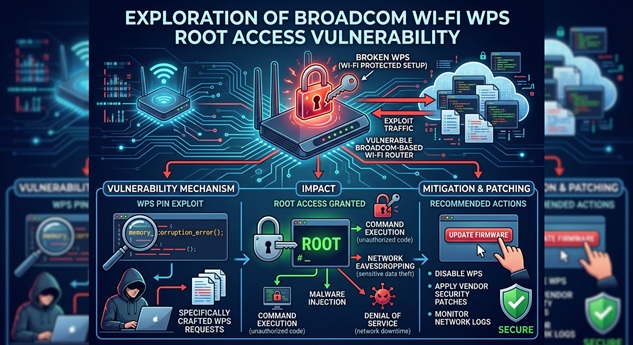
Broadcom Wi-Fi WPS Vulnerability Grants Root Access to Nearby Attackers
A newly disclosed vulnerability in Broadcom’s Wi-Fi software lets attackers within wireless range take complete control of vulnerable routers without knowing the Wi-Fi password. Security researcher Quentin Kaiser revealed the flaw at Hexacon in Paris on October 16, 2026, demonstrating unauthenticated remote code execution with root privileges across millions of Broadcom-based access points worldwide.
What Happened: Broadcom Wi-Fi WPS Flaw Exposes Routers to Root Access
The vulnerability affects Broadcom’s proprietary implementation of Wi-Fi Protected Setup (WPS), a feature designed to simplify device connections to wireless networks. Kaiser found that errors in how Broadcom’s software handles fragmented WPS messages could lead to memory corruption and arbitrary code execution.
An attacker within Wi-Fi range does not need to join the network, enter a password, or complete the normal WPS enrollment process. Furthermore, the attack can work over long distances, not only when an attacker stands next to the target device. This makes the flaw particularly dangerous because routers sit between users and the internet, often carrying traffic from many connected devices.
Broadcom has known about the bug since at least 2018, when an incomplete patch was silently released. However, Broadcom refused to assign a CVE identifier or communicate publicly about the issue. Consequently, many Original Equipment Manufacturers (OEMs) never patched their devices, leaving millions of routers exposed years after the supplier became aware of the risk.
Technical Details of the Broadcom Wi-Fi Vulnerability
The flaw exists in how Broadcom’s software receives and reassembles fragmented messages used during WPS communication. Kaiser developed exploitation techniques that leverage memory corruption to disclose sensitive information and execute code on vulnerable devices.
The vulnerability is present in Broadcom’s software development kit (SDK) since at least 2010. Broadcom later replaced the vulnerable components with hostapd in a newer SDK version and recommended that OEMs migrate. However, this effectively creates a “forever day” for eCos-based platforms, while Linux-based products may only be fixable if manufacturers are willing to make the required software changes.
Affected Broadcom chip families include:
- BCM3380, BCM3383, BCM33834 (eCos-based platforms)
- BCM3390, BCM63xx, BCM65xx, BCM68xx (Linux-based platforms)
Confirmed affected devices:
- Proximus BBOX 3 and BBOX3V+ (Sagemcom F@st)
- VOO-supplied Netgear CG3100, Netgear CG3700
- Technicolor TC7210 and CGA4233
- Orange Belgium ASKEY TCG3000
In one demonstration, Kaiser used code execution to retrieve the Wi-Fi network key stored on an Orange Belgium ASKEY TCG3000 gateway. In another, he obtained a reverse shell from a Proximus gateway using Wi-Fi frames alone, eliminating the need for cloud-based command and control infrastructure.
Business and Operational Impact
The real-world consequences of this vulnerability are substantial. Router compromise gives an attacker full control over network traffic, the ability to intercept communications, and a foothold for lateral movement into connected devices.
- Network traffic interception: Attackers can monitor all traffic passing through the router, including unencrypted data and DNS queries.
- Credential theft: Stored Wi-Fi keys and potentially other credentials can be extracted from device memory.
- Lateral movement: Compromised routers serve as launch points for attacks against devices on the local network.
- Persistence: Attackers can modify router firmware or configurations that survive reboots.
- Supply chain exposure: Broadcom technology is used by dozens of vendors across hundreds of products worldwide.
Kaiser estimated that in Belgium alone, approximately 1.5 million gateways may be affected. Proximus has roughly 850,000 affected BBOX devices, VOO’s legacy fleet accounts for approximately 500,000 units, and Orange Belgium has around 210,000 ASKEY TCG3000 gateways. These numbers do not include the broader global impact across other countries and ISPs.
Mitigation and Recommendations
Unfortunately, there are no easy fixes for most affected devices. As of October 15, 2026, none of the tested provider devices had been patched. Therefore, organizations and individuals must take proactive steps to reduce exposure.
Immediate Actions for Defenders
- Contact your router manufacturer or internet service provider to confirm whether your device is affected and whether a firmware update is available.
- If your device is affected and no patch exists, consider replacing it with a supported model that uses a different Wi-Fi chipset.
- Disable WPS on your router if the feature is not required, though this may not fully mitigate the risk depending on implementation.
- Monitor network traffic for unusual patterns that may indicate router compromise, such as unexpected DNS changes or unknown devices on the network.
- Use end-to-end encryption for sensitive communications to reduce the impact of traffic interception.
Long-Term Recommendations
Enterprises should inventory all network edge devices and assess their exposure to Broadcom-based routers. Security teams can use the fingerprinting script and YARA rule published by Kaiser to identify potentially affected equipment. Additionally, organizations should pressure vendors and ISPs to provide clear communication about patch status and replacement timelines.
Bottom line: This vulnerability demonstrates how supply chain complexity and vendor silence can create lasting security gaps. Router owners should not assume safety simply because their admin password is strong, because this flaw is triggered entirely through Wi-Fi and requires no authentication whatsoever.
Incident Summary
| CVE ID / Incident: | No CVE assigned (Broadcom refused CVE registration) |
| Affected Systems: | Broadcom BCM3380, BCM3383, BCM33834, BCM3390, BCM63xx, BCM65xx, BCM68xx chipsets; routers from Proximus, VOO, Orange Belgium, and potentially dozens of other vendors worldwide |
| Disclosure Date: | October 16, 2026 (Hexacon Paris) |
| Patch Status: | No patches available for affected eCos devices as of October 15, 2026; Linux-based devices may be fixable if OEMs migrate to hostapd |
| Severity: | Critical — Unauthenticated remote code execution with root privileges |
| Attack Vector: | Wi-Fi proximity (802.11), no password or network access required |
References
- Quentin Kaiser, “One Parser, Two Bugs, Many Routers: Exploiting Broadcom WiFi Across eCos and Linux,” quentinkaiser.be, October 16, 2026, https://quentinkaiser.be/security/2026/10/16/one-parser-two-bugs/, accessed October 20, 2026.
- GBHackers, “Researchers Hack Broadcom Wi-Fi Routers Without Passwords and Gain Full Root Access,” GBHackers, October 2026, https://gbhackers.com/broadcom-wi-fi-routers/, accessed October 20, 2026.
- Quentin Kaiser, “WPSplinter — Broadcom WPS Vulnerability Documentation,” GitHub, 2026, https://qkaiser.github.io/broadcom-wps/, accessed October 20, 2026.
- Quentin Kaiser, “broadcom-wps Fingerprinting Script and YARA Rule,” GitHub, 2026, https://github.com/qkaiser/broadcom-wps/, accessed October 20, 2026.