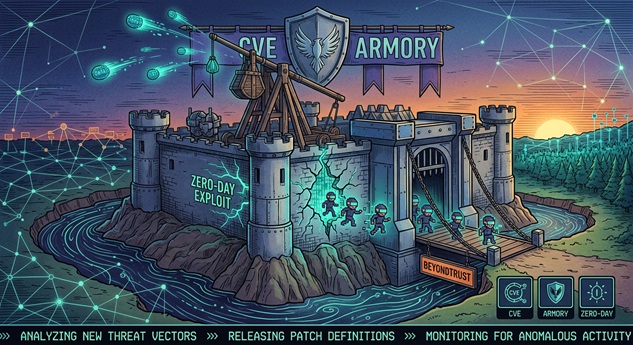
BeyondTrust patched a critical authentication bypass vulnerability in its Remote Support appliances on October 15, 2026, after Mandiant confirmed that a China-nexus espionage actor had exploited it as a zero-day since late August. Tracked as CVE-2026-102764, the flaw allows unauthenticated remote attackers to perform file operations on affected appliances. Consequently, threat actors can escalate privileges, harvest stored credentials, and move laterally through victim networks.
What Happened: Armory Castle Exploits BeyondTrust Zero-Day for Host-Level Control
On October 15, BeyondTrust disclosed CVE-2026-102764 and urged customers to patch immediately. The vulnerability affects Remote Support versions 26.2.3 and earlier. BeyondTrust patched its SaaS tenants automatically on October 8, but self-hosted appliances require manual patching.
Mandiant and Google Threat Intelligence Group (GTIG) attributed the zero-day exploitation to Armory Castle, a suspected China-nexus espionage actor also tracked by CrowdStrike as Warp Panda and formerly known as UNC5221. Armory Castle has a documented history of targeting edge appliances, including Citrix NetScaler and Ivanti Connect Secure zero-days, since at least October 2023.
The actor exploited CVE-2026-102764 to upload files to vulnerable appliances. Within minutes, they deployed a new custom webshell named SAWFLY, escalated privileges to root, and extracted credentials from the appliance’s vault. They then used a custom SOCKS5 tunneler called BARECLAW to maintain covert access and moved laterally by abusing compromised administrator accounts.
Technical Details of the CVE-2026-102764 Exploit Chain
CVE-2026-102764 is an authentication bypass flaw in BeyondTrust Remote Support. Successful exploitation allows unprivileged remote attackers to perform arbitrary file operations on the appliance. Mandiant identified exploitation evidence in access, syslog, messages, and SSL logs stored on an LUKS-encrypted partition.
Initial Exploitation and SAWFLY Webshell Deployment
After exploiting the vulnerability, Armory Castle staged an initial webshell via POST requests. Approximately 11 minutes later, they deployed the SAWFLY webshell to the web root path. SAWFLY is a lightweight PHP webshell that implements bidirectional encrypted command-and-control communication.
SAWFLY uses a custom Base32 transport layer and a 256-bit RC4 stream cipher. The webshell inspects incoming HTTP POST requests for an obfuscated parameter. If the parameter is absent, the script returns HTTP 404 to evade automated scanners. When the parameter is present, the webshell decrypts the payload and executes it via eval(). Return values are encrypted, Base32-encoded, and echoed back to the client.
Privilege Escalation via SUID Manipulation
The SAWFLY webshell ran under an unprivileged site service account. To escalate privileges, Armory Castle copied the system shell executable to a disguised path. They then modified the file’s ownership to root and enabled Set User ID (SUID) permissions. This granted the actor a persistent root-level backdoor on the host system.
After gaining root access, the actor harvested credentials from the appliance’s native secrets management database using the proprietary bt-secrets CLI utility. They attempted to dump vault passwords and API keys for both site-specific and global administrative accounts. They then deleted bt-secrets logs to cover their tracks.
Persistence via Startup Configuration Tampering
For long-term persistence, Armory Castle targeted BeyondTrust startup configuration templates. They created a shell script in the post_boot.d directory named zz-root-persist. This script appended passwordless root privileges for the site service account to the sudoers template. It then forced the appliance backend to rebuild the active sudoers file immediately.
Consequently, the actor maintained administrative access that survived reboots and configuration resets.
Lateral Movement via Administrator Session Abuse
Armory Castle pivoted into the BeyondTrust Remote Support application using compromised administrator credentials. They logged into the web administrative portal and upgraded permissions for a compromised account. Specifically, they changed Jump Item and Team permissions from No Access to Administrator.
This change granted the actor permanent authorization to launch remote sessions to downstream systems. Mandiant observed the actor using BeyondTrust’s file transfer service to download sensitive internal documents, including software inventories, directly from user desktops.
BARECLAW SOCKS5 Tunneler and HAProxy Modification
Mandiant also identified a new custom tunneler called BARECLAW. Written in C, BARECLAW provides a SOCKS5 proxy service carried over WebSocket transport. It statically embeds a CivetWeb web server and uses OpenSSL for TLS.
BARECLAW supports authentication, XOR stream obfuscation, destination filtering, upstream proxy chaining, and configurable listening ports. The actor executed BARECLAW on TCP port 19800 with a custom WebSocket endpoint and token-based authentication.
To expose BARECLAW to the internet, Armory Castle modified the appliance’s HAProxy reverse proxy configuration. They added an access control list that routed requests for a specific URI path to the local BARECLAW listener. This ensured the backdoor remained hidden from external network scans while accessible via the appliance’s public address.
Anti-Forensics Techniques
Throughout the intrusion, Armory Castle systematically deleted system, web server, and application logs to evade detection. They removed auth logs, SSL logs, HTTP access logs, PHP logs, and site-specific web server logs using elevated sudo privileges. This behavior significantly complicates incident response and forensic analysis.
Business and Operational Impact
The exploitation of CVE-2026-102764 carries severe consequences for affected organizations. BeyondTrust Remote Support stores and brokers credentials for thousands of endpoints. A compromised appliance grants attackers access to every credential it manages.
- Credential exposure: Attackers can extract all passwords, API keys, and endpoint credentials stored in the appliance vault.
- Lateral movement: Compromised administrator accounts enable unrestricted remote access to downstream systems via Jump Items.
- Data exfiltration: Attackers can download sensitive documents and software inventories from compromised endpoints.
- Persistent access: Startup configuration tampering and reverse proxy modifications ensure long-term covert access.
- Operational disruption: Incident response may require rebuilding appliances from clean images and rotating all integrated credentials.
BeyondTrust serves over 20,000 customers worldwide, including government agencies and 75 percent of Fortune 100 companies. Shadowserver tracks over 1,400 BeyondTrust Remote Support instances exposed to the internet. Mandiant warns that any appliance reachable from the internet on a vulnerable version during the exploitation window should be treated as potentially compromised.
Mitigation and Recommendations
Organizations using BeyondTrust Remote Support must act immediately to contain risk and prevent further exploitation.
Immediate Actions for Defenders
- Apply the BT26-05 patch immediately. Self-hosted appliances running version 24.3.1 or later should apply the patch from the /appliance interface. Older versions require upgrading to a supported release first.
- Assume compromise for internet-exposed appliances. Any appliance reachable from the internet while running a vulnerable version should be treated as compromised until forensically reviewed.
- Rebuild suspected appliances from clean images. Host-level persistence survives reboots and configuration resets. Redeploy from a confirmed clean image rather than attempting cleanup.
- Rotate all credentials in dependency order. Start with /appliance administrative credentials, then /login administrators, API secrets, vault credentials, and integration credentials. Rotate only after patching or rebuilding.
- Review configuration for unauthorized changes. Audit user roles, Jump Item permissions, group policies, API accounts, and outbound event destinations against a pre-exposure baseline.
Hardening and Long-Term Controls
Furthermore, organizations should implement the following controls to reduce future exposure:
- Restrict access to /login and /appliance interfaces by IP address or network segment.
- Deploy a reverse proxy or WAF with full URI logging in front of the appliance.
- Require SAML single sign-on with phishing-resistant MFA for all /login users.
- Ensure the built-in Admin account uses MFA per BeyondTrust guidelines.
- Set default Jump Item roles to No Access and grant permissions through policy.
- Scope API accounts to minimum permissions and rotate secrets on a schedule.
- Store privileged credentials in an external vault rather than the Remote Support Vault.
Bottom line: CVE-2026-102764 is a critical vulnerability in a widely deployed enterprise remote access platform. Armory Castle’s exploitation demonstrates advanced knowledge of appliance internals and a deliberate strategy of harvesting credentials for lateral movement. Patching is essential but insufficient, any internet-exposed appliance during the exploitation window requires full incident response and credential rotation.
Incident Summary
| CVE ID: | CVE-2026-102764 |
| Affected Product: | BeyondTrust Remote Support (formerly Bomgar) versions 26.2.3 and earlier |
| Disclosure Date: | October 15, 2026 |
| Patch Status: | BT26-05 patch available; SaaS patched October 8, 2026; self-hosted requires manual application |
| Threat Actor: | Armory Castle (UNC5221 / Warp Panda), suspected China-nexus espionage |
| New Malware: | SAWFLY webshell, BARECLAW SOCKS5 tunneler |
| Exploitation Window: | Late August 2026 through October 8, 2026 |
| Attack Vector: | Unauthenticated remote file operations via authentication bypass |
| Post-Exploitation: | Privilege escalation via SUID, credential vault extraction, lateral movement via Jump Items, reverse proxy modification for covert tunneling |
References
- BleepingComputer, “BeyondTrust patches zero-day exploited in attacks since August,” October 16, 2026, https://www.bleepingcomputer.com/news/security/beyondtrust-patches-zero-day-exploited-in-attacks-since-august/, accessed October 16, 2026.
- Mandiant / Google Threat Intelligence Group, “ARMORY CASTLE Exploits BeyondTrust,” October 15, 2026, https://cloud.google.com/blog/topics/threat-intelligence/armory-castle-exploits-beyondtrust, accessed October 16, 2026.
- BeyondTrust, “BT26-05 Security Advisory,” October 15, 2026, https://www.beyondtrust.com/trust-center/security-advisories/bt26-05, accessed October 16, 2026.
- CISA Known Exploited Vulnerabilities Catalog, https://www.cisa.gov/known-exploited-vulnerabilities-catalog, accessed October 16, 2026.
- Shadowserver, BeyondTrust Remote Support internet exposure statistics, https://dashboard.shadowserver.org/statistics/iot-devices/, accessed October 16, 2026.